Read The Times Australia

Daily Bulletin

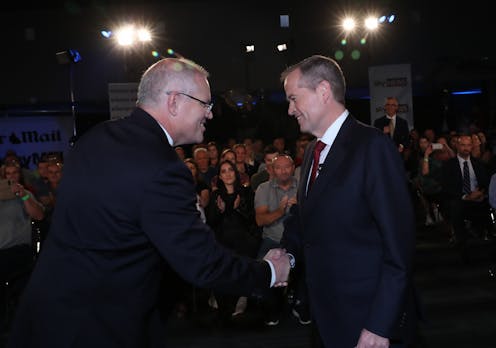
Bill Shorten at ease in town hall-type forum

  • Written by: Michelle Grattan, Professorial Fellow, University of Canberra

Bill Shorten’s many town hall meetings stood him in good stead in the Sky “people’s forum” in Brisbane on Friday night.

His engagement with the audience was more direct than Scott Morrison’s, and he packed multiple references to his promises into his answers.

Shorten was forceful, especially on the topic of...

Read more …

Morrison and Shorten get punchy in the second leaders' debate. Our experts respond.

  • Written by: Rob Manwaring, Senior Lecturer, Politics and Public Policy, Flinders University
Morrison and Shorten get punchy in the second leaders' debate. Our experts respond.

The best line of the second leaders’ debate between Scott Morrison and Bill Shorten wasn’t about policy, it was about … personal space.

Some in Queensland may have skipped the debate to watch the Friday night rugby, but they would have missed a pretty spirited clash between the Labor and Coalition leaders over everything from franking credits to religious freedom to even the closure of post offices across Australia.

Free to pace the stage and talk directly to voters in the “people’s forum” debate format in Brisbane, both Morrison and Shorten looked far more comfortable – and were certainly more confrontational – than in Monday’s more staid, conventional first debate in Perth.

Here’s what our academic experts thought.

Rob Manwaring, Senior Lecturer, Politics and Public Policy, Flinders University

When they are finally published, the no-doubt low viewing figures might well confirm that it is only a minority of committed political nerds whose idea of a great Friday night is to watch the leaders’ debate (albeit behind a TV paywall)!

Yet, once the debate got going, this was a strangely engrossing contest, covering a range of issues including religious freedom, post office closures, climate change, mental health, and inevitably, the economy.

What helped set up this oddly watchable debate was the first question on how the major parties will tackle high rates of sexual assault. It seemed to re-set the “mood”. There was a good degree of bipartisanship here, although a fault line did emerge over Labor’s commitment to introduce paid domestic violence leave.

This was a strong segment, perhaps reinforcing the best of what these debates can offer where political leaders are seeking to engage directly with the public concerns.

There were similarly compassionate discussions on other issues, especially about mental health and young people, as well as a question about support for veterans. Bill Shorten, on a number of occasions sought to engage people directly, perhaps most effectively asking the audience to indicate, with raised hands, if suicide and mental illness had impacted on their friends and family. Almost all hands went up.

On a lighter note, the debate itself had some decent jokes – for example, Scott Morrison amusingly allowing more time for Shorten to talk, as he “had more taxes to explain”. Later, as a questioner muddled their names, Shorten laughed off the claim that they looked the same.

An interesting flash point was during an increasingly heated exchange on income tax cuts for high-income earners when a fired-up Morrison moved to “stand over” and lecture Shorten. Shorten called out the PM as a “classic space invader”, and it had echoes of Mark Latham’s infamous encounter with John Howard in 2004, with the roles reversed.

Morrison tended to be better with numbers, Shorten stronger on key social policies and climate change. It was messy in places, but it was also considered, and there were clear policy and value differences at play. It was strangely watchable – much like Australian democracy.

Read more: Leaders try to dodge them. Voters aren't watching. So, are debates still relevant?

Alexandra Wake, Program Manager, Journalism, RMIT University

Even Sky News’ Peta Credlin effectively gave the second leaders’ debate to Bill Shorten, albeit through gritted teeth.

The Sky News panel agreed it was close, but by tackling issues like franking credits and negative gearing front on, Shorten came across as confident in Labor’s policy positions.

Both leaders did well, effortlessly using the campaign playbook to attempt to win over the 109 audience members chosen to attend by Galaxy Research. Shorten out-polled Scott Morrison as winner of the debate among audience members, but it was very close, just 43% to 41%. The rest were undecided.

There was a broad range of questions, most dedicated to familiar issues. But three questions were related to mental health in some way, and that appears to be the sleeper issue in this campaign.

A surprising question about the value of post offices in communities saw Shorten hint that an incoming government might use the country’s postal service as a possible competitor to the big banks.

Morrison, meanwhile, stuck to the Liberals’ core campaign message of better budget management and spending. He didn’t fluff his lines, but it’s not clear that his stock-standard responses will resonate with voters.

Shorten worked the room harder, and engaged the audience well by asking everyone who had been affected by suicide or mental illness to raise their hands. That’s an adept political tactic.

There were some light-hearted moments between the pair, but Shorten’s quip that Morrison was a “space invader”, as the taller PM came a little too close, might grab the headlines.

It’s easy to suggest the Twitterverse of political junkies hash-tagging #auspol with their sausage icon were also the real winners.

Scheduling the second leaders’ debate on Sky News in Brisbane at the same time as an NRL game – and in front of a Galaxy-selected audience – might have seemed like a stroke of PR lunacy.

But those Canberra-based commentators who scoffed at the terrible time and station for a debate clearly overlooked the fact Sky News is broadcast on WIN’s free-to-air network for regional Australia.

Morrison and Shorten were clearly tuned into 2018 Digital News Report Australia, which found that TV remains the main source of news for 36% of Australian news consumers – and it’s more popular in regional areas than metropolitan ones.

Read more: Morrison and Shorten take aim at one another in leaders' debate: experts respond

Mark Rolfe, Honorary Associate in Social Sciences, UNSW

For those who like sporting metaphors, this rumble in the jungle – well, a debate in Brisbane – showed that neither party leader is Muhammad Ali or George Foreman.

However, the “people’s forum” format made for a more free-flowing discussion that partially mitigated the leaders’ desire to control it and deliver prepared moves. Sure, they often returned to pet themes and slogans where they could. As such, we were presented with warnings of the danger of change and the failure to change, and both fought for the last word.

But both Scott Morrison and Bill Shorten were determined to emphasise civility and bipartisanship where they could. They wanted to appease the anti-politics sentiment and disillusion that abounds in Australia now, but also present differences in a palatable way to voters. Just like on Monday, Shorten got the better on these points with his queries to questioners and attempts to connect with their backgrounds.

They also had to demonstrate their spontaneity and knowledge when answering audience questions on important issues not usually highlighted in debates, such as domestic violence, sexual assault, mental health and veterans. In the process, the need to be flexible showed the personalities of both men, an important measure when there is still so much public suspicion of politicians.

With that, Shorten was more humorous, as demonstrated by his quip about Morrison being “a classic space invader” when he got too close.

And Shorten was prepared to directly demonstrate respectful disagreement with interrogators rather than avoid their questions, such as on the issue of freedom of religious expression. In this way, he aimed to present himself as not the usual politician but a man of substance.

Both leaders supplied substance with data and details of policies on issues such as profit-shifting, transfer pricing and taxing. Yet, both men were defensive on the vulnerabilities we’d expect: Morrison on climate and the Ruddock report on religious freedom; Shorten on franking credits and taxing multinationals.

Fortunately, they could avoid discussing the Labor and Liberals candidates who had walked the plank this week over imbecilic social media posts. But that is typical of a campaign so far absent the culture war battles of the past, although they still rumble below decks amongst some media.

Authors: Rob Manwaring, Senior Lecturer, Politics and Public Policy, Flinders University

Read more http://theconversation.com/up-close-and-personal-morrison-and-shorten-get-punchy-in-the-second-leaders-debate-our-experts-respond-116521

VIDEO: Michelle Grattan on candidate troubles

  • Written by: Michelle Grattan, Professorial Fellow, University of Canberra

University of Canberra Deputy Vice-Chancellor Leigh Sullivan joins Michelle Grattan to talk about the week in politics. They discuss the first leaders debate on Monday held in Western Australia, the loss of candidates from multiple parties over offensive social media posts, questions around the cost of Labor’s climate change policy and the...

Read more …

What a local newspaper means to a regional city like Newcastle

  • Written by: Paul Scott, Lecturer, School of Creative Industries, Faculty of Education and Arts, University of Newcastle

The Newcastle Herald has won eight Walkley awards for journalistic excellence over the past seven years. This includes a Gold Walkley for the groundbreaking reportage that led to Australia’s royal commission into institutional responses to child sex abuse. It has told stories of national and international importance.

But this local newspaper,...

Read more …

More Articles …

  1. We've detected new gravitational waves, we just don't know where they come from (yet)
  2. Tampa and the national security election of 2001
  3. how do babies learn to talk?
  4. Puckish charm and no politicians: the 2019 Archibald Prize
  5. The tasty, weed-like desert raisin plant is as big as a carpark
  6. local voices on how the 1973 Aquarius Festival changed a town forever
  7. the dramatic and inglorious fall of Joh Bjelke-Petersen
  8. Julian Assange has refused to surrender himself for extradition to the US. What now?
  9. Leaders try to dodge them. Voters aren't watching. So, are debates still relevant?
  10. Fixing the gap between Labor's greenhouse gas goals and their policies
  11. more preference deals as pre-polling begins
  12. It's not clear where human rights fit in the legal ruling on athlete Caster Semenya
  13. managing type 2 diabetes during Ramadan
  14. How hard is it to say 'no' to drugs?
  15. How to increase train use by up to 35% with one simple trick
  16. policies come and policies go, but surely we shouldn't be subsidising inheritances
  17. $20 billion per year. That's how much higher superannuation could take from wages
  18. Pacific countries score well in media freedom index, but reality is far worse
  19. A guide to ensure everyone plays by the same military rules in space: the Woomera Manual
  20. Friday essay: networked hatred - new technology and the rise of the right
  21. We need to treat borderline personality disorder for what it really is – a response to trauma
  22. Labor wants to keep climate debate in the clouds
  23. Blockchain can help break the chains of modern slavery, but it is not a complete solution
  24. UK becomes first country to declare a 'climate emergency'
  25. Young people won't accept inaction on climate change, and they'll be voting in droves
  26. what does Clive Palmer actually want?
  27. The exhibition Tudors to Windsors is an uncritical glorification of empire
  28. rural voters get a voice and topple a government in 1913
  29. The Conversation needs your help
  30. how does preferential voting work in the House of Representatives?
  31. how does preferential voting work in the Senate?
  32. what's the point of nits?!
  33. Indonesia isn't the only country planning new cities. Why not Australia?
  34. It's time to vote for happiness and well-being, not mere economic growth. Here's why:
  35. Pregnant women and babies can be vegans but careful nutrition planning is essential
  36. Labor wants to restore 'demand driven' funding to universities: what does this mean?
  37. Eliza Winstanley, colonial stage star and our first female Richard III
  38. how digital advertising is shaping this election campaign
  39. Can Labor's animal welfare plan improve Australia's lacklustre record?
  40. Psst... wanna buy a necklace? Humans have been faking jewellery for thousands of years
  41. How 'flags of convenience' have shrunk Australia's merchant fleet
  42. Victorian Liberal candidates find social media footprints lethal
  43. Politics with Michelle Grattan: Tim Colebatch on the battle in Victoria
  44. Shorten distances himself from Green overtures on climate policy
  45. Uranium mines harm Indigenous people – so why have we approved a new one?
  46. an exotic radical who rejected the establishment
  47. How the major parties’ Indigenous health election commitments stack up
  48. a valid argument let down by selective science and over-the-top claims
  49. Labor's anti-war message falls flat in landslide loss in 1966
  50. Are too many corporate mergers harming consumers? We won't know if we don't check

Business News

When Should You Speak to a Lawyer About a Legal Issue?

Legal issues can begin with a simple question, then become harder to manage once formal steps are involved. Many people wait until a matter feels urgent before seeking guidance, even though earlier ...

Daily Bulletin - avatar Daily Bulletin

The strategic rise of Bali as Australia’s next essential healthcare support hub

As Australian healthcare providers grapple with unprecedented operational bottlenecks, a new nearshore model is quietly transforming patient care delivery. Forward-thinking organisations,  including...

Daily Bulletin - avatar Daily Bulletin

Cost Savings and Benefits of Using Used Pallets in Logistics

In today’s competitive logistics and supply chain industry, businesses are constantly looking for ways to reduce operational costs without compromising efficiency and reliability. One of the most prac...

Daily Bulletin - avatar Daily Bulletin

How Fulfilment Services in Australia Help Businesses Scale Efficiently

The growth of e-commerce and modern retail has transformed customer expectations. Consumers now expect fast shipping, accurate order processing, and seamless delivery experiences regardless of where...

Daily Bulletin - avatar Daily Bulletin

Practical Ways Australian Workplaces Can Reduce Operating Costs

Reducing business costs doesn’t always mean cutting staff, shrinking services or making the workplace feel bare-bones. In many cases, the smarter savings are hiding in everyday operations: the light...

Daily Bulletin - avatar Daily Bulletin

Executive Recruitment Solutions That Help Organisations Secure Exceptional Leaders

Leadership has a direct impact on organisational performance, employee engagement, strategic growth, and long-term success. Businesses operating in increasingly competitive environments require experi...

Daily Bulletin - avatar Daily Bulletin

Why A WooCommerce Website Designer Matters For Online Growth

Running an online store today requires more than simply listing products and waiting for customers to arrive. Businesses need a website that is fast, reliable, easy to navigate, and designed to suppor...

Daily Bulletin - avatar Daily Bulletin

Turning Your Empty Tables into Revenue

The rise of AI demand tools in hospitality, the EatClub–CommBank partnership, and seven trends reshaping Australian dining  A growing number of Australian venues are turning to AI-powered demand mana...

Daily Bulletin - avatar Daily Bulletin

High-Impact Dental Marketing Strategies That Are Driving Real Practice Growth Today

The landscape of dental practice growth in Australia has shifted dramatically over recent years. Standard, broad-spectrum advertising campaigns no longer yield the return on investment they once did. ...

Daily Bulletin - avatar Daily Bulletin

The Daily Magazine

Lighting Shop in Perth: How The Right Lighting Can Transform Your Home And Business

The right lighting can completely change the look, feel, and functionality of any space. Whether it ...

Traffic Light System Solutions For Safer And More Efficient Traffic Management

Modern cities and growing communities rely heavily on effective traffic management to ensure safety...

Gold Migration Lawyers in Liquidation: How the Closure Affects Your ART Appeal

If your appeal was with Gold Migration Lawyers, a recent change to how the Tribunal decides cases ...

The pressure cooker: life in urban Australia in 2026

Australian cities have always been demanding. Long commutes, rising housing costs, busy schedules a...

What Actually Makes a Good Criminal Lawyer in Melbourne

Most people only think about this question once. That is usually too late. Most people charged wi...

Why Working With A Chatswood Tutor Can Improve Academic Performance

Academic expectations continue increasing for students across primary school, high school, and senio...

Is It Worth Getting Solar Panels in Melbourne?

The real question is not whether solar works in Melbourne. It works. The question is what it is co...

How A Diploma Of Project Management Builds Practical Skills For Modern Work Environments

Developing the ability to plan, execute, and deliver outcomes efficiently is a key requirement in to...

How to Choose the Right Football for Every Level

Choosing a football may seem straightforward, but the right option depends on who will be using it a...