

what does Clive Palmer actually want?
- Written by: John Wanna, Sir John Bunting Chair of Public Administration, Australian National University
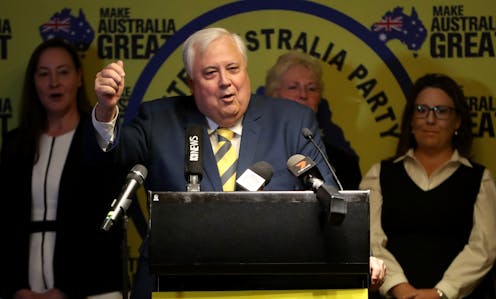
As head of the United Australia Party, Clive Palmer is no classic right-winger nor crotchety conservative. He is no angel either. He is often wrongly lumped in with Pauline Hanson and One Nation, and maybe even with the more recent retreads like Fraser Anning and Cory Bernardi.
But he is not like them. He is a big-spending, eccentric, brusque businessman espousing a strange mixture of populist musings. He is also eager to end the strangulation the major parties exert over policy options. On some issues he is more progressive than Labor (asylum seekers); on others he is more adventurous than the Coalition (taxation) – he is a protectionist nationalist without the xenophobic baggage.
So, just what is Palmer up to in this election campaign? After a fairly desultory campaign in 2013 when he won a single lower house seat and initially three senators, he sat out the 2016 federal election. Now, he’s back in full force, spending upwards of A$55 million before the election comes to an end. He’s standing candidates in every electorate and running a team in every senate constituency. Polling is showing him “influential” in many swing seats with support running into the mid-teens in some electorates.
Read more: View from The Hill: Can $55 million get Clive Palmer back into parliamentary game?
Why is he spending so much of his own money on what looks like a pyrrhic campaign, even if he is elected to the Senate for Queensland?
Many people say Palmer has no policies, he stands for nothing except himself, and is just fanning a protest vote.
It’s true that Palmer tends to campaign with hackneyed slogans: “Make Australia Great”, “Aussies aren’t going to cop it any more” and “Let’s get something done for a change”, being the main three. He also authorises crass advertising – his prominent billboards and full-page poster-style advertisements feature himself, curtained in canary yellow, with the implicit message that the Liberals and Labor “don’t fight for you”. He is partial to hyperbole, and in the media often lives in a world of denial.
At the 2013 federal election, Palmer’s United Party released a slender raft of policy proposals. He opposed the carbon tax and supported tax reductions, but he also proposed a more compassionate policy towards asylum seekers, a conscience vote on same-sex marriage, free university places for residents, tax relief for mortgagees, regional wealth retention, and smaller government. Many of his 2013 policies reappear in recycled form in 2019.
He claims as his achievements to have stopped many of the “zombie” measures Tony Abbott and Joe Hockey tried to impose in the 2014 budget. These include: stopping GP co-payments of $7 per visit, opposing cuts to universities, preventing more social security cuts, opposing an increase in the eligible age for the age pension to 70 years, supporting climate change and renewable energy proposals, and supporting a ban on lobbyists and the removal of boat-arrival children from offshore detention. He also claimed credit for supporting the abolition of the carbon tax and the mining tax, and for bringing down Campbell Newman’s LNP government in Queensland.
This election, the UAP is proposing to increase pensions by 20% immediately (or $4,000 a year for each pensioner). It is advocating an extra $80 billion spending on health and a further $20 billion for education over the next parliament. Palmer continues to support mining development (with more onshore processing of commodities) and a zonal taxation system, with wealth generated in regions remaining in regions. He wants immediate investment in very fast trains.
The UAP is also fiercely criticising other mainstream party policies. For instance, Palmer opposes the “sell-off” of agricultural land to foreign buyers, targeting in particular Chinese government-owned companies for their aggressive purchasing strategies. His position is not xenophobic: he detests Chinese Communist Party business practices because of first-hand experience, but he is not against people of Chinese descent coming here or doing well.
He opposes the ALP’s tax policy, regarding it as insufficient and mostly deferred until after 2024. He wants all income tax rates reduced by 15% now, and for companies and small businesses to pay their tax bill at the end of the financial year once their earnings are finalised (thus abolishing the pernicious provisional tax paid quarterly in advance).
He also wants mortgagees to be able to get a tax offset for the first $10,000 of repayments to help first-home buyers. Furthermore, the UAP is campaigning for the abolition of the Murray-Darling Basin Plan and ending the public profligacy of water buy-backs. Palmer claims that spending on the national broadband network has “wasted” $55 billion “and it still doesn’t work”.
Palmer’s revival in his electoral stocks has occurred despite him being embroiled in many controversies and untrustworthy business practices. These include the debacle over the Coolum Resort, which closed under his management, costing 600 jobs and leaving over 300 investors without their assets.
He was widely blamed for the collapse of his nickel refinery in Townsville (which he took on to “save”) and for not paying workers their redundancy entitlements. He has also been linked to a stalled Titanic II project, killed off a Gold Coast A-League soccer team, complains of Rupert Murdoch’s influence over the Australian media, and been charged by ASIC with violating the Corporation Act. He has also transferred some of his business interests to the tax haven of Singapore.
Read more: How much influence will independents and minor parties have this election? Please explain
Many commentators who highlight Palmer’s record believe the preference deal with the Liberals and LNP could perhaps damage the Coalition vote. But although Labor will whinge to the closing of the polls on May 18, I expect the cross-preferencing arrangement to benefit both the LNP and the UAP.
Palmer may not win any lower house seats, but his preferences might determine who does in up to 20 seats. If his electoral support continues to grow, he may well secure two or three senate positions, almost back to where he was in 2013.
But he is coming under widespread attack as an illegitimate player by many commentators and media outlets as well as his political opponents. Most of the major papers and TV news outlets regularly slam his antics (Google “Clive Palmer’s Criticism”).
The key perhaps to understanding Palmer’s gravity-defying electoral support is that he is a “positive populist” rather than a largely negative populist along the lines of Pauline Hanson’s One Nation, who has based her own protectionist stance much more explicitly on race and xenophobia. Indeed, Palmer eschews the racist policies and dog-whistling his rival right-of-centre competitors have delivered, including One Nation and Fraser Anning’s Conservatives.
Palmer carefully tailors his positive populist messages to appreciative audiences: his line that “something must be done” has resonated.
Certainly, some of Palmer’s electoral support at the ballot box will be simply a protest vote (and he will be aware of that). But perhaps some greater proportion will be voting for more genuine diversity from what the cartelised major parties are offering. Australia seems ripe for a more serious positive populism offered by Palmer and his UAP. The ultimate question will be whether the wheels will again fall of the wagon.
And what after the election? Palmer’s boast that he will form government is fanciful. He has long been anti-Labor and in this election is not directing preferences their way, so he may be well and truly ostracised by Labor if it wins office.
Alternatively, if the Coalition scrapes back in it will be partly obligated to his preferences and will have to accommodate whoever the UAP manages to get into parliament.
The last time Palmer held this power his influence quickly waned as his “team” mostly abandoned him. We will soon see if he has learnt from bitter experience.
This article is adapted from an earlier piece published in The Machinery of Government.
Authors: John Wanna, Sir John Bunting Chair of Public Administration, Australian National University


 Daily Bulletin


