Read The Times Australia

Daily Bulletin

No surplus, no share market growth, no lift in wage growth. Economic survey points to bleaker times post-election

  • Written by: Peter Martin, Editor, Business and Economy, The Conversation
No surplus, no share market growth, no lift in wage growth. Economic survey points to bleaker times post-electionThings will continue to look good enough for long enough to help the government fight the election. Beyond that, the Conversation Economic Panel is worried.Wes Mountain/The Conversation, CC BY-ND

The Australian economy will remain healthy for long enough to enable the government to claim it as a strength in the lead-up to the May election, but the...

Read more …

Why a government would be mad to advise the refusal of royal assent to a bill passed against its will

  • Written by: Anne Twomey, Professor of Constitutional Law, University of Sydney
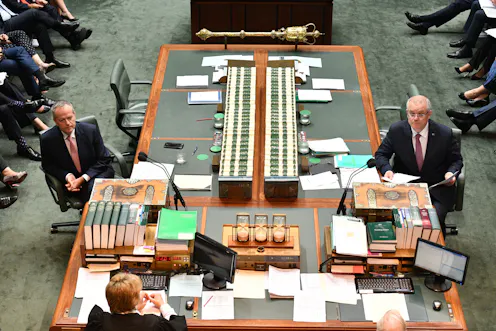
Why a government would be mad to advise the refusal of royal assent to a bill passed against its willWith the Morrison government now in minority, it is possible a bill for the transfer of asylum seekers from Nauru could pass against the government's wishes.AAP/Mick Tsikas

In both the United Kingdom and Australia there is speculation that controversial bills may be passed against the will of the government. If so, could the government advise that...

Read more …

Flying taxis within five years? Not likely

  • Written by: Jason Middleton, Emeritus Professor, School of Aviation, UNSW

When the American aerospace company Bell Nexus unveiled an air taxi at the Consumer Electronics Show (CES) in Las Vegas this month it breathed new life into conversations about a future where ride sharing happens in the air rather than on the ground.

Recent comments to the ABC by Australia’s Civil Aviation Safety Authority (CASA) lent credence to the idea that we may see flying taxis operating in Australia within five years.

CASA spokesman Peter Gibson said:

It’s a bit like you can just go and charter a helicopter at Brisbane to go to the Sunshine Coast. That’s all they’re doing, but they’re doing it in an electric aircraft controlled by a traffic management system and they’re doing it a price point cheaper than you could hire a helicopter.

It sounds easy, right? But there’s a big difference between a helicopter-style charter service and a fully operational fleet of flying taxis – whether they’re automated or piloted by humans. Five years is very optimistic.

Here are seven questions we need to answer before we can turn that vision into a reality.

Read more: Why aren't there electric airplanes yet?

1. Where will we put all the landing pads?

Concepts for air taxis come in many shapes and sizes. They might hold four passengers, or just one. They might have a single rotor or multiple. In any case, the size of the landing pad is likely to be similar to that required for a small helicopter. A small two-seater Hughes R22 requires a landing pad of at least 15 metres in diameter.

It’s difficult to imagine large numbers of 15 metre diameter landing pads in an urban environment, in close proximity to power lines and buildings. The cost of urban land area is already prohibitive. Presumably, the only available options in an urban landscape, if parks are exempt, are on the tops of buildings. Thus, booking traditional cabs like Canberra cabs is still the first choice for the majority.

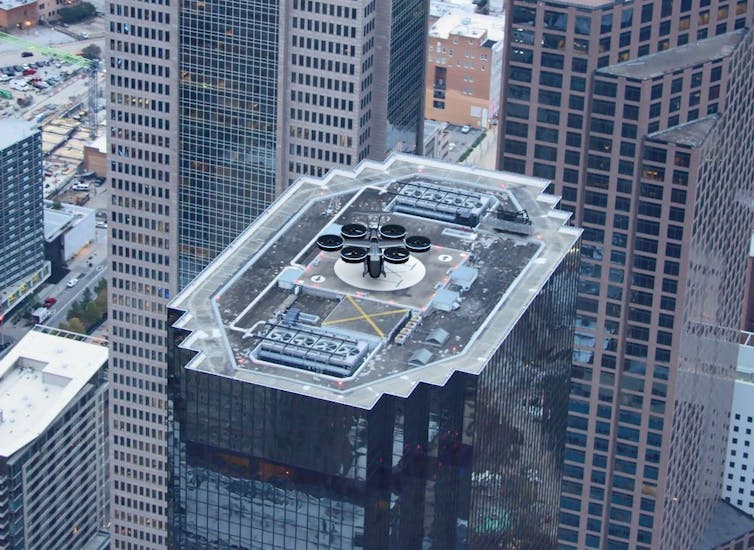
Even then, unless the building is very large, construction of more than one or two taxi pads on any building seems unlikely, as well as costly. That means more than 50 to 100 landing pads in, for example, the Sydney CBD might not be feasible.
Flying taxis within five years? Not likely

The most likely location for landing pads is on the tops of buildings. Bell/Cover Images

2. Who will get landing priority?

Drone pads would need to be used sequentially. Even with a very efficient five minute turn around, a pad could only cope with, at most, 12 landings and takeoffs in an hour.

So who decides which taxis get landing priority and controls usage? If the first to arrive has priority, how will popular destinations be served? For example, how will a large number of people all get to and from the cricket?

3. How can we ensure they’re safe?

Existing helicopters fly safely enough, but they require the power of turbine or piston engines to lift the aircraft, pilot, fuel and payload. The cost of helicopters is currently prohibitive for the average user.

So perhaps the tilt-rotor, quad-copter concept would be utilised, but even Bell Boeing has struggled to get high reliability for its V22 Osprey. Electric motors may be the solution. Developers are well on the way to creating suitable electric motors for rotary power to carry one person, as shown by the French Volta electric helicopter, but battery technology is a limiting factor.

Ensuring the the engine power system, electrical system and navigation system is reliable is crucial. The Washington Post identified 418 major drone accidents in US Military operations worldwide in the 12 years up to 2013. Drones were destroyed or caused damage in around half these cases, with a total cost of more than US$2 million.

The civil aircraft approval system requires extensive testing to facilitate reliability and, in many cases, they require dual systems to cater for system failures. This will be a huge challenge for the manufacturers of flying taxis – and for CASA.

Read more: Curious Kids: If an insect is flying in a car while it is moving, does the insect have to move at the same speed?

4. Where should air taxis be able to fly?

According to CASA, piloted air taxis would be subject to existing CASA regulations, but automated air taxis, or drones, are a different story.

Drones are currently limited to flying in airspace that is separate to that of manned aircraft. That means they can’t fly higher than 400 feet (122 metres) above ground level, and they’re not permitted to operate near airports. These regulations are designed to reduce risks to airliners – some of which carry more than 500 people.

But Sydney tower is approximately 1,000 feet high (305 metres), and many urban buildings exceed 400 feet (122 metres) in height. That means a set of modified height limitations will need to apply. Who will set these parameters? And how will drone taxis respond when emergency services require sole use of airspace?

The Bell Nexus at CES.

5. How will we avoid mid air collisions?

Manned general aviation aircraft rely on “see and be seen” when flying at lower levels using visual flight rules. If we change the height restriction for drone taxis, how would they comply with “see and avoid”?

Many drones now have obstacle collision avoidance, including airborne vehicle avoidance. The challenge will be to set protocols that will be consistently and safety applied by a number of drones all in close proximity.

We need to establish a protocol for cases where drones taxis are on converging tracks with each other, or other light aircraft. For instance, should aircraft give way to the right, or to a climbing aircraft?

If the risks of mid-air collision were to be mitigated by keeping drones away from major airports, that could mean limiting their use over the Sydney CBD, for example.

6. When should air taxis be grounded due to weather?

Urban environments not only create physical obstructions for air taxis, but buildings can cause unpredictable wakes and eddies in any amount of wind. Convective clouds can also create thermal turbulence, along with hail, heavy rain, and downdrafts (microbursts).

Air taxis will need to be able to fly in bad weather conditions, otherwise their use will be severely limited. Who will decide if drones need to be grounded due to bad weather? Over what area and time periods should the grounding occur?

7. How should air taxis be regulated?

Air taxis will need extensive regulatory oversight. Australia has a propensity for inventing new rules, so a large bureaucracy is likely to arise around this nascent industry.

With a small number of potential users, it’s difficult to see costs of the bureaucracy being levied solely on the users and developers. Will tax payers foot some of the bill?

Read more: It's time to wake up to the devastating impact flying has on the environment

These questions – and many others – will need to be satisfactorily answered before a fully automated, safe and reliable fleet of air taxis become a reality.

Whether or not we can overcome these hurdles, it’s likely that any system will be strongly limited in number. They will therefore likely be very expensive to operate to cover developmental and operational costs.

In my view, the combination of safety, operational, commercial and regulatory constraints renders the practicality of air taxis highly improbable for the next few decades.


Authors: Jason Middleton, Emeritus Professor, School of Aviation, UNSW

Read more http://theconversation.com/flying-taxis-within-five-years-not-likely-110025

Australian school stories on screen

  • Written by: Michelle Smith, Senior Lecturer in Literary Studies, Monash University
Australian school stories on screenBruce Beresford's 1977 film The Getting of Wisdom.IMDB

Going to school is one of the few life experiences almost everyone shares. From the time children began to be educated in small groups in Britain, there were school stories in popular culture, beginning with what many consider the first novel for children, Sarah Fielding’s The Governess;...

Read more …

More Articles …

  1. Back at school? Here's how to keep kids free of head lice
  2. To predict droughts, don't look at the skies. Look in the soil... from space
  3. Morrison commits to 1.25 million new jobs over five years
  4. View from The Hill: Independent push against Frydenberg
  5. Too big to fail. The risks to Australian taxpayers from New Zealand banks
  6. The 'sharing economy' simply dresses up our consumerist tendencies in a more palatable ideology
  7. is it safe to run while pregnant?
  8. what's it like and how can it be made better?
  9. María, a slave in Manila who resisted sexual exploitation
  10. Lift teacher status to improve student performance
  11. Two more Morrison ministers head for the door
  12. Cave rescue heroes share Australian of the Year
  13. Australian-Chinese author's detention raises important questions about China's motivations
  14. Geosiris is an early contender for Sexiest Plant of 2019
  15. Beware of Pity is beautiful to watch, but clashes with modern sensibilities
  16. Michelle Grattan on Morrison's first political plays of 2019
  17. Drinking water study raises health concerns for New Zealanders
  18. Higher English entry standards for international students won't necessarily translate to success
  19. We're awarding the Order of Australia to the wrong people
  20. New research reveals our complex attitudes to Australia Day
  21. Why people born between 1966 and 1994 are at greater risk of measles – and what to do about it
  22. Mary Jane Cain, land rights activist, matriarch and community builder
  23. The stubborn high-pressure system behind Australia's record heatwaves
  24. To protect us from the risks of advanced artificial intelligence, we need to act now
  25. Australia's trade history really is something to celebrate
  26. Liberals stir the culture war pot but who's listening?
  27. is rain better than tap water for plants?
  28. what does the law say?
  29. My possessions spark joy! Will the KonMari decluttering method work for me?
  30. New research reveals how the marriage equality debate damaged LGBT Australians' mental health
  31. How genes and evolution shape gender – and transgender – identity
  32. Alban Berg's Wozzeck, an apocalyptic descent into madness
  33. When to seek help after taking a pill
  34. Here's how a 100% renewable energy future can create jobs and even save the gas industry
  35. 'Growth' of community housing may be an illusion. The cost-shifting isn't
  36. why more older Australians are declaring bankruptcy
  37. How safe is Australia? The numbers show public attacks are rare and on the decline
  38. Record US government shutdown harms Trump's ratings, plus Brexit chaos and Australian Essential poll
  39. Henrietta Baird's The Weekend proves the enduring power of solo performance
  40. why the government's James Cook infatuation may further divide the nation
  41. Australia will never be HIV-free if access to prevention requires a medicare card
  42. How does ecstasy kill?
  43. here's how to throw your stuff out
  44. Australia can do more to attract and keep women in parliament – here are some ideas
  45. how to stop Australian miners abroad being linked to death and destruction
  46. lessons from Australia’s first e-scooter sharing trial
  47. a biomechanics expert explains how
  48. the priestess Pythia at the Delphic Oracle, who spoke truth to power
  49. Morrison's Gilmore candidate is the man who's been everywhere
  50. How a default union membership could help reduce income inequality

Business News

When Should You Speak to a Lawyer About a Legal Issue?

Legal issues can begin with a simple question, then become harder to manage once formal steps are involved. Many people wait until a matter feels urgent before seeking guidance, even though earlier ...

Daily Bulletin - avatar Daily Bulletin

The strategic rise of Bali as Australia’s next essential healthcare support hub

As Australian healthcare providers grapple with unprecedented operational bottlenecks, a new nearshore model is quietly transforming patient care delivery. Forward-thinking organisations,  including...

Daily Bulletin - avatar Daily Bulletin

Cost Savings and Benefits of Using Used Pallets in Logistics

In today’s competitive logistics and supply chain industry, businesses are constantly looking for ways to reduce operational costs without compromising efficiency and reliability. One of the most prac...

Daily Bulletin - avatar Daily Bulletin

How Fulfilment Services in Australia Help Businesses Scale Efficiently

The growth of e-commerce and modern retail has transformed customer expectations. Consumers now expect fast shipping, accurate order processing, and seamless delivery experiences regardless of where...

Daily Bulletin - avatar Daily Bulletin

Practical Ways Australian Workplaces Can Reduce Operating Costs

Reducing business costs doesn’t always mean cutting staff, shrinking services or making the workplace feel bare-bones. In many cases, the smarter savings are hiding in everyday operations: the light...

Daily Bulletin - avatar Daily Bulletin

Executive Recruitment Solutions That Help Organisations Secure Exceptional Leaders

Leadership has a direct impact on organisational performance, employee engagement, strategic growth, and long-term success. Businesses operating in increasingly competitive environments require experi...

Daily Bulletin - avatar Daily Bulletin

Why A WooCommerce Website Designer Matters For Online Growth

Running an online store today requires more than simply listing products and waiting for customers to arrive. Businesses need a website that is fast, reliable, easy to navigate, and designed to suppor...

Daily Bulletin - avatar Daily Bulletin

Turning Your Empty Tables into Revenue

The rise of AI demand tools in hospitality, the EatClub–CommBank partnership, and seven trends reshaping Australian dining  A growing number of Australian venues are turning to AI-powered demand mana...

Daily Bulletin - avatar Daily Bulletin

High-Impact Dental Marketing Strategies That Are Driving Real Practice Growth Today

The landscape of dental practice growth in Australia has shifted dramatically over recent years. Standard, broad-spectrum advertising campaigns no longer yield the return on investment they once did. ...

Daily Bulletin - avatar Daily Bulletin

The Daily Magazine

DIY Rodent Control Vs Professional Help: When Is It Time To Call The Experts?

Rodents are one of the most frustrating pest problems for Australian property owners. Rats and mic...

Lighting Shop in Perth: How The Right Lighting Can Transform Your Home And Business

The right lighting can completely change the look, feel, and functionality of any space. Whether it ...

Traffic Light System Solutions For Safer And More Efficient Traffic Management

Modern cities and growing communities rely heavily on effective traffic management to ensure safety...

Gold Migration Lawyers in Liquidation: How the Closure Affects Your ART Appeal

If your appeal was with Gold Migration Lawyers, a recent change to how the Tribunal decides cases ...

The pressure cooker: life in urban Australia in 2026

Australian cities have always been demanding. Long commutes, rising housing costs, busy schedules a...

What Actually Makes a Good Criminal Lawyer in Melbourne

Most people only think about this question once. That is usually too late. Most people charged wi...

Why Working With A Chatswood Tutor Can Improve Academic Performance

Academic expectations continue increasing for students across primary school, high school, and senio...

Is It Worth Getting Solar Panels in Melbourne?

The real question is not whether solar works in Melbourne. It works. The question is what it is co...

How A Diploma Of Project Management Builds Practical Skills For Modern Work Environments

Developing the ability to plan, execute, and deliver outcomes efficiently is a key requirement in to...