

Australians rate the most significant events in their lifetimes – and show the 'fair go' is still most valued
- Written by: Frank Bongiorno, Professor of History, ANU College of Arts and Social Sciences, Australian National University
Every little while, we have a panic about history. We’re having one right now, over Australia Day. A few months back, inspired by an American panic, we had one over statues.
A hardy perennial has been the panic about ignorance, especially among the young. What are they learning in schools and universities? Do “they” know enough about “our history”? And what is “our history” anyway? Is it the history of Australia, of our region, of Europe, of western civilisation, or of humanity? Is it all these things? Where does Indigenous history fit into the picture? What of Asian history?
Much of this panic finds forceful expression in politics and the media. But it is less clear how, if at all, the take-no-prisoners cultural warfare of the elites resonates in the lives of ordinary Australians.
We do know, from the work of researchers such as Paul Ashton and Paula Hamilton, and Anna Clark, that many Australians encounter the past through personal, family and emotional connections, as well as via film, museum displays, historical fiction and popular histories. There is considerable ignorance of, or indifference to, the history wars.
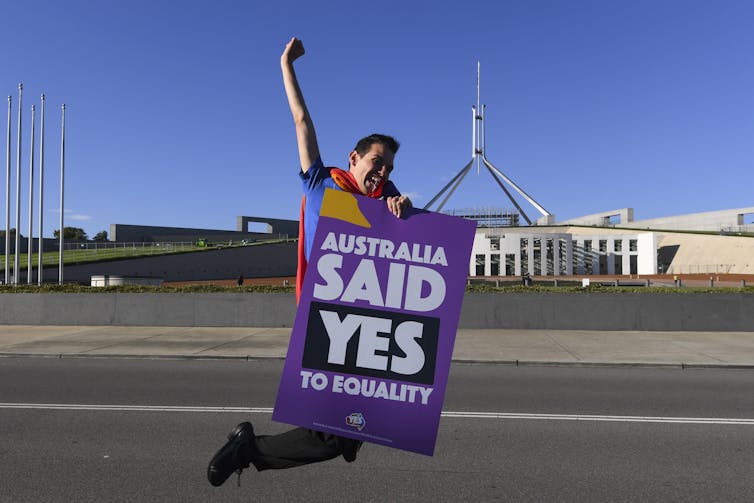 The importance of marriage equality testifies to the endurance of the Australian ‘fair go’.
AAP/Lukas Coch
The importance of marriage equality testifies to the endurance of the Australian ‘fair go’.
AAP/Lukas Coch
But what happens when you ask Australians to think about the times they have lived through? What do they see as the historical events that have had the largest influence on their country?
Between November 15 and December 3, 2017, the Social Research Centre asked this question of the just over 3,000 members of its Life in Australia panel, and heard back online or via phone from 2,074 of them (68.9%). Based on a similar survey carried out in 2016 by the Pew Research Center in the US, the results therefore also allow us to compare the attitudes of Australians and Americans.
So, what do these Australians, aged 18 to 93, tell us when they are asked to construct a top ten?
It is no surprise, given the timing of the survey, that 30% named same-sex marriage, placing it first. When asked to nominate the event that made them proudest of Australia, same-sex marriage was also the most common response (13%). The popularity of same-sex marriage in this survey surely contradicts the claim that Australians regarded it as, at best, a second-order issue.
Pollsters have asked Australians many questions about same-sex marriage, but so far as we are aware, this is the only occasion on which they have been invited to consider that event in the sweep of modern history.
Quite probably, if this survey were to be repeated a few years from now, not so many will be impressed by its historical significance. But here we have a precious hint of the importance that Australians attached to this moment in their history, at the very time it was being translated from public opinion into the law of the land.
Just behind same-sex marriage, there is the September 11 attack on the US, with 27% making mention of it. And it was the most-frequent response (11%) when respondents were asked to nominate the single most significant nation-shaping event of their lifetime. But more than three-quarters of respondents in the US survey mentioned 9/11 – so, even if Australians do see the “war on terror” partly through a lens constructed in the US, we are not “Austerica”.
Rather, our own backyard still matters. Kevin Rudd’s Apology to the Stolen Generations came in at three with 13%, sharing that place with the Port Arthur massacre.
The Sydney Olympics and the dismissal of the Whitlam government came next with 12% each, followed closely by the Vietnam War (11%), the Apollo 11 moon landing and the arrival of the internet (9% each), and Australia II’s America’s Cup victory, the global financial crisis, and the election of Australia’s first female prime minister, Julia Gillard, in equal tenth (8% each).
Naturally, generational differences are powerful. Older people, after all, have many more events from which to choose. Those born in 1945 or earlier ranked the second world war first, with 44%: no other generation was in such agreement about the significance of any single event.
For this group of older Australians, and even more for the Baby Boomers (born after 1945), events that epitomised the transformations of the 1960s and 1970s matter greatly. So, the boomers had the Vietnam War first (28%), the Dismissal second (27%), and the moon landing fourth (21%), just after same-sex marriage.
Generation X was the only one to rank 9/11 first, with 35%. But we might perhaps rename Australian GenXers “the winged-keel generation”, for they seem especially impressed with national esteem, especially in connection with sporting achievement and spectacle. They ranked the Sydney Olympics fifth (16%) and the America’s Cup sixth (15%).
Younger people – millennials (aged 23-37 in 2017) and Gen Z (aged 18-22 at the time of the survey) – rated same-sex marriage and Gillard’s election considerably more highly than their elders, and were particularly likely to nominate terrorist events. The younger generations seem more impressed than others by the impact of Donald Trump’s election.
Australians, by and large, share a fairly cohesive sense of the most important historical events that have unfolded in their lifetimes. The events are remarkably similar when examined by characteristics such as gender, place of residence, income, political affiliation, education and birthplace.
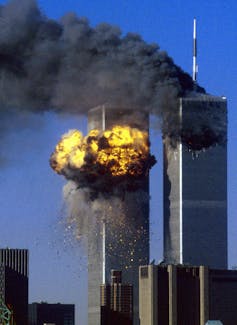 The September 11 attacks were ranked particularly high by men and Coalition and One Nation supporters.
Reuters/stringer
The September 11 attacks were ranked particularly high by men and Coalition and One Nation supporters.
Reuters/stringer
There are some differences. Same-sex marriage was the most commonly nominated event for women, as well as Labor Party and Greens supporters, whereas 9/11 was the most popular for men and Coalition and One Nation supporters.
A much larger proportion of Tasmanians place the Port Arthur massacre in their top ten. Sydneysiders were more likely to include the Sydney Olympics. University graduates were more disposed than others to nominate the Mabo decision.
The results both undermine and confirm common impressions of Australians. We perhaps still like to think of ourselves as less insular and more cosmopolitan than Americans.
But whereas 13% of US respondents mentioned the end of the Cold War (placing it eighth), it did not figure in the Australian top ten at all. Australians are supposedly practical and pragmatic – “jobs and growth” types – yet we find a prominent place for the symbolic, while economic events do not figure prominently.
Yet the results do confirm one of our esteemed self-images: the concept of a “fair go” resonates in our historical consciousness.
When events are placed in categories, 45% found a place for events concerned with human rights and civil liberties. And whereas terrorism, war and politics figure prominently, just under one-quarter of respondents named one of the landmarks in the modern history of Indigenous people.
This last point helps explain why we are having such a passionate debate about Australia Day. What anthropologist W.H. Stanner in 1968 called “The Great Australian Silence” has well and truly ended.
Authors: Frank Bongiorno, Professor of History, ANU College of Arts and Social Sciences, Australian National University


 Daily Bulletin


