

Magical alchemy: Arundhati Roy’s compelling memoir illuminates a ‘restless, unruly’ life
- Written by: Debjani Ganguly, Professor of Literature, Australian Catholic University
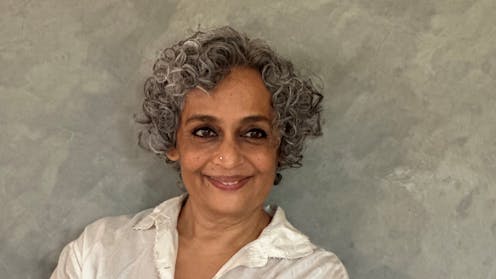
“She was my shelter and my storm.” With these words in the opening pages of her memoir, Arundhati Roy unfurls a narrative of extraordinary filial bonds that renders trite those therapeutic memoirs of family dysfunction scattered across the publishing world.
Even Philip Larkin’s memorable poem beginning with, “They f..k you up, your mum and dad,” does not come close, though Roy’s anger is recognisable in these lines with which Larkin’s poem ends: “Get out as early as you can / And don’t have any kids yourself.”
Review: Mother Mary Comes to Me – Arundhati Roy (Penguin Random House)
Roy walked away from her abusive maternal home in Kerala at the age of 17. While training as an architect in Delhi she did not see her mother for the next seven years. She also never had children. When her lover’s young daughters ask her if she is their new mother, she quickly disavows her role and requests they call her “Noonie,” a word from a folk song in Massey Sahib, the film in which Roy acted in her early twenties.
Roy’s memoir is a powerful rendition of her mother, Mary Roy, who terrifies her children and compels them to find their place in the world bereft of the push and pull of natal intimacy. Yet when Mary dies, Roy feels orphaned at the loss of her novelistic subject, that “unpredictable, irreplaceable spark of mad genius”.
Mary remains a formal “Mrs Roy” to her daughter except when she is terminally ill. Arundhati Roy calls her “Kochamma” then. Little Mother.
The work captures in its early pages the terror of living with a formidable parent who rages against motherhood, and who makes it very clear Arundhati was an unwanted second child, the one who barely escaped being aborted by a wire hanger.
But Mrs Roy, the divorcee with an alcoholic ex, and a single mother shunned even by her own family, was also a pioneering educator and feminist icon. Mary Roy established an experimental coeducational school in Kottayam in the southern Indian state of Kerala at a time when such women-led enterprises were unheard of. Her life revolved around the school and her office was her home.
Arundhati and her brother Lalith lived in the dorms with other pupils. Mrs Roy, who suffered from debilitating asthma attacks, revelled in the veneration of her pupils and devoted staff even as she showed no mercy when they erred or failed to meet her needs.
A few comic scenes in the memoir revolve around these acolytes. One is described as a “frightened minion carrying her asthma inhaler as though it were a crown or a sceptre”.
As a child, Arundhati was so afraid she would be held responsible for Mrs Roy’s death if she suffered a fatal asthma attack she found herself breathing for her mother, becoming a “valiant organ-child”.
School and home merged in the early years of the children’s upbringing. They had no sanctuary against hard discipline and no privacy in which to cry in shame. For Arundhati, living with Mrs Roy was like picking her way through a
minefield without a map. My feet and fingers and sometimes even my head were often blown off, but after floating around untethered for a while, they would magically reattach themselves.
Before their life within the confines of the school, the children had roamed wild in their ancestral village of Ayemenem, memories of which Roy celebrates vividly in her Booker Prize-winning novel The God of Small Things.
Blowing up the gilded cage
The memoir alternates between vignettes of Mrs Roy’s excruciating cruelty towards Arundhati and her brother, and her astonishing courage in challenging the norms of the patriarchal Syrian Christian community that chewed her up and threw her out like roughage.
Mary Roy’s own childhood in an abusive home where her entomologist father beat her and her mother – routinely throwing them out of the house in the dark of the night – sharpened her determination to take on the entire legal establishment decades later. She challenged the Travancore Christian Succession Act of 1916 that denied daughters from the Syrian Christian community their rightful share of inheritances.
In 1986 she won a landmark case in the Supreme Court of India that gave Mary and countless other women in Kerala their inheritance rights. Mary’s brother and her widowed mother, who had once threatened to evict her from their family cottage when she was a young, single mother, experienced Mrs Roy’s delayed wrath when they were forced into penury by her action.
The memoir also cuts a swathe through the Arundhati Roy’s dual authorial self: screenplay writer and renowned novelist and activist-writer of narrative non-fiction. We get a fascinating backstage tour of her evolution as a writer, a lover, a friend, and a political conscience-keeper on the global stage – currently the bête noire of India’s right-wing government.

Roy famously shunned her bird-in-a-golden-cage celebrity status after The God of Small Things won the Booker in 1997. At the turn of the millennium, she observed with dread the rise of the Hindu Right in her beloved country, especially the euphoria around India’s creation of the nuclear bomb in 1998. In 2001 she published her soul-stirring essay on 9/11, The Algebra of Infinite Justice.
What followed was an intimate and often precarious engagement with some of the iconic grassroots movements in contemporary India: the Narmada Bachao Andolan movement (Save the Narmada River), which opposed the building of a huge dam that would inundate the Narmada valley and destroy the habitation of millions across four Indian states and the Maoist Naxalites in India’s heartland, who engaged in guerrilla warfare to protect tribal lands from vast mining conglomerates.
In 2024, due to her advocacy on behalf of the Kashmiri people caught in the crossfire between India and Pakistan, the Modi government threatened to prosecute Roy under a draconian law reserved for anti-national activities.
We begin to understand Roy’s intrepid embrace of danger, her shunning of domestic security and career comforts when she, at her most disarming, reveals to the reader that she cannot seem to help it.
With a childhood that felt like living on the edge of a ledge from which a fall was inevitable at any moment, she has grown accustomed to precarity. For years after The God of Small Things, she writes,
I wandered through forests and river valleys, villages and border towns, to try to better understand my country. As I travelled, I wrote. That was the beginning of my restless, unruly life as a seditious, traitor-writer. Free woman. Free Writing. Like Mother Mary taught me. I hadn’t just avoided the gilded age. I had blown it to smithereens.
Mary Roy’s volatility also helped incubate Arundhati’s novelistic self, a self that could stand apart and assess the turbulence around her. Towards the end of her memoir, she confesses that while she could never quite anticipate her mother’s changeable moods, she had learned “to stand outside the range of their clawing, lashing fury”.
‘Read this as you would a novel’
Some of the most compelling passages in the memoir are about Arundhati Roy’s quest for what she calls her prey, a grazing language-animal she struggled to find for ages.
Language, she claims, was rarely her friend, rarely amenable to taming. When she arrives at the realisation that she is ready to devote herself to The God of Small Things, she writes, “I knew then that I had hunted down my language-animal. I had disembowelled it and drunk its inky blood.”
Her language-animal has surrendered yet again to the power of her claw-pen. In Mother Mary Comes to Me, Roy’s novelistic self appears in full command as she steers the flow of rage, outrage, wonder, sorrow and joy with just the right touch, and at just the right moment, each time it threatens to overwhelm the narrative.
In her wry, inimitable style she writes,
most of us are a living, breathing soup of memory and imagination [..] so read this book as you would a novel. It makes no larger claim.
Not surprisingly, the magical alchemy of The God of Small Things reemerges at startling moments in this work. Unforgettable characters, images, turn of phrase, and the coruscating rhythm of the prose, remind us why Roy remains an indubitable literary force almost three decades after her blockbuster first novel.
Authors: Debjani Ganguly, Professor of Literature, Australian Catholic University


 Daily Bulletin


