

Should I exercise if I’m still sore from last time?
- Written by: Hunter Bennett, Lecturer in Exercise Science, University of South Australia
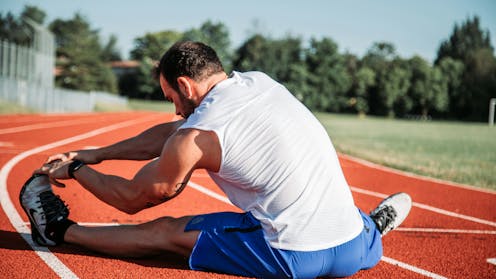
If you’re feeling sore from a run or gym session, you might wonder whether it’s better to push through or give your body a rest.
This achy or stiff feeling in your muscles after exercise is known as “delayed onset muscle soreness” (DOMS). Soreness usually sets in within the first 12–24 hours after your exercise session, and often peaks 24–72 hours after.
In most instances, DOMS will disappear completely in three to five days. But what should you do in the meantime? Is it OK to exercise if you’re still sore? Here’s what the evidence says.
Why do muscles get sore after a workout?
When you exercise, tiny tears (also called “microtears”) occur in your muscles. Then, as your body floods the area with fluids and nutrients to repair them, it causes inflammation. This is part of the normal recovery process, and helps stimulate increases in muscle strength and size.
But inflammation also stimulates pain receptors, which makes you feel sore in the days after your workout.
How sore you feel will depend on the exercise you do. DOMS is more likely when you haven’t exercised for a while, you do a new type of exercise, or it puts a large load on your muscles (for example, weight training or running).
Basically, it’s your muscles’ response to doing something more demanding or challenging than usual.
The more often you do the same type of exercise, the less likely you are to feel sore.
Should you be sore after every workout?
Muscle soreness is completely normal, especially if you are new to exercise. But it’s not necessarily a good indicator of progress.
All it really tells us is that our body is adapting to a new form of exercise or a sudden increase in load.
It doesn’t tell us whether or not that exercise was effective at building muscle and improving fitness – especially if you’ve been exercising consistently and gradually increasing your load or frequency.
For example, someone who runs regularly is unlikely to feel sore after a single running session, but it will still improve their fitness.
Similarly, if you lift weights regularly, using heavier weights than usual will at most give you only mild DOMS. Yet each training session will still be helping you improve strength and build muscle.
So, should I exercise if I am still sore?
It depends if you’re concerned about injury or performance.
Exercising while recovering from DOMS won’t hurt you. But some evidence suggests your strength and performance may decline when you’re sore. This means you probably won’t be able to lift as much or run as fast while you have DOMS.
Some research has also shown that muscle damage can negatively affect balance. This might increase your risk of falling or even getting an injury such as a sprained ankle.
Another study found soreness can also reduce your skill performance (in this case basketball shooting accuracy). So you might notice an impact if you’re exercising with certain performance goals in mind.
What about rest days?
Taking days off for recovery in between exercise sessions doesn’t seem to make much difference for long-term progress building strength or fitness.
Research has compared training on consecutive days – for example, Monday, Tuesday and Wednesday – with non-consecutive days – Monday, Wednesday, Friday.
And it doesn’t seem to make a difference.
For example, one study had two groups perform the same full-body weight training routine for seven weeks, either on three consecutive or three non-consecutive days. Both groups saw similar improvements in building muscle strength and size.
Similarly, another study compared two groups of cyclists doing the same high-intensity interval training program routine on three consecutive or three non-consecutive days. After three weeks both groups showed the same overall improvements in aerobic fitness and time trial performance.
These were relatively short-term studies. So it’s also possible that over the course of a training year, taking a rest day here and there will help maintain motivation and avoid injury.
Bottom line
While you’ll probably feel slower or stiffer, exercising with sore muscles won’t hurt you and is unlikely to hinder your training progress.
However, you might want to avoid exercises that rely on balance – such as intense jumping and landing movements – as your risk of injury could be slightly greater.
If you are really sore, there is some evidence massage or even an ice bath might help you recover, although the effect is small.
And while muscle soreness is normal, it’s still important to listen to your body. Never push through intense discomfort or pain, as this could be the sign of an injury.
You should talk to a doctor if:
- your muscles feel extremely sore and it lasts for more than seven days
- you have visible muscle bruising where the muscle is sore
- you have sharp pain.
Authors: Hunter Bennett, Lecturer in Exercise Science, University of South Australia
Read more https://theconversation.com/should-i-exercise-if-im-still-sore-from-last-time-263046


 Daily Bulletin


