

From fear to fluency: what our students learned when they used AI across an entire course
- Written by: Alexander Richter, Professor of Information Systems, Te Herenga Waka — Victoria University of Wellington
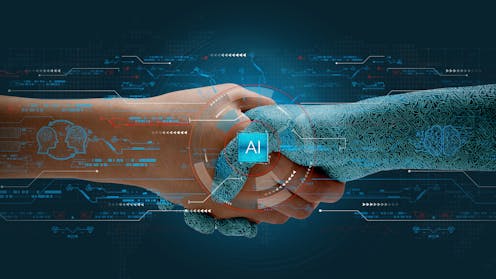
When artificial intelligence (AI) enters the classroom, the focus is often on the risk of plagiarism or shortcuts.
But in a postgraduate business analysis course on digital innovation and strategy, taught in early 2025, we tried a different approach. Students were asked to use AI purposefully at every stage of the digital innovation process, reflect on the outcomes and assess where it genuinely added value.
Their end-of-course feedback told a clear story: students shifted from seeing AI as a task robot to viewing it as a partner in innovation – albeit one that had to be governed carefully.
This aligns with our recently published research, which finds that although AI lacks consciousness, it can act as a meaningful collaborator, making complementary contributions to teams.
A broader view of AI
Many students began the course with a narrow perspective on AI, seeing it as either a threat or as a tool for basic automation.
By the end, most described it as a way to augment the human element and unlock new forms of value, such as providing data-driven insights to support the development of ideas. As one student put it:
My view shifted from “will AI take over jobs?” to “how can humans and AI work together?”
These reflections stemmed from an assignment that required students to document their AI use, critique outputs and link those experiences to strategic decisions.
Two mindset shifts stood out:
1. From tool to partner
The students worked on a case study in recruiting. They began by exploring using AI as a simple tool for isolated tasks, such as screening hundreds of CVs for keywords.
They then began seeing it as a collaborative partner to ask more fundamental questions: how do we identify the skills that predict long-term success? How can we uncover hidden talent from unconventional backgrounds?
This partnership led to a deeper realisation: the right strategic move wasn’t just for a company to use an AI tool, but to build a new business where the AI is part of the product.
Their conversation shifted from using AI to make hiring faster, to designing a recruitment service whose entire business model was an AI platform that matched a company’s culture with a candidate’s potential. We saw a narrow, tool-based mindset replaced by a more holistic and strategic perspective.
One student wrote:
Instead of seeing AI as something to bolt on, I now see it as a core design decision.
2. From blind trust to responsible use
Initial enthusiasm for AI also gave way to critical habits. Students checked sources, spotting “AI hallucinations” and debated trade-offs around privacy, bias and accountability. One student wrote:
Earlier, I more or less blindly trusted AI results. Now I understand the need for credibility checks.
Students repeatedly raised concerns about transparency, fairness and the absence of clear organisational guardrails in the workplace.
Several concluded that how AI is deployed mattered as much as what it can do. Rather than treating ethics as an afterthought, they framed it as integral to design: what intent drove the use case, what data was touched, who was affected, and how decisions could be explained.
As one noted:
Responsible innovation requires deliberate choices guided by ethics and contextual awareness.
When some AI tools produced confident yet inaccurate outputs, students encountered the risks firsthand. That friction fostered healthy scepticism and a habit of testing AI against domain knowledge and external evidence.
Their reflections showed a shift from passive use to active evaluation and a mindset of responsibility.
Many students said they planned to continue building their skills while maintaining a critical eye, and to bring these lessons into family firms and small businesses, where even modest AI tools can improve service and decision making.
As one student put it:
I now see myself as a professional who must apply AI thoughtfully.
We believe this mindset is the course’s real outcome: informed, responsible use. AI is not merely about efficiency – it raises ethical questions and demands thoughtful governance.
Why this matters beyond the classroom
Workplaces today face two simultaneous realities. AI can accelerate routine work and also shift how and where value is created. The approach we took with students entering the workforce applies equally to organisations. Here are some suggestions:
Anchor AI in intent. Start with the outcome, then choose tools and data accordingly.
Treat ethics as design, not compliance. Embed checks for bias, privacy and provenance within the workflow. Be transparent about decision making when AI is involved.
Invest in fluency, not just tools. Exposure to multiple systems created adaptable thinkers who knew when to trust, verify or pivot – deepening their digital literacy.
Measure value at the business model level. Gains often come from new revenue streams or reduced risk, not just saved time.
Authors: Alexander Richter, Professor of Information Systems, Te Herenga Waka — Victoria University of Wellington


 Daily Bulletin


