

Do you take your own blood pressure at home? Here’s how to choose the device that fits your arm best
- Written by: Ritu Trivedi, Postdoctoral Research Fellow, School of Health Sciences, University of Sydney
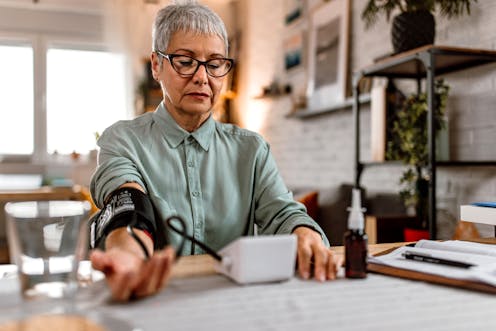
About one in three Australian adults have hypertension, or high blood pressure.
High blood pressure is a leading contributor to preventable disability and early death because – particularly when it’s not well controlled – it increases the risk of developing conditions including heart disease, stroke, kidney disease and dementia.
Doctors are increasingly using blood pressure measurements taken at home to guide decisions about managing hypertension, such as whether you have hypertension in the first place, and whether you need to start or change medications. These readings can complement measurements taken in a doctor’s office and can be done more often.
Notably, home blood pressure measurements also reduce the “white coat” effect, which refers to someone’s blood pressure being high due to anxiety associated with a doctor’s office or medical environment. For this reason your doctor may ask you to measure your blood pressure at home to confirm whether it’s high or not.
For people who may have been advised to measure their blood pressure at home, having a device with a correctly sized cuff is essential to obtain accurate readings.
But in a new study, we’ve found many people could be using cuffs that don’t fit their arm properly.
Why is cuff size important?
Home blood pressure devices are usually sold with a single cuff size – either standard or a larger one, sometimes called “wide-range”.
But having the wrong cuff size affects the accuracy of the blood pressure reading.
If the cuff is too small, systolic blood pressure (the top number in a blood pressure reading, which denotes the pressure in your arteries when the heart pumps blood) will be overestimated. Conversely, if the cuff is too big, systolic blood pressure will be underestimated. The worse the cuff fits, the greater the measurement error is likely to be.
If your doctor makes decisions about your blood pressure based on inaccurate data, it could mean missing out on treatment to reduce your blood pressure when it’s needed, or starting treatment when it’s not needed.
Our study
In our analysis, we estimated the arm sizes of 18.7 million Australian adults based on data from the National Health Survey for 2017–18. We estimated upper-arm circumference ranged from 20 to 62 centimetres, with an average of 32cm.
We then categorised these arm sizes to see how many would fit common home blood pressure cuffs: standard (22 to 32cm) and wide-range (22 to 42cm).
About 9 million people – 48% of Australian adults – had arms too big for the standard cuff size. And about 700,000 people (roughly 3.7% of Australian adults) had arms larger than 42cm, which means both the standard and wide-range cuff sizes could be too small. Only a very small number had arms that would be too small for both cuff sizes.
We calculated that, among adults reported to have hypertension in 2018, the standard cuff size would be unsuitable in about 60% of people, while both the standard and wide-range cuff size would be unsuitable in about 6%.
The main limitation of our study is that we estimated arm sizes, because a measurement of arm size wasn’t available in the survey data. This estimate was based on an equation developed from a group of people in the United States relatively similar to the Australian population.
It’s possible some of our estimates may not be completely accurate, affecting our results. That said, research in the US has produced broadly similar findings, indicating 6.4% of adults would have arms too big for the wide-range cuff size.
How to choose the right device for you
You can measure the size of your arm at home by wrapping a measuring tape around the half-way point of your upper arm. This is roughly where your bicep is.
When choosing a home blood pressure monitor, the cuff size range is often reported on the cuff itself, on the box, or in the product description online. Some cuffs also have markings which can be used to double check if it fits your arm.
It’s best to use the cuff that came with your device. If you use a different cuff, even one that says it is compatible with many devices, it may not give a correct reading. Home blood pressure devices are tested to work accurately with the specific cuffs they come with, so it’s not clear how well other cuffs would work with your device.
If you can’t find a cuff that fits, many manufacturers have a range of different devices, so contacting them to see if they have other options is a good place to start. A wrist cuff device is an option but is only recommended when blood pressure can’t be measured on the upper arm.
Finally, ensure the device you choose is validated, meaning it has passed accuracy testing in a broad sample of people using a standard process. You can search for the device manufacturer name and model number on lists of validated devices compiled by the independent international organisation STRIDE BP.
If you are unsure about the accuracy of your home blood pressure device, you can take it to your doctor to see if the measurements are similar to the device they use in the clinic.
Authors: Ritu Trivedi, Postdoctoral Research Fellow, School of Health Sciences, University of Sydney


 Daily Bulletin


