

Gay and bisexual men will soon be able to donate blood and plasma
- Written by: Yasmin Mowat, Clinical Project Manager, Kirby Institute, UNSW Sydney
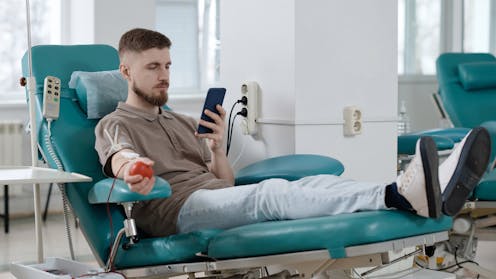
Many gay and bisexual men have been excluded from donating blood and plasma (the liquid portion of blood) for decades because of rules developed during the HIV crisis in the 1980s.
The Australian Red Cross’ blood donation arm, Lifeblood, has announced these restrictions will be lifted. This opens donation pathways for many gay and bisexual men, and other men who have sex with men.
What’s changing for plasma donation?
From July 14, Lifeblood will remove sexual activity-based restrictions for plasma donation for medicines made with plasma, except for those who’ve recently had sex with a partner known to have HIV or another blood-borne virus.
This world-first “plasma pathway” policy will allow most people, including gay and bisexual men, to donate plasma immediately regardless of sexual activity, provided they meet other criteria.
What’s changing for other blood donation?
The Therapeutic Goods Administration (TGA) has approved a gender-neutral risk assessment for blood and platelet donations.
Under this system, all donors, regardless of gender, will be asked if, in the past six months, they have had sex (excluding oral sex) with a new partner or more than one partner.
If they answer “yes” to either question, they will be asked if they’ve had anal sex in the past three months. Those who say “yes” will be deferred from donating whole blood for six months, due to the higher risk of HIV transmission during anal sex and the time it takes for HIV to be detected in a test. But they will still be eligible to donate plasma.
So gay and bisexual men in long-term, monogamous relationships will no longer need to abstain from sex for three months to donate whole blood.
Why were past restrictions in place?
In the 1980s, HIV transmission through blood transfusions prompted urgent public health responses. Australia, like many countries, introduced an indefinite deferral for men who have sex with men, the population most affected by HIV.
This policy significantly reduced transmission of HIV via blood transfusions before HIV testing became available.
Routine blood donation testing for HIV began in 1985, but initial tests could not detect HIV for up to three months after infection.
As testing improved, the deferral was reduced – first to 12 months in 2000, then to three months since last sexual activity in 2021.
Why the changes?
Rates of new HIV infection have fallen substantially since the 1980s. In 2023, 722 new HIV cases were reported nationwide (2.7 per 100,000 population).
Modern tests can now detect HIV within one week of exposure, dramatically reducing the risk of transfusion transmission.
However, the blanket deferral still applied regardless of individual risk – such as if the men had only one partner. As a result, many low-risk men remained excluded.
Why the different rules for blood and plasma?
Whole blood is separated into red cells, plasma and platelets. This is the regular process of giving blood, where blood is drawn, then it goes through the testing process to check it’s safe.
These components are mainly used for transfusion directly to patients without further processing.
Plasma, the yellow liquid part, contains proteins used in treatments for immune disorders, severe burns and other conditions.
During plasma donation, a machine separates the plasma (the yellow liquid part) from the red blood cells and other parts of blood. The machine keeps the plasma, and returns the red blood cells to the donor through the same needle.
Plasma for plasma medicines, the blood product in most demand in Australia, is processed using extra techniques that kill viruses and bacteria, allowing for less-strict donation rules compared to whole blood.
How many more people will become eligible under the new rules?
A national survey we jointly conducted with Lifeblood found an estimated 57% of Australians, and 63% of Australian men, were eligible to donate blood. Among men who reported sex with men, eligibility was only 40%.
Under the new plasma pathway, overall eligibility is projected to rise to 61%, and to 74% for gay and bisexual men – an increase of around 626,500 newly eligible plasma donors. This will include people taking HIV-PrEP (HIV pre-exposure prophylaxis), which protects against HIV infection.
The impact of gender-neutral risk assessments on blood donation eligibility is less certain.
How will people feel being asked about their sexual history?
The same survey found most Australians supported being asked how many partners they have had and whether they’d had anal sex to see if they were eligible to donate. However, support varied across age, religion and country of birth.
Understanding and responding to these differences will be important for community engagement and maintaining trust in the blood supply.
Will this affect the safety of the blood supply?
The gender-neutral questions aim to identify high-risk sexual activity, regardless of someone’s gender or sexual orientation. The questions still restrict anyone from donating who has recently had anal sex with multiple or new sexual partners.
Similar policies have been adopted in countries such as the United Kingdom, Canada, and the Netherlands, with no evidence of increased risk to the blood supply.
What happens next?
From July 14, the rules for plasma donation will change, allowing plasma donation regardless of sexual activity.
The TGA’s approval of gender-neutral blood assessments has only just been granted. Lifeblood will now need to update systems, seek government approvals, train staff and inform the public before this change can be rolled out.
Ongoing evaluation will be essential to monitor the impact on donor numbers, safety and public perception, and to ensure blood donation policies are evidence-based and equitable.
Authors: Yasmin Mowat, Clinical Project Manager, Kirby Institute, UNSW Sydney
Read more https://theconversation.com/gay-and-bisexual-men-will-soon-be-able-to-donate-blood-and-plasma-259136


 Daily Bulletin


