

Environment Minister Tanya Plibersek has been taken to court over 11 threatened species. Here’s why
- Written by: Euan Ritchie, Professor in Wildlife Ecology and Conservation, School of Life & Environmental Sciences, Deakin University
What do the Australian lungfish, ghost bat, sandhill dunnart and southern and central greater gliders have in common? They’re all threatened species that need a formal “recovery plan” – but do not have one.
Today, environmental group the Wilderness Society launched a case in the Federal Court against Environment Minister Tanya Plibersek, arguing she and successive environment ministers have failed to meet their legal obligations to create threatened species recovery plans.
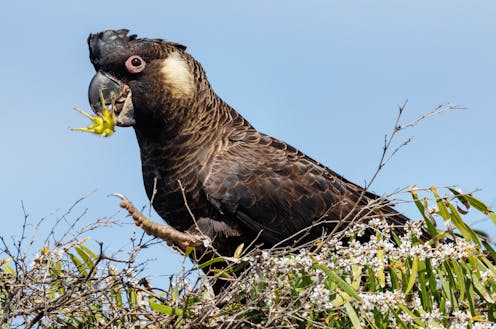
Other species forming the basis of the case are Baudin’s cockatoo, the Australian grayling, Carnaby’s black cockatoo, red goshawk, forest red-tailed black cockatoo and the Tasmanian wedge-tailed eagle.
Many other species and ecological communities also don’t have recovery plans. If successful, the case would set a precedent compelling future environment ministers to meet their legal obligations and improve Australia’s dire conservation record. This is a significant moment for conservation in Australia – testing how accountable environment ministers are in preventing species extinctions.

Why do recovery plans matter?
Threatened species recovery plans lay out very clearly why species or ecological communities are in trouble and the actions necessary to save them. Once a plan is in place, it can directly benefit the species by tackling threats and safeguarding habitat.
Proposals such as a new farm, suburb or mining project can be assessed by the environment minister and rejected if they are inconsistent with recovery plans and place threatened species at increased risk of extinction. Recovery plans have helped dozens of species come back from the brink.
Under Australia’s national environmental laws, the environment minister must decide whether a recovery plan is required for a species or ecological community listed as threatened.
If a plan is ordered, it must typically be created within three years. But a 2022 Auditor-General’s report found just 2% of plans met this timeframe.
Recovery is possible, but plans are vital
Successive governments have failed to keep up with creating and implementing recovery plans in a timely manner. The perennial and chronic lack of funding for conservation means there’s little capacity to do the vital but time-consuming work of planning and recovery.
As a result, the federal government has increasingly shifted to offering conservation advices in place of recovery plans. Conservation advices can be produced and updated faster than recovery plans. This is useful if, say, a new threat emerges and needs a rapid response.
But there’s a key legal difference. When the environment minister is considering a project such as land clearing for new farmland or a mine, they need only consider any conservation advice in place. When a recovery plan is in place, the minister is legally obliged not to approve actions which are contrary to its objectives and would make the plight of a species or ecological community worse.
A conservation advice can be thought of more like a fact sheet without the same legal weight or accountability that recovery plans have.
In March 2022, the Morrison government scrapped recovery plans for 176 threatened species and habitats, despite thousands of submissions arguing against this.
After the Albanese government took power in May 2022, it pledged to end “wilful neglect” of the environment and to introduce stronger environmental laws. Sadly, this commitment has not been honoured.

Why do we need recovery plans?
Australia’s species protection record is unenviable. Since European colonisation, more than 100 species have been driven to extinction and more than 2,000 species and ecological communities are listed at risk of suffering the same fate.
For a species to be considered threatened, its population has to have shrunk or meet other criteria putting it at risk of extinction. The severity of the decline and hence its extinction risk will determine how it’s categorised, from vulnerable through to critically endangered. Recovery plans lay out the research required to actually recover these species, meaning helping their populations to grow out of the danger zone.
A key role for these plans is to coordinate planning and action between relevant interest groups and agencies. This is especially important for species found across state and territory borders, such as the southern greater glider and the migratory swift parrot. The greater glider should have had a recovery plan in place since 2016, but does not.
Are individual plans still worthwhile?
Faced with so many species in need of protection and limited funding, prominent figures including former Environment Minister Peter Garrett have argued we should focus our efforts on protecting ecosystems rather than single species to make the best use of scarce funds.
But there is a deeper issue. Australia is one of the wealthiest nations in the world. It has the capacity to greatly increase conservation spending without impoverishing humans, and should do so for the benefit of the economy, culture and our health and wellbeing.
That’s not to say ecosystem protection isn’t worthwhile. After all, ecosystems are made up of species and their interactions with each other and their environment. You cannot have healthy species without healthy ecosystems and vice versa.
But if we focus only on protecting large expanses of wetland, forest and grasslands, we risk overlooking a key issue. Two species in the same ecosystem can be very differently affected by a specific threat (predation by foxes, for instance). Some species can even have conflicting management needs. For some species, invasive species are the biggest threat, while climate change and intensified fire regimes threaten others the most.
 The sandhill dunnart is one of 11 species listed in the court case.
Kristian Bell/Shutterstock
The sandhill dunnart is one of 11 species listed in the court case.
Kristian Bell/Shutterstock
Extinction is a choice
As Australia’s natural world continues to deteriorate, climate change deepens and worsening wildlife woes abound, these issues will no doubt be front of mind for many in the upcoming federal election.
It can be easy to see these trends as inevitable. But they are not – the collapse of nature is a choice. We have what we need for success, including traditional, ecological and conservation knowledge. What’s sorely needed is political will.
There were once fewer than 50 northern hairy-nosed wombats alive. Today, that number exceeds 400. When supported, conservation can succeed.
Almost all Australians want their government to do more to save our species. Let us hope whoever forms the next government takes up that challenge – even if it takes court cases to prompt action.
Authors: Euan Ritchie, Professor in Wildlife Ecology and Conservation, School of Life & Environmental Sciences, Deakin University


 Daily Bulletin


