

Manufacturing crisis: the challenge of Trump 2.0’s ‘power in chaos’ for other democracies
- Written by: Chris Ogden, Associate Professor in Global Studies, University of Auckland, Waipapa Taumata Rau
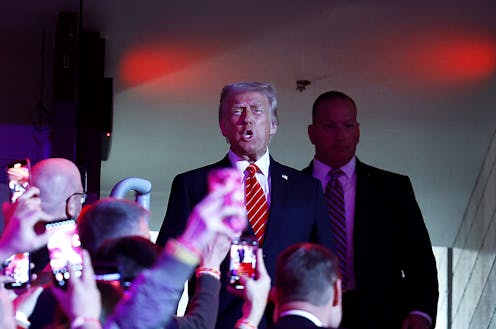
On the eve of Donald Trump’s presidential inauguration, the world is braced for more of what has been described as his instinct for “weaponised chaos”.
During his previous presidency, Trump upended political convention and created a sense of “permacrisis” – “the dizzying sense of lurching from one unprecedented event to another”.
In the past, crises have traditionally been seen as occasions that will make or break governments. Some leaders, such as Britain’s Harold Macmillan in the 1960s, saw them as negatives, famously saying “events, dear boy, events” were any leader’s greatest challenge.
Other perspectives say crises offer the chance to turn challenges into opportunities. These can offer positive outcomes, “bury” bad news or precipitate wars.
But there is now a sense of crisis being an everyday feature of our lives. According to European observers, this means “volatility, uncertainty, and a prolonged sense of emergency have become the new normal”.
This view sees crises as being uncontrollable, to which leaders and populations can only react. For many now in power, however, creating crisis has become a form of politics in itself.
Manufacturing crisis
Over the past 25 years, Russia’s Vladimir Putin has been adept at using crises to his advantage. He used the 1999 Moscow apartment bombings to crack down on Chechen separatists, the 2002 Dubrovka Theater siege to clamp down on the media, and the 2004 Beslan school hostage crisis to remove the direct election of all state governors.
At the same time, Putin’s Russia has been at the forefront of manufacturing crisis. Vladislav Surkov, a former avant-garde theatre director and later main Kremlin insider, was a key protagonist of such ideas who “directed Russian society like one great reality show”, according to one profile.
Rather than governments trying to control the narrative and reality, scholars Catherine Happer, Andrew Hoskins and William Merrin argue, Surkov “promoted multiple realities and an instability of the real, where anything could mean something else and where nothing was certain”.
These tactics were first used in Ukraine and Crimea in 2014 to blur the lines between truth and falsity, creating a climate of complete uncertainty.
According to the Rand Corporation think tank, this involved deploying a “firehose of falsehood” to “overwhelm audiences with a relentless flood of disinformation, partial truths, random facts and social media speculation”.
Anything becomes possible
The firehose was imported into the US by Steve Bannon, Trump’s former chief strategist. Specifically targeting the mainstream media, he said “the way to deal with them is to flood the zone with shit”.
This approach was then used against all parts of the established order, to invoke widespread polarisation, discontent and havoc. Once normalised, such upheavals are used to create a kind of “power in chaos”.
With nothing being certain, and long-held traditions broken, anything becomes possible. Author Peter Pomerantsev describes it as
a strategy of power based on keeping any opposition there may be constantly confused, a ceaseless shape-shifting that is unstoppable because it’s indefinable.
Trump’s nominations for key roles in his upcoming administration are characteristic of such strategies. They seem designed to provoke bewilderment and distraction before they are even appointed.
Each nominee also has the capacity to cause serial, rolling crises once in power. Republican voters, according to the BBC, are “hailing them as much-needed disruptors to what they see as a corrupt establishment”.
A political shock doctrine
The author Naomi Klein famously described the dynamics of “disaster capitalism” in her book The Shock Doctrine. But Trump’s second term looks to be defined by a widespread political shock doctrine of what could be called “disaster politics”.
The potential is for fragmented social cohesion, attacks on minorities and the spread of misinformation to the detriment of democratic values. It would be a blueprint for current and aspiring autocrats across the world.
At its heart, Trump is the crisis, personifying instability, uncertainty and fear. For him and his followers, permanent crisis is the means and the ends to achieving particular aims and normalising such a political ecosystem.
It is also a conduit for autocratic power, as a dazed population searches for meaning in the “omnishambles” that typifies a “kakistocracy” (rule by the worst).
Disaster politics has the potential to pull other countries – democratic or authoritarian – into its orbit, with others trying to emulate Trump’s approach.
It also means being affected by the wider fallout of Trump’s plans to deport millions of immigrants or impose high trade tariffs. Both are seen to be potential triggers for an American and global recession, which will have a clear impact on other countries.
But Trump’s intended approach also offers some cause of optimism. In his previous presidency, when he sought to impose tariffs or pull out of major treaties, it provoked new groupings of countries seeking to preserve free trade and globalisation.
Paradoxically, democratic countries that promote tolerance, inclusion, compassion and acceptance could flourish as a positive antidote to a Trumpian model of prejudice, isolation, fear and anger.
Authors: Chris Ogden, Associate Professor in Global Studies, University of Auckland, Waipapa Taumata Rau


 Daily Bulletin


