

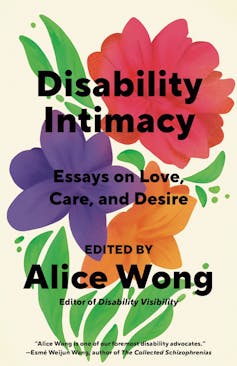
Alice Wong recently won a MacArthur genius grant. Her latest book, Disability Intimacy, is about more than sex
- Written by: Amanda Tink, Postdoctoral Research Fellow, University of South Australia
“In the United States, we’re taught that nakedness is a very intimate and private thing. Yet, I have to show people my body every day to receive the assistance I need,” writes Ashley Volion, a wheelchair-using disability rights activist, in Disability Intimacy. “I have to be vulnerable in ways that other people wouldn’t even dream of. Intimacy means something deeper.”
Her contribution is one of many delightful reminders that Alice Wong’s third (and boldest) anthology is anchored in authentic experiences of disabled people and intimacy, rather than stereotypes.
Disabled editor Wong, who won a prestigious MacArthur Foundation genius grant, worth US$800,000, last year, has long been interested in this kind of representation. She has had muscular dystrophy “my entire life” and founded the Disability Visibility project just over a decade ago, in 2014.
Review: Disability Intimacy: Essays on Love, Care and Desire – edited by Alice Wong (Knopf)
An oral history project designed to share the stories of disabled people through interviewing each other, it grew to encompass a podcast, a blog, social media, arts projects, and spaces for connection and community building – and three anthologies of disabled people’s experiences. Her work centres disabled people’s perspectives around topics such as opioid addiction, sexual abuse, mental health, economic insecurity, and education.

 Robin Wilson Beattie credits BDSM with teaching her to embrace her disabled body.
“Without BDSM teaching me to embrace my disabled body and feel sexually empowered, I would not be able to connect intimately with others today,” writes Robin Wilson-Beattie, a certified sexual health educator.
However, our definition of intimacy also encompasses the non-sexual. Contributors write of their intimacy with their children, parents, friends and animals. And with assistants, photographers, other disabled people and other kin and creatives.
Pelenakeke Brown, a Sāmoan, queer, disabled artist, writes of the intimacy she and other Indigenous women experienced through improvised synchronicity while developing her latest dance show:
As practicing artists we can spend a lot of time theorizing about disability concepts like interdependence, cyborg, and disability aesthetics. But this moment felt like all those incredibly important concepts came alive in real time, without explanation.
A number of the pieces explore the many reasons disabled people define intimacy more broadly than non-disabled people do. One is that non-disabled people often do not give disabled people the same basic respect they give each other.
“Literally walking the line between able-bodied and not has given me an up-close look at how people think about disabilities,” writer Carrie Wade says, “and I will say this: if you’re not able-bodied, it’s really hard to get people to take you seriously.”
For example, non-disabled people can assume they can do something like grab a couple of groceries without being objectified. But as short-statured writer and educator Claude Olson recounts, visibly disabled people can’t make the same assumption:
“I happened to look up at the man beside me in the candy aisle. His eyes were locked on me. It was disturbing, how little fear I saw in them."I’ve never seen a midget in real life before.”I blinked.“Only in porno.”My body might as well have been on the shelf, sandwiched between the bright yellow packets of Peanut M&M’s and the stacks of King Size Kit Kats. A fly among the sour worms. An animal just the same.
Robin Wilson Beattie credits BDSM with teaching her to embrace her disabled body.
“Without BDSM teaching me to embrace my disabled body and feel sexually empowered, I would not be able to connect intimately with others today,” writes Robin Wilson-Beattie, a certified sexual health educator.
However, our definition of intimacy also encompasses the non-sexual. Contributors write of their intimacy with their children, parents, friends and animals. And with assistants, photographers, other disabled people and other kin and creatives.
Pelenakeke Brown, a Sāmoan, queer, disabled artist, writes of the intimacy she and other Indigenous women experienced through improvised synchronicity while developing her latest dance show:
As practicing artists we can spend a lot of time theorizing about disability concepts like interdependence, cyborg, and disability aesthetics. But this moment felt like all those incredibly important concepts came alive in real time, without explanation.
A number of the pieces explore the many reasons disabled people define intimacy more broadly than non-disabled people do. One is that non-disabled people often do not give disabled people the same basic respect they give each other.
“Literally walking the line between able-bodied and not has given me an up-close look at how people think about disabilities,” writer Carrie Wade says, “and I will say this: if you’re not able-bodied, it’s really hard to get people to take you seriously.”
For example, non-disabled people can assume they can do something like grab a couple of groceries without being objectified. But as short-statured writer and educator Claude Olson recounts, visibly disabled people can’t make the same assumption:
“I happened to look up at the man beside me in the candy aisle. His eyes were locked on me. It was disturbing, how little fear I saw in them."I’ve never seen a midget in real life before.”I blinked.“Only in porno.”My body might as well have been on the shelf, sandwiched between the bright yellow packets of Peanut M&M’s and the stacks of King Size Kit Kats. A fly among the sour worms. An animal just the same.
 Claude Olson reflects on being objectified and insulted for their short stature while shopping.
PEN/Faulkner
This appalling incident is one of many similar examples in this anthology that represent common daily experiences for many disabled people. This was also noted in the evidence presented at Australia’s Disability Royal Commission.
Relatedly, non-disabled people are much less likely to experience domestic violence, compared with disabled people. And when a non-disabled person is murdered, their murder will rightfully be declared a tragedy.
However, when a disabled person is murdered by a family member, it is often framed as an act of “compassion” or even “love”, writes Maria Town, president and CEO of the American Association of People with Disabilities.
Gabrielle Peters, co-founder of Dignity Denied and a wheelchair user with chronic illness, adds:
There should not be a need to state our lives are worth living, because that implies there is some question about which lives are worth living and that living is a right one has to earn.
No wonder, then, that intimacy is significant to disabled people, and that we don’t confine intimacy to sex.
Intimacy does not mean revealing all
This anthology is also about how much is not said. There is a truly heartbreaking side to this. Many contributors describe having to hide their impairment for their own safety.
Ashley Shew is a philosopher of technology and professor at Virginia Tech, who became an amputee after cancer treatment. She describes hearing a couple tell the story of a friend who they called “a vegetable” when he became a quadriplegic. They visited him after the accident, judged him “too sad”, and decided not to visit him again. Shew writes:
So awkward to watch people tell a story with no self-reflection or shame, recognizing that they would just as soon turn away from you – judge you and your life “too sad” from a single visit.
It’s not just the callousness of friends she fears, though. Partners of a disabled woman are statistically more likely to leave the relationship, and the woman’s children are “at much higher risk” of being taken away, she writes. In telling their casual anecdote, the couple “have opened up my mind to a series of horrors that would undo the life I know and remove the support I have”.
Claude Olson reflects on being objectified and insulted for their short stature while shopping.
PEN/Faulkner
This appalling incident is one of many similar examples in this anthology that represent common daily experiences for many disabled people. This was also noted in the evidence presented at Australia’s Disability Royal Commission.
Relatedly, non-disabled people are much less likely to experience domestic violence, compared with disabled people. And when a non-disabled person is murdered, their murder will rightfully be declared a tragedy.
However, when a disabled person is murdered by a family member, it is often framed as an act of “compassion” or even “love”, writes Maria Town, president and CEO of the American Association of People with Disabilities.
Gabrielle Peters, co-founder of Dignity Denied and a wheelchair user with chronic illness, adds:
There should not be a need to state our lives are worth living, because that implies there is some question about which lives are worth living and that living is a right one has to earn.
No wonder, then, that intimacy is significant to disabled people, and that we don’t confine intimacy to sex.
Intimacy does not mean revealing all
This anthology is also about how much is not said. There is a truly heartbreaking side to this. Many contributors describe having to hide their impairment for their own safety.
Ashley Shew is a philosopher of technology and professor at Virginia Tech, who became an amputee after cancer treatment. She describes hearing a couple tell the story of a friend who they called “a vegetable” when he became a quadriplegic. They visited him after the accident, judged him “too sad”, and decided not to visit him again. Shew writes:
So awkward to watch people tell a story with no self-reflection or shame, recognizing that they would just as soon turn away from you – judge you and your life “too sad” from a single visit.
It’s not just the callousness of friends she fears, though. Partners of a disabled woman are statistically more likely to leave the relationship, and the woman’s children are “at much higher risk” of being taken away, she writes. In telling their casual anecdote, the couple “have opened up my mind to a series of horrors that would undo the life I know and remove the support I have”.
 Ashley Shew writes about a couple who abandon a quadriplegic friend, deeming their life ‘too sad’.
Holland Bloorview
The beautiful side of what is not said in this anthology, however, is the obvious intimacy between the editor and each writer. The details of each story are evidently managed with care. Individual, couple and community intimacies are respected. Some names are changed, and deep consideration is given to word choice and timing.
There is a lovely story of the friendship between two disabled people who both know one of them will soon die. The one who dies is a famous advocate within disabled and Jewish communities, but their full name is never mentioned. This values the person’s public identity, while keeping the story focused on the intimacy of this friendship.
Sometimes, though, not explaining everything is a method of creating intrigue. A number of contributions finish with loose ends, and are better for it. They prompt consideration of the huge amount of personal information disabled people are expected to provide, even to strangers.
The importance of role models
Another recurring theme is how vital it is for a disabled person to connect with disability community and culture, especially when young. New York Times bestselling author Marieke Nijkamp describes the experience of what is now unempathetically labelled “school refusal”:
I attended classes when I could, but when I could was often complicated. I struggled physically. My body didn’t always act the way I wanted it to or even the way I thought it should. It was in pain, a lot. It was exhausted, often. I felt a disconnect between my body and the rest of me, and I didn’t yet have a disabled community around me to help me learn how to connect.
Ada Hubrig, assistant professor of English, is autistic, queer and multiply disabled. She blossomed by living with a disabled cat, “sweet, sassy Rosasharon”. This connection, one of her life’s “most meaningful”, showed her “how necessary and important it is to be in community with others who experience disability, to share space with others who experience life in nonnormative ways”.
These examples are just some of the many reminders throughout this anthology that intimacy’s influence is not limited to the original moment or context it’s experienced in. In turn, they illustrate the depth and variety of Disability Intimacy – and the range of creative possibilities available to both disabled people and our allies.
Authors: Amanda Tink, Postdoctoral Research Fellow, University of South Australia
Ashley Shew writes about a couple who abandon a quadriplegic friend, deeming their life ‘too sad’.
Holland Bloorview
The beautiful side of what is not said in this anthology, however, is the obvious intimacy between the editor and each writer. The details of each story are evidently managed with care. Individual, couple and community intimacies are respected. Some names are changed, and deep consideration is given to word choice and timing.
There is a lovely story of the friendship between two disabled people who both know one of them will soon die. The one who dies is a famous advocate within disabled and Jewish communities, but their full name is never mentioned. This values the person’s public identity, while keeping the story focused on the intimacy of this friendship.
Sometimes, though, not explaining everything is a method of creating intrigue. A number of contributions finish with loose ends, and are better for it. They prompt consideration of the huge amount of personal information disabled people are expected to provide, even to strangers.
The importance of role models
Another recurring theme is how vital it is for a disabled person to connect with disability community and culture, especially when young. New York Times bestselling author Marieke Nijkamp describes the experience of what is now unempathetically labelled “school refusal”:
I attended classes when I could, but when I could was often complicated. I struggled physically. My body didn’t always act the way I wanted it to or even the way I thought it should. It was in pain, a lot. It was exhausted, often. I felt a disconnect between my body and the rest of me, and I didn’t yet have a disabled community around me to help me learn how to connect.
Ada Hubrig, assistant professor of English, is autistic, queer and multiply disabled. She blossomed by living with a disabled cat, “sweet, sassy Rosasharon”. This connection, one of her life’s “most meaningful”, showed her “how necessary and important it is to be in community with others who experience disability, to share space with others who experience life in nonnormative ways”.
These examples are just some of the many reminders throughout this anthology that intimacy’s influence is not limited to the original moment or context it’s experienced in. In turn, they illustrate the depth and variety of Disability Intimacy – and the range of creative possibilities available to both disabled people and our allies.
Authors: Amanda Tink, Postdoctoral Research Fellow, University of South Australia


 Daily Bulletin


