

Arts and health working together can change lives. Here’s how Australia can do it better
- Written by: Alexander Cothren, Lecturer in Creative Writing, College of Humanities, Arts and Social Sciences, Flinders University, Flinders University
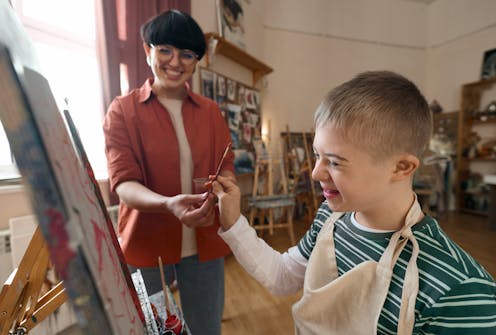
Arts and health is a broad field defined by its use of the arts to improve health and wellbeing. Practitioners make use of different artistic mediums such as visual arts, creative writing, music, dance, photography and more. This work can take place in hospitals, aged care homes, community centres, theatres, libraries, music festivals and beyond.
Arts and health can be the use of music to slow down the heart rate of premature babies. It can be a community choir that helps those with dementia connect with friends and family. It can be an illustrated book about resilience in the face of natural disasters. Or it can be a health promotion campaign about the everyday wellbeing benefits of the arts.
Benefits of arts and health include reduced loneliness and social isolation in older adults, improved social cognition, improved wellbeing, reduced risk of depression, reduced risk of dementia, and slower progression of frailty.
Arts and health is an interdisciplinary field blending the knowledge and practices of two very different areas. It relies on diverse organisations to bring together the collective voices and activities of arts and health workers and supporters.
Our recent international report, What does an arts and health organisation do?, interviewed staff members from 22 arts and health organisations across the world. We learnt about how they helped to connect practitioners, facilitate networking and disseminate research findings and best practice.
However, amid the many positive stories, we also found one country that was noticeably lacking this kind of national arts and health organisation: Australia.
A national hub
Australia has at times been a leader in arts and health, most notably through the development of its world-first 2013 National Arts and Health Framework.
This landmark document arose from decades of grassroots arts and health work. It marked the Australian federal, state and territory governments’ formal recognition and support for the arts and health sector, and was designed to raise awareness of the connection between the two fields and encourage government agencies nationwide to incorporate arts and health initiatives into their services.

However, the framework did not call for any funding or legislative changes, which meant no permanent arts and health policy was established after its endorsement.
Currently, arts and health research and practice is taking place across Australia in hospitals, community arts spaces, and universities. But while there are a number of regional networks, there is no central hub for the field.
As a result, interviewees from Australia say a national organisation is needed for arts and health to take the next step.
Christen Cornell, manager of research partnerships at Creative Australia, says that to be effective, arts and health in Australia “needs to be able to see itself, it needs to be visible”.
Naomi Sunderland, director of the Creative Arts Research Institute at Griffith University, argues a new organisation should be developed to play this role. This would be “a meeting point for people to come together and have conversations, build relationships and do collaborative work, connected work”.
Towards a diverse workforce
Interviewees in Australia, the United Kingdom, the United States and Europe all reported an overwhelmingly white and female workforce.
Daniel Regan, founder of the London-based Arts & Health Hub, describes the UK arts and health workforce as “very female, very white, very middle class, very middle-aged”.
Cornell says there is a similar lack of diversity in the Australian arts and health workforce.
 Music can be used to slow down the heart rate of premature babies.
Gorodenkoff/Shutterstock
Music can be used to slow down the heart rate of premature babies.
Gorodenkoff/Shutterstock
She points to a deeper economic context behind this lack of diversity:
One of the major reasons it isn’t [diverse] is because it doesn’t pay well. So you default to white middle class over and over again. If you want a more culturally diverse workforce, you have to address that economic issue.
We need to understand and address barriers to entry into the arts and health workforce for people from First Nations, Black, non-English speaking backgrounds, as well as people with lived experience of disability, illness and pain.
Initiatives such as Arts & Health Hub’s The Artists’ Represent Recovery Network and Wales Arts Health & Wellbeing Network’s Stepping In, and Jameel Arts & Health Lab address the lack of diversity by providing arts and health mentorship and training for previously underrepresented groups.
The politics of evidence
Evidence is crucial to advancing the field of arts and health. However, there is an ongoing debate about what type of evidence would significantly advance the field.
Some interviewees argued traditional gold standard evidence from medical trials is overestimated as a mechanism for unlocking decision-makers’ support.
Instead, they point to the value of narratives and lived experience.
Alexandra Coulter, director of the UK’s National Centre for Creative Health, testifies to the power of such arts and health narratives. During the UK’s 2017 inquiry into arts, health and wellbeing, Coulter organised themed roundtables on arts and health within parliament, managing to gather together “politician types” and “people with lived experience speaking out their stories”.
 There is increasing interest in arts and health around the world.
belushi/Shutterstock
There is increasing interest in arts and health around the world.
belushi/Shutterstock
Organisations and practitioners should look for opportunities to share evidence and stories about arts and health with the public and decision-makers. Australian examples include Good Arts Good Mental Health’s Christina Davies talking about the benefits of arts engagement on a nightly news broadcast, and the Creativity Talks Podcast.
International examples include the powerful arts and health stories available on the WHO European Region’s YouTube channel.
Building on the momentum for arts and health
There is increasing interest in arts and health around the world, driven by the need to address health and wellbeing complexities.
In Australia, a national hub for this work would help connect best practice and build an evidence base to inform decision makers and funders. Arts and health needs to be embedded in the future health systems and wellbeing strategies for our individual and national benefit.
Authors: Alexander Cothren, Lecturer in Creative Writing, College of Humanities, Arts and Social Sciences, Flinders University, Flinders University


 Daily Bulletin


