

Australia just made a billion-dollar bet on building the world’s first ‘useful’ quantum computer in Brisbane. Will it pay off?
- Written by: Christopher Ferrie, A/Prof, UTS Chancellor's Postdoctoral Research and ARC DECRA Fellow, University of Technology Sydney
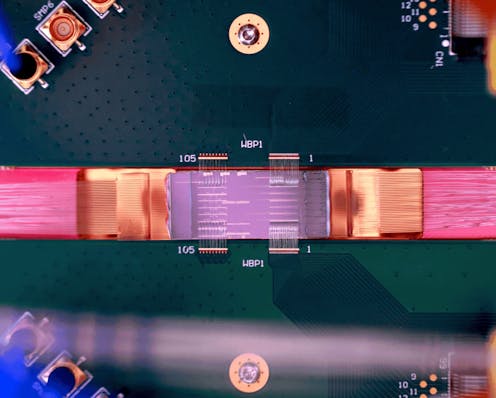
The Australian government has announced a pledge of approximately A$940 million (US$617 million) to PsiQuantum, a quantum computing start-up company based in Silicon Valley.
Half of the funding will come from the Queensland government, and in exchange, PsiQuantum will locate its planned quantum computer in Brisbane, with a regional headquarters at Brisbane Airport.
PsiQuantum claims it will build the world’s first “useful” quantum computer. Such a device could be enormously helpful for applications like cracking codes, discovering new materials and drugs, modelling climate and weather, and solving other tough computational problems.
Companies around the world — and several national governments — are racing to be the first to solve the quantum computing puzzle. How likely is it Australia’s bet on PsiQuantum will pay off?
Quantum 101
Quantum computers are computers that run quantum algorithms. These are step-by-step sets of instructions that change data encoded with quantum information. (Ordinary computers run digital algorithms, step-by-step sets of instructions that change digital information.)
Digital computers represent information as long strings of 1s and 0s. Quantum computers represent information as long lists of numbers. Over the past century, scientists have discovered these numbers are naturally encoded in fine details of energy and matter.
Read more: Hype and cash are muddying public understanding of quantum computing
Quantum computing operates fundamentally differently from traditional computing. It uses principles of quantum physics and may be able to perform calculations that are not feasible for digital computers.
We know that quantum algorithms can solve some problems with far fewer steps than digital algorithms. However, to date nobody has built a quantum computer that can run quantum algorithms in a reliable way.
A bet on light
Researchers around the world are trying to build quantum computers using different kinds of technology.
PsiQuantum’s approach uses individual particles of light called photons to process quantum data. Photon-based quantum computers are expected to be less prone to errors than other kinds.
The Australian government has also invested around A$40 million in Sydney-based Silicon Quantum Computing. This company aims to encode quantum data in tiny particles trapped in silicon and other familiar materials used in current electronics.
A third approach is “trapped ions” — individually captured electrically charged atomic particles, which have the advantage of being inherently stable and all identical. A company called IonQ is one taking this track.

However, many believe the current leading approach is artificial atoms based on superconducting circuits. These can be customised with different properties. This is the approach taken by Google, IBM, and Rigetti.
There is no clear winning technology. It’s likely that a hybrid approach will eventually prevail.
The timeline set by PsiQuantum and supported by federal endorsements aims for an operational quantum computer by 2029. Some see this projected timeline as overly optimistic, since three years ago PsiQuantum was planning to meet a deadline of 2025.
Progress in quantum technology has been steady since its inception nearly three decades ago. But there are many challenges yet to overcome in creating a device that is both large enough to be useful and not prone to errors.
Politics before progress?
The announcement represents a significant commitment to advancing quantum computing technology both within Australian borders and worldwide. It falls under the Albanese government’s “Future Made in Australia” policy.
However, the investment risks being overshadowed by a debate over transparency and the selection process.
Criticisms have pointed to a lack of detailed public disclosure about why PsiQuantum was chosen over local competitors.
These concerns underscore the need for a more open dialogue about government spending and partnership selections to maintain public trust in such large-scale technological investments.
Public trust is difficult to establish when little to no effort has been made to educate people in quantum technology. Some claim that “quantum literacy” will be a 21st-century skill on par with digital literacy.
An Australian quantum future
Australia has made its quantum hardware bet. But even if the hardware works as planned, it will only be useful if we have people who know how to use it — and that means training in quantum theory and software.
The Australian Quantum Software Network, a collaboration of more than 130 of the nation’s leading researchers in quantum algorithms, software, and theory — including myself — was launched in late 2022 to achieve this.
The government says the PsiQuantum project is expected to create up to 400 specialised jobs, retaining and attracting new highly skilled talent to both the state and country. The media release also contains the dramatic forecast that success could “lead to up to an additional $48 billion in GDP and 240,000 new jobs in Australia by 2040.”
Efforts like the Sydney Quantum Academy, the Australian Centre for Quantum Growth, and my own quantum education startup Eigensystems, which recently launched the Quokka personal quantum computing and quantum literacy platform, will help to meet this goal.
In the coming decade, education and training will be crucial, not only to support this investment but also to expand Australia’s expertise so that it may become a net exporter in the quantum industry and a substantial player in the global race for a quantum computer.
Authors: Christopher Ferrie, A/Prof, UTS Chancellor's Postdoctoral Research and ARC DECRA Fellow, University of Technology Sydney


 Daily Bulletin


