

To limit coronavirus risks on public transport, here's what we can learn from efforts overseas
- Written by: Yale Zhuxiao Wong, Research Associate, Institute of Transport and Logistics Studies, University of Sydney
Public transport in our cities is highly vulnerable to disease outbreaks such as the global coronavirus (COVID-19) pandemic. However, public transport is the lifeblood of our cities, so it’s desirable to keep services running as long as possible. Australia can learn from what has been done overseas, especially in China, where concrete strategies to reduce the spread of the virus on public transport helped eventually to contain the disease.
The confined spaces and limited ventilation of public transport vehicles could lead to infections among passengers, while frontline transport workers are particularly exposed. An outbreak among these workers could bring entire fleets to a standstill. It would also disrupt the travel of health workers who need to be mobilised during the pandemic.
Unions representing transport workers have rightly voiced their concerns and imposed actions including a unilateral ban on cash handling. The Australian government has offered guidelines for drivers and passengers. Transport authorities have engaged expert taskforces and begun the process of sourcing products like hand sanitisers.
While these steps are important, surely we need advice beyond general instructions to “practise good hygiene” and “use disinfectant wipes”?
What are other countries doing?
In China, despite most of the country being in lockdown, public transport was entirely suspended only in Wuhan and its commuter belt. Buses were then used to move medical staff and deliver goods.
Read more: Coronavirus: why China's strategy to contain the virus might work
Most other Chinese cities ran reduced public transport services, with a heavy focus on hygiene and sanitation.
In most cities, the temperatures of transport staff are checked daily. They are equipped with adequate protection gear like face masks and gloves. Masks are compulsory for all staff and passengers, as is common practice across Asia.
In a typical city like Shenzhen, the bus fleet is sanitised after each trip. Particular attention is paid to seats, armrests and handles. At depots and interchanges, this is done as often as every two hours.
Buses are filled to no more than 50% capacity (one person per seat). On-board cameras are used to enforce this rule. Floor markings (also adopted in Europe) provide a guide to minimum distances between passengers and encourage social distancing.
Across China, health control checkpoints are being used at train and metro stations (as well as in many public and private buildings). This enables temperature checks and the tracing of the movement of people, in case of contact with a suspected COVID-19 carrier. In many taxis, buses and metro carriages, passengers are encouraged to scan a QR code to register their name and contact number, to help with contact tracing.
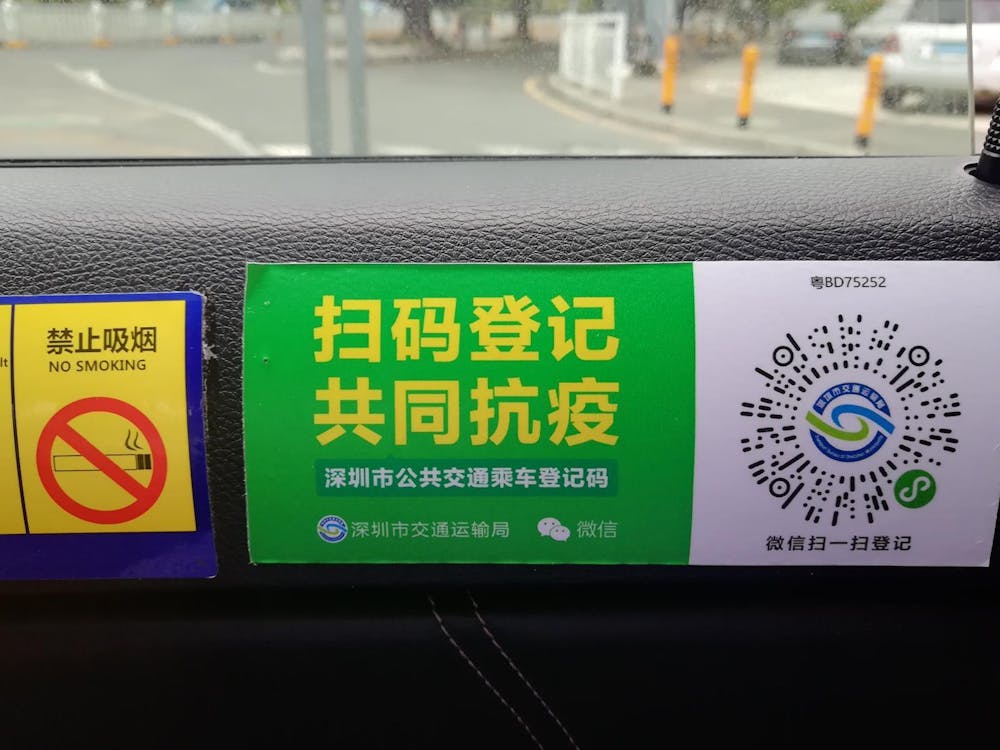 China is using QR codes to help trace sources of viral contact and contraction.
Joe Ma, Author provided (No reuse)
China is using QR codes to help trace sources of viral contact and contraction.
Joe Ma, Author provided (No reuse)
Constant public education reminders are broadcast to passengers.
Read more: The urban history that makes China's coronavirus lockdown possible
Cities across Asia are providing hand sanitiser gel in public transport vehicles and interchanges. Cleaning of air-conditioning filters has been enhanced. To increase natural ventilation and reduce the risk of infection, some operators have retrofitted window vents to air-conditioned fleets.
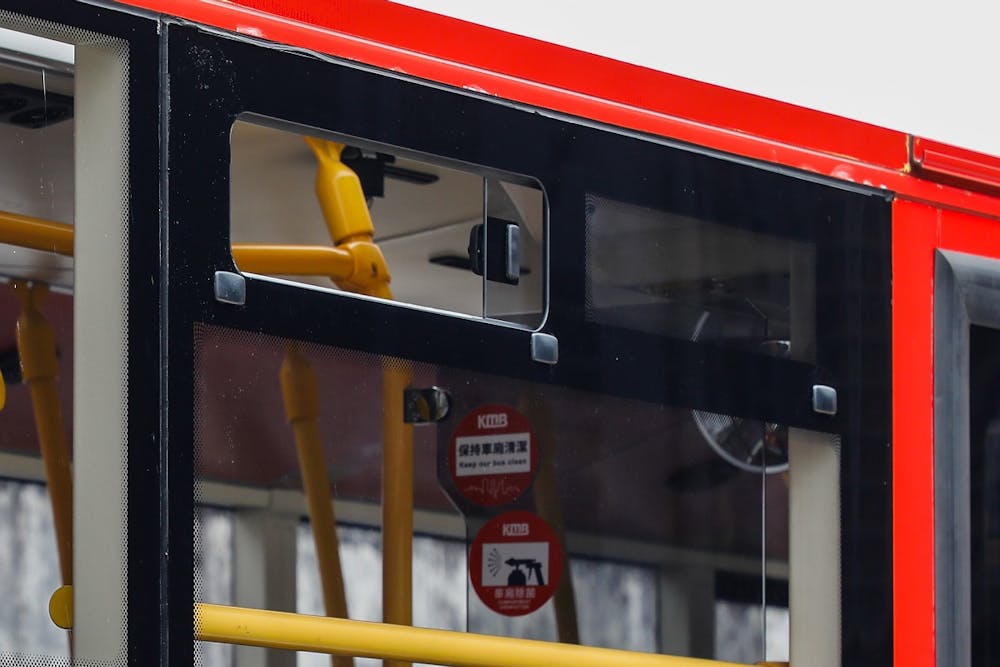 Some bus operators have retrofitted opening windows to help increase air circulation.
Kowloon Motor Bus, Author provided
Some bus operators have retrofitted opening windows to help increase air circulation.
Kowloon Motor Bus, Author provided
Hong Kong rail operator MTR is even using a fleet of cleaning robots to disinfect trains and stations. In Shanghai, ultraviolet light is being used to disinfect buses.
In Europe, many public transport agencies have closed off use of the front door to reduce infection risk for drivers. Passengers now use the rear door (all-door boarding has been common practice).
What’s happening in Australia?
One of the best ways to reduce infection risk is to step up cleaning efforts. Public transport operators are already doing this, but not to the extent required during the course of the day.
Most private bus operators (contracted to government) are simply not equipped to take on the massive task if required to disinfect their vehicles, say, three times a day. For many operators, drivers are required to “sweep” their bus at the end of their shift. Buses undergo a full interior clean overnight.
There is no capability to clean buses en route during shifts. Extreme cases like biohazard incidents (blood and vomit) require vehicles to be taken out of service.
To increase the frequency of cleaning, perhaps a government authority could organise “rapid response” cleaners stationed at terminals. While this might cause delays between trips, it would reduce the pressure on individual operators. Having a cleaning crew work across multiple operators would also be more efficient.
The government could provide free health services via video consultation for frontline transport workers. The critical role of the transport sector also warrants their protection through government-issued face masks, especially given how hard it is now to source these in the community.
These proactive measures based on disease prevention should always be preferred to any reactive approach after a major outbreak hits our transport system. Industry associations like the American Public Transportation Association (APTA) and International Association of Public Transport (UITP) have developed a suite of responses that can be adopted.
Our transport authorities and operators must step up in this critical time of need.
Authors: Yale Zhuxiao Wong, Research Associate, Institute of Transport and Logistics Studies, University of Sydney


 Daily Bulletin


