

High tech specs and adapted World Cup pitch sensors awarded share of £1.5m as finalists in Longitude Prize on Dementia
- Written by: PR Newswire Asia - Daily Bulletin Au RSS
- AI glasses that help people living with dementia navigate their environment and a smartwatch that learns daily routines to assist in everyday tasks are among five groundbreaking technologies announced as finalists in The Longitude Prize on Dementia
- The Longitude Prize on Dementia is a £4.4m prize funded by Alzheimer's Society and Innovate UK and delivered by Challenge Works
- The prize is driving the creation of AI-based assistive technologies that can help people living with dementia maintain their independence for longer
- The five finalists will share £1.5m to develop their solutions in pursuit of the £1m first prize to be awarded in 2026
LONDON, Oct. 8, 2024 /PRNewswire/ -- State of the art AI glasses to help people with dementia navigate their environment and a smartwatch that learns daily routines are among five groundbreaking technologies awarded £300,000 as a finalist in the £4.4m Longitude Prize on Dementia.
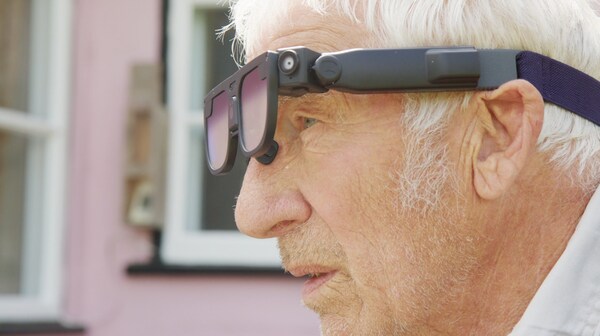 Image of Peter testing CrossSense
It is rewarding the creation of new assistive technologies that use AI to transform how people live with dementia after a diagnosis so that they can maintain their independence for as long as possible.
The global challenge prize is funded by Alzheimer's Society and Innovate UK and delivered by Challenge Works (part of Nesta).
One in three people born in the UK today will develop dementia in their lifetime, with around a million people in the UK living with a form of dementia now. This is projected to rise to 1.4 million people by 2040.
The five finalists, who were announced today in the UK on BBC One's The One Show, will each receive £300,000 to develop their technologies in the next 15 months. The finalists are:
- High-tech glasses that help users recognise objects and people – the technology helps people living with dementia to recognise objects and people and remember what to say or do to improve memory recall. This will help them to carry out daily activities independently, such as making a cup of tea or greeting a loved one. The glasses, which also work with existing prescriptions, aim to delay the progression of memory loss and use synaesthesia – associating senses such as sights and sounds (CrossSense, Animorph, UK).
- Football pitch sensor technology applied to predict and prevent falls – existing 'fall' technology can only inform caregivers once an accident has happened, this groundbreaking update will use the technology that maps how a football moves on a pitch (Ultra Wideband) to establish when falls are likely to happen and ultimately prevent them. This tech, worn in the form of a smartwatch designed for older people, could anticipate slips at certain points in a daily routine (e.g. before bed) or in certain locations (e.g. the bathroom). By detecting and calculating fall risk, the tech could limit risk of hospital admission which can speed dementia symptom progression (Theora 360, Clairvoyant Networks, Inc, USA).
- A smartwatch-based app to provide guidance on daily routines – this AI software processes data from a smartwatch and sensors around the home to learn about its users' activities and gently guide them on their routines, reminding them of actions they may have forgotten through personalised cues such as illustrations (eg an open fridge or running tap), text, audio and vibrations. If they are not responsive, it will alert a carer. The software will become more intensive as a person's dementia progresses, helping them to stay in their own home and community for longer (AUTONOMOUS, Associação Fraunhofer Portugal Research, Portugal).
- At-home monitoring-box that protects privacy – when a loved one is in the early stages of dementia and is still able to live independently, family members can sometimes worry about their wellbeing. This 'sensor' box and automated messaging system scans rooms to help remotely inform family members of the loved one's wellbeing via WhatsApp or text message (e.g. your mum is up and about and the heating came on at the usual time this morning). This provides reassurance for both family member and user, but unlike existing monitoring technology, doesn't use cameras or wearables, connecting caregivers without infringing on privacy (Supersense Technologies, UK).
- Home assistance device resembling a traditional telephone – this familiar-looking device offers a screen for video calls which can also display personalised reminders of daily activities. The phone connects users to a reassuring voice-recording of their choice that shares prompts on daily activities and displays images of items in that person's house. It also makes video-calling loved ones as easy as picking up the phone, to empower people living with dementia to do things they love that bring meaning (MemoryAid, The MARCS Institute, Western Sydney University, Australia).
Dr James Brown, CEO of Supersense Technologies said: "A few years ago, I was volunteering with a charity supporting people who had just received a dementia diagnosis. At almost every house we visited there would be a drawer full of unused gadgets – fall-detection watches or pendants, AI speakers – great tech but clearly not being used by the people it was designed for.
"As an engineer and researcher with a decade of experience in developing sensor technology, I knew that there was far better, unintrusive technology that could help people with dementia or mild cognitive impairment to live safely in their own homes for longer, and to help families know that their loved one is safe and well. Our system is specifically designed to maintain a person's privacy and autonomy, while identifying new behavioural patterns as soon as they develop, so that loved ones or carers can provide support at the right time, all with the aim of helping people to stay independent in their homes for longer."
Kate Lee, CEO of Alzheimer's Society said: "Currently, around one million people in the UK live with dementia, a figure projected to rise to 1.4 million by 2040. AI presents exciting opportunities to help those with dementia stay active and independent, enabling them to remain in their own homes for as long as possible. By harnessing the power of technology, we can support memory recall and assist individuals in maintaining their daily routines. The five finalists of the Longitude Prize on Dementia are tackling these challenges in innovative and diverse ways. I look forward to seeing how their technologies evolve over the next year."
Dr Jennifer Bute was diagnosed with young-onset Alzheimer's disease in 2009 at the age of 63, leading to her retiring early from her career as a GP. She adds: "Research suggests that remaining independent, whether in your own home or a place where extra help is available, is one of the best contributors to slowing the progression of Alzheimer's disease. As a daily user of technology to help manage my finances, medications – even my home lighting – it's really encouraging to see the breadth of new tools and services being developed to support independent living."
Tris Dyson, Managing Director at Challenge Works said: "The Longitude Prize on Dementia was launched to help meet the urgent need for intuitive, AI technologies that could support independent living for people with dementia. Last year we saw some incredible ideas come through the 24 semi-finalist entries and it was a challenge for the judges to select the five finalists announced today. This announcement proves the critical role innovation, and challenge prizes, have to play in helping to solve some of the biggest challenges of our time."
Stella Peace, interim Executive Chair, Innovate UK said: "Dementia's impact is devastating for those who develop the condition and for their loved ones. There is much we can do to ensure that those with dementia continue to live fulfilling lives. Technology has a great role to play and the projects for which we have announced funding today have the potential to truly change lives for the better."
In addition to the financial reward, non-financial support has been funded to provide innovators with crucial insight and expertise until the end of 2025. The support includes access to potential product users, mentorship, and expert advice on technical and business aspects of the innovation to ensure products are scalable. It will also facilitate knowledge sharing between participants. All teams will be working with people with lived experience to ensure solutions are fully co-created.
In early 2026, one winner will receive a prize pot of £1 million, following a judging process with the international Judging Panel and Lived Experience Advisory Panel. For more information on the finalists and prize, please visit dementia.longitudeprize.org.
Authors: PR Newswire Asia - Daily Bulletin Au RSS

Read more https://www.prnasia.com/story/archive/4524508_AE24508_0


 Daily Bulletin


