Education in Conflict Zones: Advancing Technology for Learning in Chad
The initiative's aim is to improve and ensure continuity of children's learning for displaced children in conflict affected regions through engaging technology.
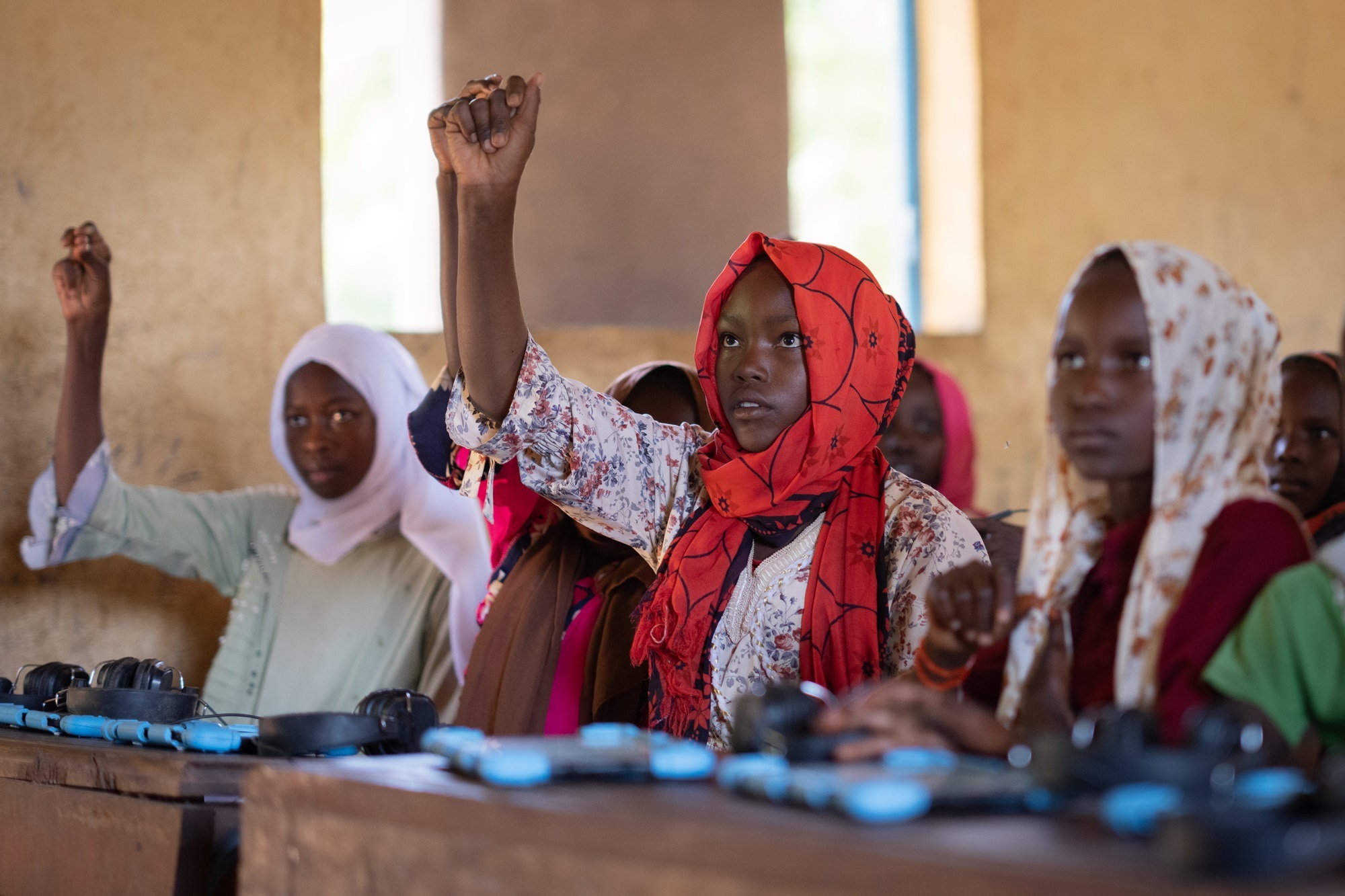
14-year-old student Sumaya Abdel Rahman Mahmoud Mohamad, centre, raises her hand during a lesson, part of an EdTech program developed by War Child named ‘Can’t Wait to Learn’, at a school in Djabel Refugee Camp, Eastern Chad. (Michael Knief/Global Partnership for Education)
The challenge
Despite its own social and economic challenges, which include poverty, malnutrition and food insecurity, the government of Chad provides shelter and asylum to 1.3 million displaced persons including 1,025,640 refugees from Sudan, Central African Republic, Cameroon and Nigeria.
The UN predicts that due to the conflict that erupted in Sudan on April 15, 2023, there will be an influx of 600,000 new Sudanese refugees in Chad by the end of 2023.
This burgeoning refugee crisis compounds the strain on Chad's already underfunded education system.
Children make up 54% of the displaced population in Chad, putting significant pressure on the country's education system. With limited funding in the education sector, overcrowded classrooms and a shortage of qualified teachers, hundreds of thousands of children including refugees have limited access to education.
"When you have a large population of refugees, with around 750,000 kids knocking on your country's doors, [you can] understand the concern that is shared today." – Saeed Farah, Secretary General of the Chadian Ministry of Education and Civic Promotion
To tackle these challenges, War Child, funded by GPE KIX (a collaborative initiative between GPE and Canada's International Development Research Centre) researched the scaling of technology for education in Chad, Sudan and Uganda.
The GPE KIX initiative aims to explore how technology programs like Can't Wait to Learn can be scaled, with the overall goal of enhancing the quality of education for refugee and displaced children.
Can't Wait to Learn
In 2019, War Child launched Can't Wait to Learn in Chad, and introduced an engaging educational platform delivered via tablets and mobile devices. This technology follows the national curriculum and is tailored to cover grades 1-3 (students age 5-14).
It offers refugee and internally displaced children the chance to continue their learning journey, advancing at their own pace at school and at home, while earning credits within the host education system that enable a smoother transition into formal schooling.
"The Can't Wait to Learn program was designed to help children in conflict situations. This program is designed first by the children themselves, drawing on their everyday lives." – Emmanuel Uwamungu, Project Lead, Can't Wait to Learn, Jesuit Refugee Service
What distinguishes the program is the involvement of local learners in its creation: War Child conducted workshops in local communities where they facilitated artistic sessions for children to share their stories and ideas with local artists. These narratives and designs were then woven into the Can't Wait to Learn program, enriching it with the children's perspectives and creativity.
The program plays a vital role in strengthening fundamental mathematical and literacy competencies and knowledge and as learners master new skills and concepts in numeracy and literacy, they unlock more challenging levels. The success is in large part because recognizing their own community and context in the learning content is very meaningful and motivating to children.
Chad's Refugee Education Strategy for 2018-2019 highlighted the Can't Wait to Learn program as a notable achievement within the education sector.
"You can see the impact this program has on the students ... They never miss a class, especially on the day of the device-based learning program."Nour Haroun Babakar, Parent
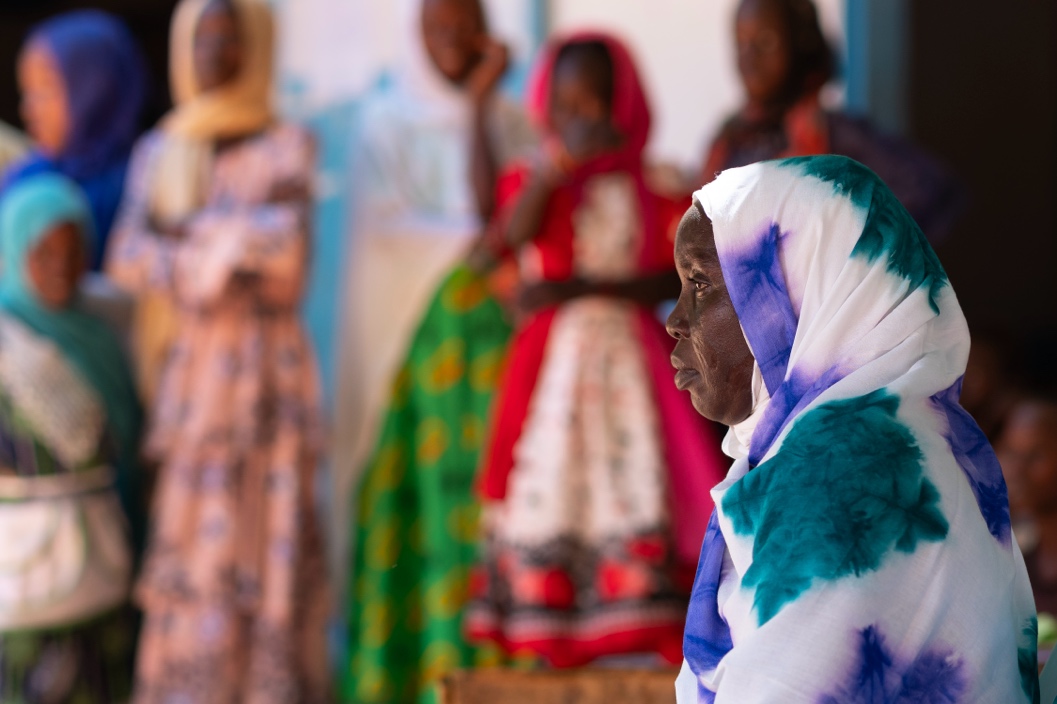
In 2003, Nour fled Sudan due to an attack on the region she lived in. Currently residing in Djabel camp in Chad with her husband and children, she has observed a positive change since the introduction of Can’t Wait to Learn. Her son, who aspires to be an accountant or pilot, has a newfound enthusiasm for learning, eagerly racing to be the first in class every day. Nour has seen a significant shift: not only are children learning more, but they're also noticeably happier and more engaged outside of lessons. (Michael Knief/Global Partnership for Education)
The research
GPE KIX supported research aims to explore, extend and integrate the roles of multiple stakeholders – including caregivers, the community, teachers and educators, academic institutions, implementing organizations and policy makers – to deliver sustainable education and the provision of education technology programming informed by evidence.
In Chad, the research produced analyses and tools to support the adoption of Can't Wait to Learn by partners and guide its sustained impact at scale. It combined interviews with key members of the government and private companies, organizational document analysis, and social network analysis among technology actors.
Using the International Competency Assessment of Numeracy, War Child and GPE KIX also analyzed the learning of over 800 students in 20 schools across three refugee camps in Chad: Djabal, Gos Amir and Goz Beida. In 11 of the schools, Can't Wait to Learn accounted for more than half of the numeracy lessons each week. In the remaining 9 schools, education continued as before.
The results
Results suggest that between November 2021 and March 2022, children participating in the Can't Wait to Learn program showed noticeably better learning than those in the comparison group.
Children using Can't Wait to Learn learned 50% more than children who didn't use the program.
Girls learned four times more than boys.
Girls started with lower numeracy skills compared to boys but caught up in just 4 to 4.5 months.
These results are significant in the face of Chad's learning poverty rate (being unable to read and understand a simple text by age 10) which stands at 98% for children completing primary school. The findings suggest that with the right support, technology initiatives such as Can't Wait to Learn can help bridge the gender gap in educational achievement and improve learning for refugee children in Chad.
In terms of the broader research Jasmine Turner, from War Child, highlighted a crucial insight regarding scaling strategies, emphasizing that a "one size fits all" approach doesn't apply universally. In some contexts, governments are readily embracing technology programs, whereas in others, NGOs and private companies are better equipped to facilitate scaling up efforts. Chad's Ministry of Education has endorsed War Child's research and appealed to NGOs to support the scaling up of Can't Wait to Learn in the country.
Hashtag: #CantWaittoLearn
The issuer is solely responsible for the content of this announcement.
For a long time, you might have defaulted to overseas suppliers when sourcing fabricated metal components for a project. The unit price was lower on paper, and the maths seemed straightforward. That...
Tariff escalations, supply chain fragility, geopolitical events, and the ongoing threat of cyber disruption have reshaped the risk environment facing Australian organisations. The problem is that ma...
Starting out as an Uber driver in Melbourne is not as complicated as it sounds but getting the vehicle right is where most new drivers get stuck. Uber has strict requirements around vehicle age, condi...
Legal issues can begin with a simple question, then become harder to manage once formal steps are involved. Many people wait until a matter feels urgent before seeking guidance, even though earlier ...
As Australian healthcare providers grapple with unprecedented operational bottlenecks, a new nearshore model is quietly transforming patient care delivery. Forward-thinking organisations, including...
In today’s competitive logistics and supply chain industry, businesses are constantly looking for ways to reduce operational costs without compromising efficiency and reliability. One of the most prac...
The growth of e-commerce and modern retail has transformed customer expectations. Consumers now expect fast shipping, accurate order processing, and seamless delivery experiences regardless of where...
Reducing business costs doesn’t always mean cutting staff, shrinking services or making the workplace feel bare-bones. In many cases, the smarter savings are hiding in everyday operations: the light...
Leadership has a direct impact on organisational performance, employee engagement, strategic growth, and long-term success. Businesses operating in increasingly competitive environments require experi...




 Daily Bulletin


