

Rugby league may finally have reached its tipping point on player behaviour and violence
- Written by: Jessica Richards, Lecturer Sport Business Management, Western Sydney University
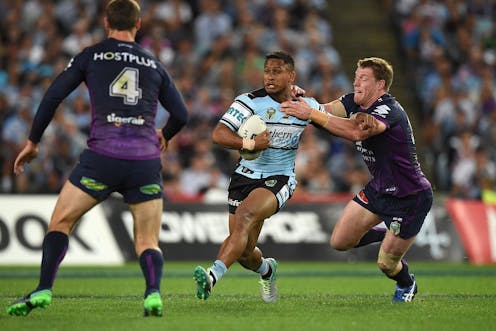
St George Illawarra and NSW State of Origin player Jack de Belin has become the first player to be banned under a new “no fault stand down” policy introduced by the National Rugby League (NRL).
This policy allows the NRL to stand down players facing criminal charges that carry a jail term of 11 years or more, pending the outcome. Players will remain on full pay and will be allowed to continue to train with their teams until the matter is resolved.
In December 2018, the NRL was urged to take “urgent action” after a spate of allegations of domestic violence and assault by players. The sport’s governing body was accused of failing to adequately condemn these acts of violence against women.
Could it be that finally rugby league is listening to the criticism?
Just a few weeks ago, Ben Barba was sacked by his NRL club following allegations he physically assaulted his partner and mother of his four children. After a history of off-field incidents, he was deregistered by the NRL. Despite one former player speaking out in support of Barba, he has been widely condemned by the NRL community.
Violence on the field too often translates to violence off the field. Barba’s sacking should herald a culture shift in the NRL away from versions of masculinity that are exclusive and threatening to women. The sport must move towards a culture that is better aligned with the values of society.
Rugby League – a bastion of masculinity
For many years, rugby league has provided an outlet for violence that allows masculinity to be performed.
Throughout the 1980s and into the 1990s, league epitomised orthodox masculine characteristics such as aggressive competition and toughness. Fighting, confrontation and belligerence has been revered in media coverage and by the wider public. For example, The Footy Show valorised versions of masculinity that portrayed men as hyper-heterosexual, stoic and aggressive. The hosts repeatedly demonstrated disrespect for women.
But in recent years, social customs, gender relations and the expectations of even hyper-masculine warrior athletes began to change. The Footy Show has been cancelled; and evidence from America’s most similar sport, American football (NFL), suggests that since 2006, there has been a slight decrease in players arrested for domestic violence.
Barba’s sacking appears to provide evidence of an emerging social contract with masculinity. No longer is men’s violence acceptable to the public. Rugby League — finally now — is taking action.
While player welfare is important, so is the welfare of women. The “boys will be boys” excuse no longer stands. NRL endorsed campaigns, such as Power For Change, an initiative described as “empowering young people to be leaders of change against domestic violence”, appeared hypocritical in the face of five sexual assault charges in the most recent off-season. On the sixth, the NRL took action.
It appeared the Australian sporting community had had enough. NRL fans, particularly, were fed up with misbehaving players and seeking significant change. Sanctioning players with bans and fines has proven ineffective.
In addition to introducing their “no fault stand down policy”, NRL chief executive Todd Greenberg has called on other codes to honour the NRL-imposed ban. The Northern Hemisphere Super League has closed the door on Barba and Rugby Australia boss, Raelene Castle, said they would also respect the NRL’s wishes.
Inclusive masculinities
The NRL is today at a crossroads.
There has been a highly visible, and extensively documented phenomenon that millennial men reject orthodox notions of masculinity. They instead value intimacy among friends, tactility, respect for women, and disregard for violence. Much of the reason for this is considered to be related to changing mores surrounding male homosexuality. When this changes, so does everything about masculinity.
The sociological work on this suggests that when heterosexual men exist in a culture that maintains high antipathy toward gay men (as existed in the 1980s), they will try to distance themselves from anything associated with gay men. Thus, men revere violence and stoicism, and hyper-sexualise women. They are thought weak for showing emotions concerning care for other men, or fear of confrontation.
However, as cultural attitudes have shifted, making homophobia and not homosexuality stigmatised, heterosexual men have more social freedom to express gender in ways that were once taboo. So it becomes permissible to talk your way through a problem with another male instead of fighting.
Scholars call this inclusive masculinity, but more colloquially it might be understood as a highly revered, feminised masculinity. In the last few decades, we have seen wholesale shifts to adolescent masculinities, something epitomised by the burgeoning of the “bromance”.
Read more: The bromance is blossoming, says study
The NRL has divided fans with its recent rule change. Although the rule change sends a strong message to players and clubs that violence will not be tolerated within the code, until the wider culture of Rugby League begins embracing alternative forms of masculinity, the cause of the problem will still remain.
Authors: Jessica Richards, Lecturer Sport Business Management, Western Sydney University


 Daily Bulletin


