

How to Get a Document Notarised in Sydney: What to Bring, What It Costs and How Long It Takes
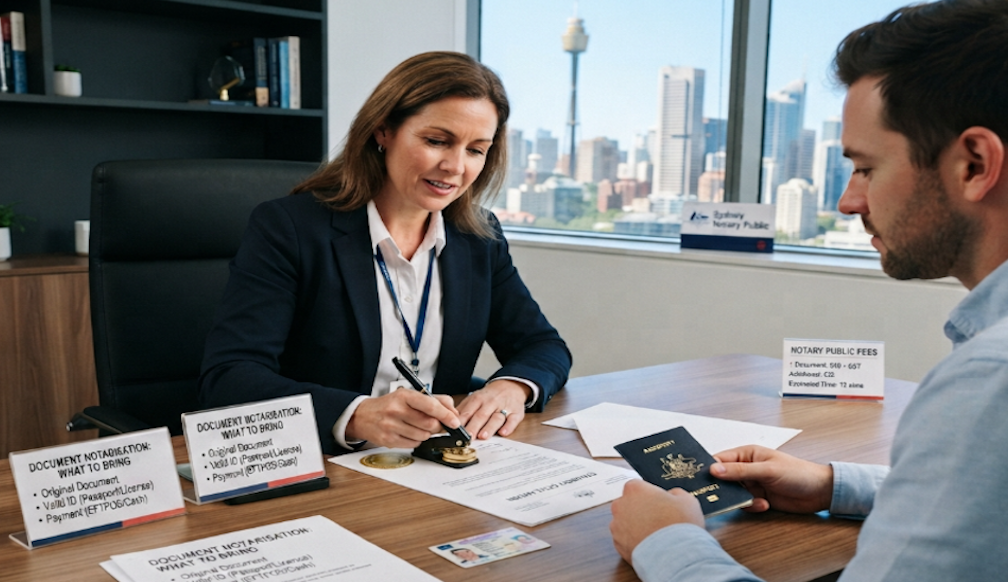
If an overseas bank, embassy, university, employer or land registry has asked you for a notarised document, you are probably working to somebody else's deadline and looking for a straight answer about what happens next.
This is that answer, in order, with the costs and the realistic timing included.
Step 1: Get the Requirement in Writing
Before booking anything, ask the organisation that made the request to put its requirement in writing, ideally as a screenshot or a forwarded email.
The reason is that four different words get used interchangeably by people who should know the difference. Certified usually means a copy verified against an original. Notarised means an act performed by a notary public under seal. Apostilled means a certificate issued by the Australian government under the Hague Convention. Legalised means a stamp applied by a foreign embassy or consulate.
Acting on a verbal instruction, or on somebody's best guess, is the most common way people end up doing this twice.
Step 2: Work Out Whether You Need a JP or a Notary
This distinction decides everything, and getting it wrong wastes weeks.
A Justice of the Peace handles documents that stay in Australia. The service is free and JPs are easy to find at libraries, courthouses and shopping centres. There is no international register of Australian JPs and no seal that a foreign authority can verify, so documents heading overseas with a JP signature are commonly rejected on arrival.
A notary public is appointed for exactly the opposite purpose. In New South Wales, notaries are appointed by the Supreme Court under the Public Notaries Act 2016 (NSW). The appointment requires an experienced Australian legal practitioner who has completed a prescribed notarial practice course. Every notary keeps a register of the acts they perform and signs under a personal seal that overseas authorities are able to trace and confirm.
Note that a solicitor is not automatically a notary. The appointments are separate and relatively few Australian lawyers hold both.
The test is simple: if the document leaves the country, you need a notary.
Step 3: Find Out Whether You Also Need DFAT
Notarisation is frequently only the first stage. Many overseas authorities also want the Australian government to confirm that the notary is genuine, which is handled by the Department of Foreign Affairs and Trade.
Which certificate applies depends entirely on the destination country. Countries inside the Hague Apostille Convention receive an apostille, and that closes the matter with no consulate involved. Australia has been a member since 1995 and the Convention now covers more than 120 countries, including China, which joined in November 2023.
Countries outside the Convention receive an authentication certificate from DFAT, after which the document must go to that country's embassy or consulate in Australia to be legalised. That is two queues instead of one.
The order is fixed and cannot be shortcut: notary, then DFAT, then embassy if required. A document that arrives at DFAT without valid notarisation is sent back unprocessed.
Step 4: Book, and Bring the Right Things
Once you know what you need, book the appointment and bring:
- The original documents, not scans or photocopies. A copy cannot be certified as a true copy unless the original is physically produced.
- Current photo identification, such as a passport or driver's licence. Identity has to be verified before any act can be performed.
- The written requirement from Step 1, so the notary can confirm the right act is being carried out.
- Any translation, if the destination requires one. Ask in advance whether the translation itself must also be notarised, because that affects both cost and time.
One thing not to do: do not sign the document beforehand. Affidavits, statutory declarations, deeds and powers of attorney have to be signed in the notary's presence. A pre-signed document generally has to be executed again.
Step 5: What It Costs
Notarial fees in New South Wales are commonly quoted against the Society of Notaries NSW guide rates. Published GST-inclusive guide rates currently include:
- Affidavit or declaration: $220
- Statement that two names or IDs refer to the same person: $220
- Certified copy, up to five pages: $275
- Witnessing a signature on a deed: $176
- Power of attorney: $302.50
- Corporate document, such as a company resolution: $440
- Certificate of good standing with ASIC attachments: $550
- Australian academic document: $302.50
Authentication is charged separately because it involves third-party fees. A DFAT apostille submission runs at $105 per document plus $220 for the notary to prepare and lodge the application. Embassy or consular legalisation is $715, with the consulate's own fees charged on top.
Some providers discount for online submission and payment. Discounts of this kind typically apply only to the notarial guide fees and not to disbursements such as DFAT, embassy, ASIC, postage or courier charges, so read the conditions before assuming a headline figure applies to your whole job.
Step 6: How Long to Allow
Two separate clocks run on this, and confusing them is what produces the panic.
The notarial appointment is a same-day job. Witnessing a signature, certifying a copy, administering an oath on an affidavit or executing a power of attorney takes roughly fifteen to thirty minutes, and the document is released the same day on payment. Corporate and academic documents can need an extra business day or two where records must be verified or a certificate obtained first.
The government stages take weeks. An apostille or authentication lodged through a notary generally takes five to ten business days. Going to DFAT yourself is often slower rather than faster, because appointment availability in Sydney frequently sits five to six weeks out, and lodging through a notary is how most people avoid that queue. Consular legalisation can only happen after DFAT and commonly adds another two to four weeks, longer around holiday periods.
If a settlement, visa lodgement, shipment or enrolment depends on this, count backwards from that date now. Nobody in the private sector controls the DFAT or embassy queue, and a provider promising a same-day apostille is promising something that was never theirs to give.
The Four Mistakes That Cost the Most Time
- Using a JP for a document going overseas.
- Signing the document before the appointment.
- Bringing a photocopy instead of the original.
- Finding out about the DFAT or embassy step only after the notarisation is done, rather than planning for it from the start.
Where to Start
You can compare the individual services, see fixed guide pricing including the DFAT and embassy add-ons, upload your documents and book a notary appointment in Sydney online, then track the job through to completion. The notarial work is performed by Alton Legal, a Sydney law firm with a registered public notary, currently acting for clients in New South Wales who can attend its Sydney office. Appointments are usually available within the same week, and the practice operates in English and Mandarin.
If you are still unsure what your particular document needs, the site has an AI assistant that works through the preliminary questions with you before you pay for anything, built and supported by lawplexity.ai, an Australian legal AI company.
General information only and not legal advice. Fees quoted are guide rates current at the time of writing and are subject to change. Requirements vary by document and destination country.


 Daily Bulletin


