

Sussan Ley talks about ‘Australian values’ in assessing migrants. What exactly does that mean?
- Written by: Kate Darian-Smith, Professorial Fellow in History, School of Historical and Philosophical Studies, The University of Melbourne
Recent calls by Opposition Leader Sussan Ley to cut Australia’s intake of migrants have been accompanied by a promised revision — if the coalition is elected — of not only the immigration system, but the “integrity” of Australia’s citizenship test and its “character test”.
Ley’s comments came in the wake of the case of civil engineer Matthew Gruter, a South African national who moved to Australia in 2022 on a work-sponsored visa.
Gruter’s visa was cancelled, and he is interned in Villawood Detention Centre with one month to leave Australia or be deported following his participation in a neo-Nazi rally in Sydney.
The rising threat of right-wing extremism has meant both the government and the opposition have doubled down on their support for core national values of tolerance and respect.
But when politicians talk about “Australian values”, what exactly do they mean?
Immigration and Citizenship Minister Tony Burke has stated “modern” Australia is equated with a “multicultural” society. Yet there has not always been such agreement across the political spectrum about what constitutes Australian identity and character. And the much-lauded value of egalitarianism has long been, and remains, deeply problematic.
Citizenship and Australian values
A multiple-choice citizenship test was first introduced under the Howard government in October 2007. It aimed to ensure applicants understood Australian society and culture, and their own rights and responsibilities.
Opinion polling at the time was generally positive, with the Labor opposition ultimately supporting the legislation. Yet there was considerable criticism of the test, notably whether it sanctioned a version of Australia’s history and identity that was outdated, conservative and irrelevant to contemporary experiences. After the Labor Rudd government came to power, the logistics of the test were amended to provide greater accessibility to migrants on refugee and humanitarian visas.
In 2020, the Morrison government revamped the citizen test much more substantially. This now included a new mandatory section on Australian values. To pass the test, all the “values” questions have to be answered correctly, with score of 75% achieved overall and completed within 45 minutes.
Subscribing to Australian values is not restricted to migrants seeking citizenship. Most visa applicants must sign up to the Australian Values Statement, confirming they acknowledge the key tenets that underpin Australian society and culture. Those seeking a permanent visa must also confirm they will “make reasonable efforts” to learn English if it is not their first language, and acknowledge that citizenship requires a pledge of loyalty to Australia and its people.
The history of ‘Australian values’
Since British colonisation of Australia, there has been discussion and debate about the distinctive culture and characteristics of the white settler population. These initially came from visiting observers to the colonies. More recently, there has been ongoing commentary on Australian identity, beliefs and social and political divisions from journalists, politicians, academics — especially historians – and others.
Australia’s colonial histories and the continent’s unique environments have influenced conversations about a national “type” and collective values. The convict system, the gold rushes, the colonial appropriation and exploitation of the land and its natural resources, and the waves of “free” settlers were seen as contributing to a society defined by a democratic spirit and an egalitarian ethos.
This was seen most sharply in the white male workforce of the bush. The rise of the union movement in the late 19th century underscored an emerging radical nationalism. In this “paradise for workers”, it was popularly claimed that the high standard of living meant all could afford to “eat meat three times a day”.
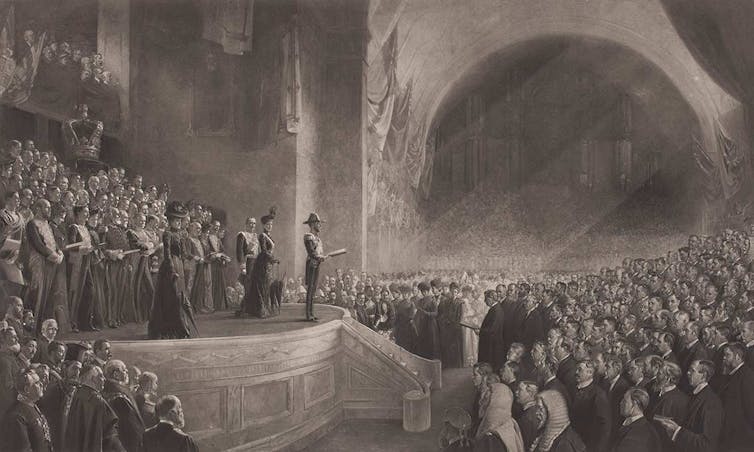
At federation in 1901, there was dawning recognition that while the new nation was founded on British institutions and culture, the experiences and outlook of its white peoples were different from the old, class-riven world of Britain.
The first world war and the power of the “Anzac legend”, spawned at Gallipoli, cemented Australia’s coming of age. The heroic, and broadly universal, qualities attributed to Australian soldiers brought the masculinist mateship of the bush to the battlefield. This was in turn cast as exemplifying national values.
In the aftermath of the second world war, popular ideas around “Australianness” became increasingly conservative and complacent. National characteristics were less concerned with progressive social changes than with maintaining the status quo.
From the late 1940s, mass migration from countries other than Britain deeply challenged the notion of a homogenous Australian settler population. Waves of migrants from Europe, the Middle East and, by the 1970s, South-East Asia were creating a more culturally and linguistically diverse society.
Migrants at the time were expected to speak English and follow an “Australian way of life”. The best-selling 1957 satirical novel, and later film, They’re a Weird Mob, by John O’Grady under the pseudonym Nino Culotta, shows the bewilderment new arrivals faced in understanding Australian society and its values.
Exclusion and inclusion
Egalitarianism or equality of opportunity was, and continues, to be seen as a core Australian value. The Life in Australia booklet glosses over how Australia’s legal and social systems have been historically discriminatory on the grounds of race and ethnicity. While Indigenous Australians are acknowledged as Australia’s “first inhabitants”, there is no suggestion that British colonisation resulted in frontier violence, failed to recognise Indigenous ownership of traditional lands under the doctrine of terra nullius, and long denied the human rights of First Nations peoples.
The booklet explains the meaning of the anachronistic term “fair go”, stating that in Australia everyone “is given an equal opportunity to achieve success”.
Yet the exclusion of non-white migrants was also enforced by colonial and later Commonwealth legislation. The 1948 Nationality and Citizenship Act was the first legislation that provided for Australian citizenship, including Aboriginal and Torres Strait Islander people. However, it did not grant them voting rights.
Successive amendments to the act introduced residency requirements for migrants, removed preferential treatment for those from Britain. In 1984, a further amendment repealed the laws that meant all Australians were British subjects.
It was, however, the dismantling of the racially restrictive White Australia Policy in 1973 and the embrace of multiculturalism that was to have a major impact on Australia’s identity as a multicultural nation.
The Life in Australia information also explains that Australians value “mateship”, now somewhat oddly linked to “a strong tradition of community service and volunteering” rather than to a historically masculinist culture. There are strong statements about the equality of men and women, and their right to make decisions about personal matters free from intimidation and violence.
The official preparation for new arrivals to live in Australia and understand its society and culture is limited. It is also simplistic and selective in its explanation of core values. In this context, what are new migrants to make of the growing inequities in Australia in terms of wealth distribution, or the recent data on the significant gender pay gap, or the troubling statistics on gender-based violence? How are they to understand national conversations about Indigenous and non-Indigenous reconciliation, truth-telling and Treaty? How can the decline in Australians’ belief in democratic processes be explained and addressed?
Ley’s intention to explore how migrants will be made aware of Australian national values would benefit from explaining these historical issues. A meaningful investment in civics education is certainly one dimension in fostering a greater understanding of contemporary Australia. This applies not only to new migrants but across the population more widely.
It would also be a good time to hold a national conversation about the relevant values that underpin the society that we want to live in now and leave as a legacy for subsequent generations.
Authors: Kate Darian-Smith, Professorial Fellow in History, School of Historical and Philosophical Studies, The University of Melbourne


 Daily Bulletin


