

Who will the next pope be? Here are some top contenders
- Written by: Darius von Guttner Sporzynski, Historian, Australian Catholic University
The death of Pope Francis this week marks the end of a historic papacy and the beginning of a significant transition for the Catholic Church. As the faithful around the world mourn his passing, attention now turns to the next phase: the election of a new pope.
This election will take place through a process known as the conclave. Typically held two to three weeks after a pope’s funeral, the conclave gathers the College of Cardinals in the Vatican’s Sistine Chapel. Here, through prayer, reflection and secret ballots, they must reach a two-thirds majority to choose the next Bishop of Rome.
While, in theory, any baptised Catholic man can be elected, for the past seven centuries the role has gone to a cardinal. That said, the outcome can still be unpredictable – sometimes even surprising the electors themselves.
Read more: How will a new pope be chosen? An expert explains the conclave
An unlikely candidate
Cardinal Jorge Mario Bergoglio – who became Pope Francis – wasn’t among the front-runners in 2013. Nonetheless, after five rounds of voting, he emerged as the top candidate. Something similar could happen again.
This conclave will take place during a time of tension and change within the church. Francis sought to decentralise Vatican authority, emphasised caring for the poor and the planet, and tried to open dialogue on sensitive issues such as LGBTQIA+ inclusion and clerical abuse. The cardinals must now decide whether to continue in this direction, or steer towards a more traditional course.
There is historical precedent to consider. For centuries, Italians dominated the papacy. Of the 266 popes, 217 have been Italian.
However, this pattern has shifted in recent decades: Francis was from Argentina, John Paul II (1978–2005) from Poland, and Benedict XVI (2005–2013) from Germany.
The top papabili
As with any election, observers are speaking of their “favourites”. The term papabile, which in Italian means “pope-able”, or “capable of becoming pope”, is used to describe cardinals who are seen as serious contenders.
Among the leading papabili is Cardinal Pietro Parolin, aged 70, the current Secretary of State of Vatican City. Parolin has long been one of Francis’ closest collaborators and has led efforts to open dialogue with difficult regimes, including the Chinese Communist Party.

Parolin is seen as a centrist figure who could appeal to both reform-minded and more conservative cardinals. Yet some observers argue he lacks the charismatic and pastoral presence that helped define Francis’ papacy.
Another name to watch is Cardinal Pierbattista Pizzaballa, the Latin Patriarch of Jerusalem. At 60, he is younger than many of his colleagues, but brings extensive experience in interfaith dialogue in the Middle East. His fluency in Hebrew and his long service in the Holy Land could prove appealing.
Then again, his relative youth may cause hesitation among those concerned about electing a pope who could serve for decades. As the papacy of John Paul II demonstrated, such long reigns can have a profound impact on the church.

Cardinal Luis Antonio Tagle of the Philippines is also frequently mentioned. Now 67, Tagle is known for his deep commitment to social justice and the poor. He has spoken out against human rights abuses in his home country and has often echoed Francis’ pastoral tone. But some cardinals may worry that his outspoken political views could complicate the church’s diplomatic efforts.
Cardinal Peter Turkson of Ghana, now 76, was a prominent figure during the last conclave. A strong voice on environmental and economic justice, he has served under both Benedict XVI and Francis.
Turkson has largely upheld the church’s traditional teachings on matters such as male-only priesthood, marriage between a man and a woman, and sexuality. He is also a strong advocate for transparency, and has spoken out against corruption and in defence of human rights.
 Cardinals Luis Antonio Tagle (left) of the Philippines and Peter Kodwo Appiah Turkson of Nigeria attend a Mass inside St. Peter’s Basilica for the election of the new pope in 2013.
Andrew Medichini/AP
Cardinals Luis Antonio Tagle (left) of the Philippines and Peter Kodwo Appiah Turkson of Nigeria attend a Mass inside St. Peter’s Basilica for the election of the new pope in 2013.
Andrew Medichini/AP
Though less widely known among the public, Cardinal Mykola Bychok of Melbourne may also be considered. His election would be as surprising (and perhaps as symbolically powerful) as that of John Paul II in 1978. A Ukrainian-Australian pope, chosen during the ongoing war in Ukraine, would send a strong message about the church’s concern for suffering peoples and global peace.
 Parish Andriy Mykytyuk (left) and Cardinal Mykola Bychok bless worshippers during a Ukrainian Catholic Easter celebration in Melbourne, April 2023.
Diego Fedele/AAP
Parish Andriy Mykytyuk (left) and Cardinal Mykola Bychok bless worshippers during a Ukrainian Catholic Easter celebration in Melbourne, April 2023.
Diego Fedele/AAP
Other names that may come up are Cardinal Fridolin Ambongo Besungu from the Democratic Republic of the Congo, and Cardinal Jaime Spengler of Brazil – both of whom lead large and growing Catholic communities. Although news reports don’t always list them among the top contenders, their influence within their regions – and the need to recognise the church’s global demographic shifts – means their voices will matter.
On the more conservative side is American Cardinal Raymond Burke, who had been one of Francis’ most vocal critics. But his confrontational stance makes him an unlikely candidate.
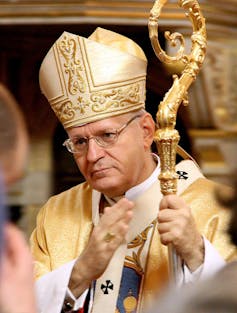
More plausible would be Cardinal Péter Erdő of Hungary, aged 71. Erdő is a respected canon lawyer with a more traditional theological orientation. He was mentioned in 2013 and may reemerge as a promising candidate among conservative cardinals.
 Cardinal Péter Erdő was ordained as a priest in 1975 and has a doctorate in theology. He will be a top pick among conservatives.
Wikimedia, CC BY-SA
Cardinal Péter Erdő was ordained as a priest in 1975 and has a doctorate in theology. He will be a top pick among conservatives.
Wikimedia, CC BY-SA
One tough act to follow
Although Francis appointed many of the cardinals who will vote in the conclave, that doesn’t mean all of them supported his agenda. Many come from communities with traditional values, and may be drawn to a candidate who emphasises older church teachings.
The conclave will also reflect broader questions of geography. The church’s growth has shifted away from Europe, to Asia, Africa and Latin America. A pope from one of these regions could symbolise this change, and speak more directly to the challenges faced by Catholic communities in the Global South.
Ultimately, predicting a conclave is impossible. Dynamics often change once the cardinals enter the Sistine Chapel and begin voting. Alliances shift, new names emerge, and consensus may form around someone who was barely discussed beforehand.
What is certain is that the next pope will shape the church’s future: doctrinally, diplomatically and pastorally. Whether he chooses to build on Francis’ legacy of reform, or move in a new direction, he will need to balance ancient traditions with the urgent realities of the modern world.
Authors: Darius von Guttner Sporzynski, Historian, Australian Catholic University
Read more https://theconversation.com/who-will-the-next-pope-be-here-are-some-top-contenders-255006


 Daily Bulletin


