

Social media ads are littered with ‘green’ claims. How are we supposed to know they're true?
- Written by: Christine Parker, Professor of Law, The University of Melbourne

Online platforms are awash with ads for so-called “green” products. Power companies are “carbon neutral”. Electronics are “for the planet”. Clothing is “circular” and travel is “sustainable”. Or are they?
Our study of more than 8,000 ads served more than 20,000 times in people’s Facebook feeds found many green claims are vague, meaningless or unsubstantiated and consumers are potentially being deceived.
This costs consumers, as products claiming to be greener are often more expensive. And it costs the planet, as false and exaggerated green claims – or “greenwashing” – make it seem more is being done to tackle climate change and other environmental crises than is really happening.
The widespread use of these claims could delay important action on tackling climate change, as it dilutes the sense of urgency around the issue.
The colours of environmental friendliness
Our research is part of a newly published report produced by the not-for-profit Consumer Policy Research Centre, researchers at Melbourne Law School and the Australian Ad Observatory, a project of ADM+S (ARC Centre of Excellence for Automated Decision-Making and Society).
The Ad Observatory captures ads from the personal Facebook feeds of around 2,000 people who “donate” their ads to the project via a browser plugin. This lets us analyse otherwise unobservable and ephemeral ads.
We found the most common claims were “clean”, “green” and “sustainable”. Other popular terms were “bio”, “recycled” or “recyclable”, “pure” and “eco-friendly”, often with no explanation of what lay behind them. All are very general, undefined terms, yet they imply a more environmentally responsible choice.
Our report didn’t verify each claim nor analysed their accuracy. We intended to highlight the volume and breadth of the green claims consumers see in social media ads.
Many ads used colours and symbols to put a green “halo” around their products and business. These included green, blue and earthy beige tones, background nature imagery and emojis featuring leaves, planet Earth, the recycling symbol and the green tick, often with no context or specific information.
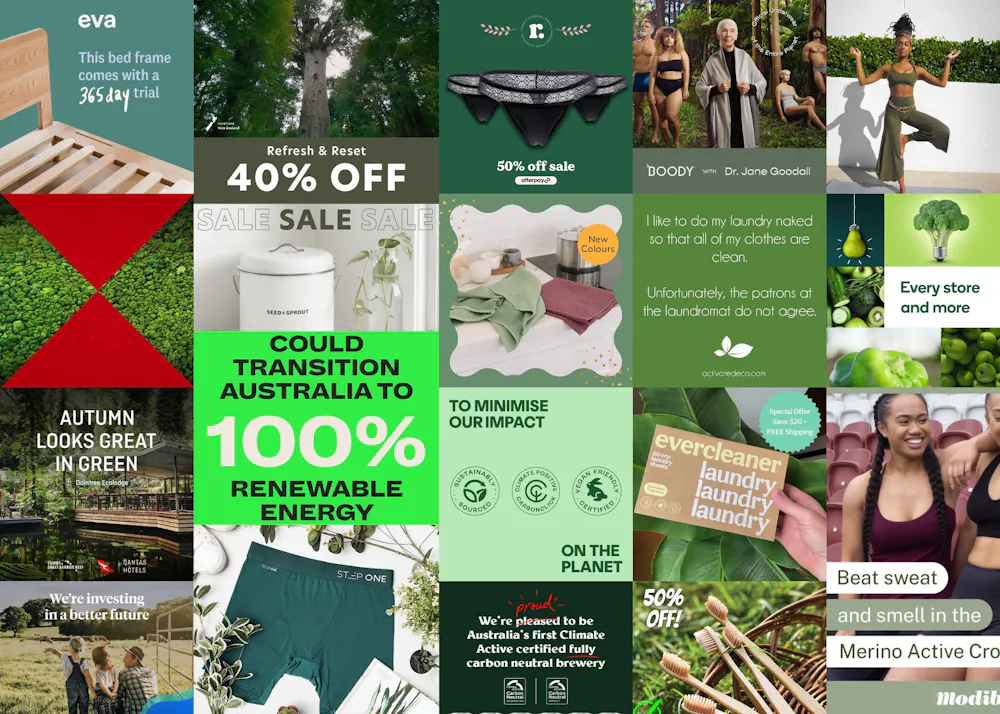
The top five sectors making green claims were energy, household products, fashion, health and personal care, and travel.
This was consistent with a recent internet sweep by the Australian Competition and Consumer Commission (ACCC), which found 57% of the business websites checked were making concerning claims. The proportion was highest among the cosmetic, clothing and footwear, and food and drink packaging sectors.
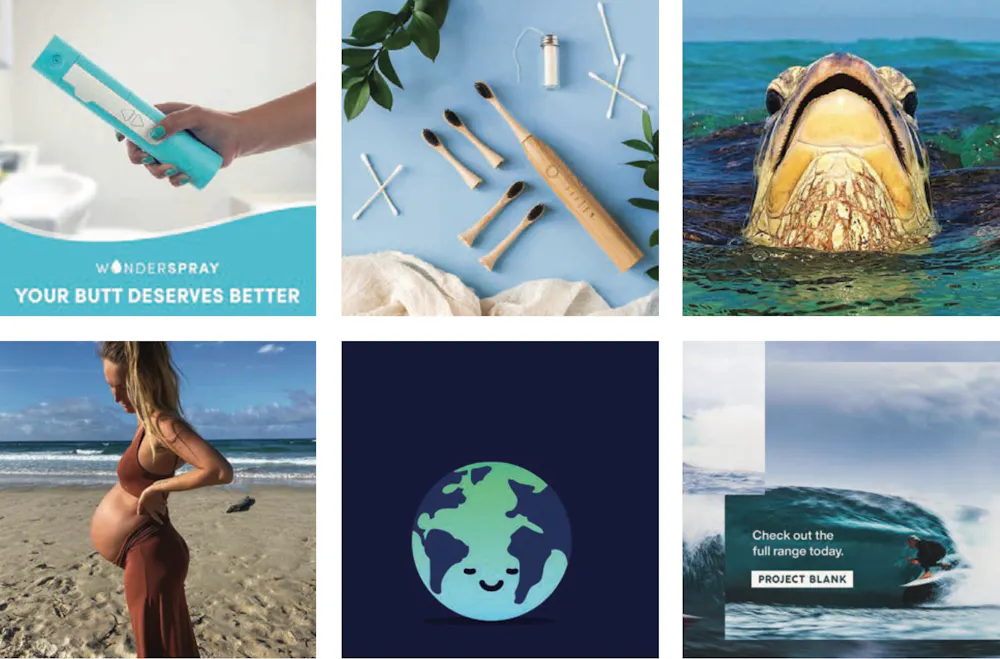 Examples of blue-coloured ads. The claims in these ads may well be true, but in many cases consumers need to ‘deep dive’ to verify this information.
CPRC, Author provided
Examples of blue-coloured ads. The claims in these ads may well be true, but in many cases consumers need to ‘deep dive’ to verify this information.
CPRC, Author provided
Strong incentives for greenwashing
Recent Consumer Policy Research Centre research shows 45% percent of Australians always or often consider sustainability as part of their purchasing decision-making. At least 50% of Australians say they are worried about green claim truthfulness across every sector.
Given consumer concern, businesses have a strong incentive to “green” their businesses. But that comes with a strong incentive to claim more than is justified.
Major Australian business regulators – the ACCC and Australian Securities and Investment Commission (ASIC) – are both prioritising enforcement action against greenwashing.
ASIC has issued dozens of interventions against misleading and deceptive environmental disclosures by companies and super funds. The ACCC has issued draft guidance for businesses on how to avoid greenwashing when making environmental and sustainability claims.
A Senate inquiry into greenwashing is expected to report in mid-2024 as to whether stricter regulation is necessary to protect consumers from misleading greenwashing.
Read more: Airlines are being hit by anti-greenwashing litigation – here's what makes them perfect targets
What is ‘sustainable’, anyway?
Our research highlights the plethora of green claims businesses make in social media advertising. Consumers are forced to choose between accepting claims at face value or committing to a deep dive to research each product they buy and the claims they make.
Many green claims come from the energy sector, with some energy companies claiming to be “greener” without any detail. Some claim carbon offsets or carbon neutrality – highly contested terms.
Ads for “sustainable” travel often showed destinations emphasising a connection with nature, but did not explain what aspect of the travel was sustainable.
 Examples of travel ads containing ‘green’ claims. The claims in these ads may well be true, but often consumers need to ‘deep dive’ to verify this information.
CPRC, Author provided
Examples of travel ads containing ‘green’ claims. The claims in these ads may well be true, but often consumers need to ‘deep dive’ to verify this information.
CPRC, Author provided
One personal care brand heavily advertised its “sustainable” packaging, but the fine print showed it related only to the boxes their products are shipped in, not the actual product packaging. A claim like this can create an undeserved green halo across a whole product range.
Claims that products are biodegradable, compostable or recyclable can be particularly problematic, since this is often technically true yet practically difficult. Some products labelled biodegradable may need to be taken to a specific facility, but a consumer might assume they will biodegrade in their home compost bin.
Read more: Do you toss biodegradable plastic in the compost bin? Here’s why it might not break down
What can we do?
Australians cannot wait years for enforcement action against potentially misleading green claims. The economy and the digital world is moving too fast and the need for sustainability is too urgent. Governments must enact laws now to ensure green terms are clearly defined and based on the truth.
The European Union is currently working on a “Green claims” directive that seeks to ban generic claims such as “eco-friendly”, “green”, “carbon positive” and “energy efficient”. Claims would have to be specific, meaningful and based on independently verified excellent environmental performance.
The United Kingdom has already issued similar guidance via an environmental claims code and is also considering stricter legislation.
Australian regulators should have the power to blacklist green terms that cannot be substantiated and are inherently meaningless or misleading.
Some high-polluting sectors should be banned from making any kind of green claim in advertising, due to the overwhelming negative environmental impact of their business models and practices, as the EU is considering. Fossil-fuel companies, for example, should not be permitted to use green claims in marketing.
Australian consumers deserve green choices that are clear, comparable, meaningful and true.
Authors: Christine Parker, Professor of Law, The University of Melbourne


 Daily Bulletin


