

Labor has introduced its controversial climate bill to parliament. Here's how to give it real teeth
- Written by: John Quiggin, Professor, School of Economics, The University of Queensland
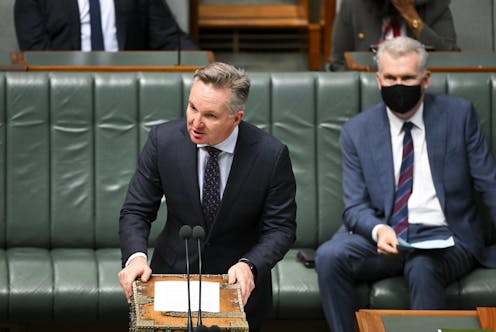
Earlier today, the federal government introduced its hotly awaited climate change bill to parliament. Despite the attention and controversy it’s attracted, the proposed legislation – as it stands – would be almost entirely symbolic.
Labor has updated Australia’s obligations under the Paris Agreement. So we’re already committed to a 43% emissions reduction by 2030, based on 2005 levels.
Enshrining the target in law might send a message that the new government is committed to reducing emissions. But as I explain below, the law will have little material effect.
Labor needs the support of the Greens and one other crossbencher to get the bill through the Senate. Labor won’t concede to the Greens’ core demands, but a climate “trigger” on new developments could ensure the bill has real force.
New laws are not needed
Introducing the bill to parliament on Wednesday, Climate Change and Energy Minister Chris Bowen said Labor’s emissions reduction target of 43% was “ambitious but achievable”. But in fact, the goal is far from ambitious – and in all likelihood will be easily met.
Even before the election, Australia was on track for a 35% emissions reduction – well above the commitment of the Morrison government. This was mainly due to state government action, and rapid take up of clean energy by households and businesses.
Former prime minister Scott Morrison could not publicly admit this, or adjust the government’s official target accordingly, at the risk of antagonising climate denialists on his own side.
But it means Australia is likely to be well on track to achieve the 43% target by the next election – with a little help from Labor’s modest proposed policy changes, and steep increases in the cost of coal, oil and gas. So legislating the target isn’t really necessary.
Nor does Labor need new laws to prevent a future Coalition government from scaling back the emissions reduction target.
Under the Paris Agreement, there is no process to go backwards. Nations are expected to rachet up their pledges until, it is hoped, global emissions fall to a trajectory consistent with global temperature goals.
Unless Australian withdrew from the agreement altogether – as the Trump administration did in the United States – the 43% commitment is almost impossible to reverse.
Even ignoring our international commitments, the Coalition is unlikely to propose backtracking on the 43% target.
Even if it went to the next election promising no further action on climate change, Australia would still be on track to hit the target. So modifying the target would bring no policy benefit – and would kill off any chance of recapturing seats lost to teal independents and Greens at the last election.
Labor has proposed to tighten the so-called “safeguard mechanism” established by the previous government. But this policy is achievable under existing law and did not require inclusion in the bill now before parliament.
The mechanism is supposed to prevent big industrial polluters from increasing their emissions beyond a certain cap – a move necessary to protect gains in emissions reduction made elsewhere in the economy.
In theory, polluters receive a financial incentive if their emissions fall below a previously established baseline, and incur a financial cost if their emissions exceed it. But under the Coalition, many polluters were allowed to increase their baselines to avoid being penalised.
Labor has proposed to implement the scheme more effectively. This relatively modest policy will proceed regardless of the climate bill’s passage.
Room to move on a climate ‘trigger’
The Greens have made two key demands in exchange for supporting Labor’s climate bill in the Senate: increasing the 43% target and a ban on new coal and gas projects.
There is virtually no chance Labor will agree to a higher target – given both its election commitments, and the political imperative of not being seen to cave in to the Greens.
Read more: No, Mr Morrison – the safeguard mechanism is not a 'sneaky carbon tax'
Nor is the government likely to accept an explicit ban on new coal and gas projects, even though the International Energy Agency says such a ban is needed.
There is, however, room for compromise. The Greens have called for the legislation to incorporate a “climate trigger”, which would mean development proposals are not approved unless their impact on climate change has been considered.
The trigger would mean new coal and gas projects could be rejected on the grounds of potential damage to the climate, without Labor having to commit to such a ban.
Labor did not rule out the trigger before the election, and elements of its grassroots membership are calling for the policy to form part of the government’s planned overhaul of federal environment laws.
Making real progress
The election in May of an unprecedented number of independent and Green MPs reflected a groundswell of community feeling on the need for climate action. The federal government must take account of this, if the current parliament is to land on a sustainable climate policy.
The Greens and other crossbenchers should not rubber stamp a purely symbolic statement of Labor’s targets. But for their part, they should seek a sensible compromise on measures to help decarbonise the Australian and global economies.
And what of the Dutton-led opposition? The Coalition’s embrace of climate denialism produced one of its worst electoral defeats in history. Even if it votes against the legislation now before parliament, the Coalition’s political recovery depends on it taking a more constructive climate position in future.
Read more: 3 lessons from Australia's ‘climate wars’ and how we can finally achieve better climate policy
Authors: John Quiggin, Professor, School of Economics, The University of Queensland


 Daily Bulletin


