

Think taxing electric vehicle use is a backward step? Here's why it's an important policy advance
- Written by: Jago Dodson, Professor of Urban Policy and Director, Centre for Urban Research, RMIT University
The South Australian and Victorian governments have announced, and New South Wales is considering, road user charges on electric vehicles. This policy has drawn scorn from environmental advocates and motor vehicle lobbyists who fear it will slow the uptake of less-polluting vehicles. But, from a longer-term transport policy perspective, a distance-based road user charge on electric vehicles is an important step forward.
Superficially, a charge on electric vehicle use seems misguided. Road sector emissions are the worst contributors to climate change. Electric vehicles powered by clean energy offer the promise of near-zero emissions.
Read more: Transport is letting Australia down in the race to cut emissions
As electric vehicle and renewable energy costs decline we can expect a shift to full electrification of urban vehicles over the next 30 years. Surely accelerating this transition is an urgent climate task?
The downside lies not in the carbon benefits of these vehicles, but in their use as private passenger transport in congested urban areas and the costs this use imposes on cities. As renewable energy becomes cheaper, the marginal cost of every kilometre driven is likely to decline. As driving becomes cheaper, more of it is likely to occur.
More driving means more congestion. Inevitably, that increases demand for increasingly expensive road projects, such as Sydney’s WestConnex, or Melbourne’s Westgate Tunnel and North East Link. It certainly will run against the recognition in urban plans such as Plan Melbourne that we must shift to alternative transport modes.
If we don’t have a pricing regime that accounts for the cost of car use in cities, the transition to electric vehicles is likely to work against the wider goals of urban and transport policy.
Read more: Cars rule as coronavirus shakes up travel trends in our cities
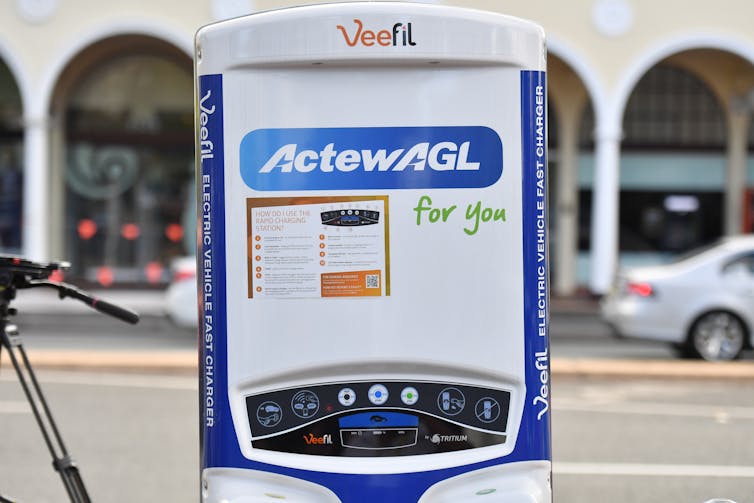 The cheaper electric cars are to run, the greater the incentive to increase car use, with all the associated costs that imposes on cities.
Mick Tsikas/AAP
The cheaper electric cars are to run, the greater the incentive to increase car use, with all the associated costs that imposes on cities.
Mick Tsikas/AAP
How would distance-based charging work?
Many urban transport policy advocates have called for distance-based road-user charging to be imposed on all vehicles in cities. This sounds great in theory, but in practice is difficult for technical and political reasons of privacy and surveillance. Such concerns will diminish over time as cars increasingly incorporate automated telematics that necessarily track their movement.
Distance-based road-user charging efficiently matches road use to its costs – of infrastructure, congestion, noise, pollution and deaths. It improves on fuel excise, which drivers can nearly completely evade by using a highly efficient vehicle. It also goes beyond tolling to fund major roads, which typically apply only to specific links.
Second, road-user charging can be varied in response to demand that exceeds road capacities. Higher rates can be applied at peak times to ensure free-flowing traffic and shift travel to other times and modes. Various taxation reviews, including the 2009 Henry Taxation Review and Productivity Commission reports, have promoted such policies.
Read more: Road user charging belongs on the political agenda as the best answer for congestion management
Exactly how big would the disincentive be?
Would imposing such charges on electric vehicles retard their uptake?
Based on our work with ABS Census journey-to-work data, in Melbourne the average daily round-trip commuting distance by car is about 25 kilometres. The proposed Victorian charge is 2.5 cents per kilometre. Thus, in Melbourne the average daily commuter’s road user charge is likely to be 63 cents – $3.13 for a typical five-day working week. Over a 48-week working year that totals A$150, hardly a large sum for most people.
By comparison, a commuter in a conventional vehicle with the average current fuel efficiency of 10.9 L/100km will use about 2.73 litres of fuel on which they pay 42.3 cents per litre in fuel excise. That’s about $1.15 a day, or $5.75 a week.
The average tax saving for electric vehicles compared to conventional vehicles will be about 2.1 cents per kilometre. Electric vehicle drivers will be taxed about 53 cents a day, or $2.64 a week, less for their car work travel. They’ll be about $126 a year better off.
Commuting trips make up about 25% of car use, so electric car users’ overall savings are likely to be even greater.
It is difficult to see how such savings on excise tax are a disincentive to electric vehicle uptake. Fears of a “great big new tax”, as the Australia Institute puts it, seem unfounded, as are concerns that road-user charges would “slam the brakes on sales”.
Let’s be clear, the big barrier is the upfront cost of electric vehicles, about $10,000 more than their conventional equivalents. Advocates for electric vehicles should focus on that difference, and the failures in Australian government policy, not state road-user charges.
Read more: Electric car sales tripled last year. Here's what we can do to keep them growing
Why taxing actual road use matters
It needs to be recognised that, with lower marginal costs, electric vehicles are likely to be used more than conventional cars. That would increase pressure on urban road capacity. So while the new road-user charge of 2.5 cents per kilometre is flat across the time of day or the route driven, this will likely need to change.
Distance-based road-user charges have been politically controversial. Imposing a tiny charge on a minority vehicle type is an expedient way of introducing a needed reform. Fewer than 1.8% of vehicles in Australia are currently electric or hybrid. But as all cars become electric, distance-based road charges will become an increasingly powerful policy tool.
Thanks to advancing telematics, transport planners will eventually be able to impose variable road-user charging by time of day and route, similar to ride-hailing companies’ “surge” pricing. We could then apply novel approaches such as a cap-and-trade system. A city could allocate its motorists an annual kilometres quota, which is then traded to create a market for excess urban road use.
The private car could also be integrated into mobility-as-a-service models.
Road-user charges could be regressive for people with few alternatives to the car. But telematic tracking could allow for lower charges for less affluent households in dispersed outer suburbs with few other options.
Beyond fuel, private cars have high environmental costs in steel, plastic, aluminium, glass and rubber use. And about one-third of our increasingly valuable urban space is given over to cars in the form of roads and parking.
Read more: Freeing up the huge areas set aside for parking can transform our cities
To reduce this demand on resources and space, car use could be priced to shift travel to, and fund, more sustainable and city-friendly modes such as public transport, walking and cycling. We could even price the car out of cities completely. The most environmentally sustainable car, after all, is no car at all.
Authors: Jago Dodson, Professor of Urban Policy and Director, Centre for Urban Research, RMIT University


 Daily Bulletin


