

Tampering with history: how India's ruling party is erasing the Muslim heritage of the nation's cities
- Written by: Sudipta Sen, Professor of History, University of California, Davis
For centuries many millions of Hindus have gathered at the confluence of the rivers Ganges, Yamuna and Sarswati in northern India for the festival of Kumbh Mela. Their pilgrimage, which ends with a sacred bath in the Ganges, takes them through the historic city of Allahabad.
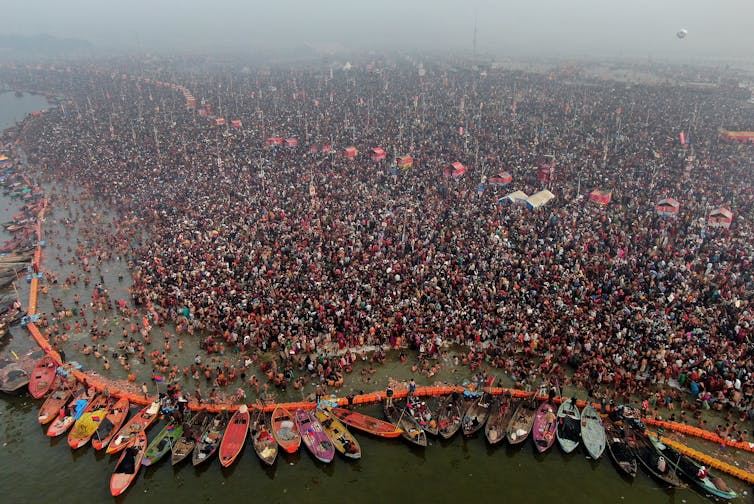 Millions of pilgrims gather at the confluence of the Ganges, Yamuna and Sarswati rivers for the festival of Kumbh Mela.
EPA/AAP
Allahabad is no longer on the map of India. In October 2018, officials of the ruling Hindu nationalist Bharatiya Janata Party (BJP) changed its name to Prayagraj. Allahabad was founded by the Mughals, Muslim rulers from Central Asia who governed India from the 16th to the 19th centuries. This name change emphasises the primacy of the Hindu gathering over the city’s Mughal heritage.
This renaming is part of a growing trend in the lead-up to India’s current general election, which is expected to return the BJP government. To appeal to its voter base of Hindu nationalists, the BJP is attempting to erase India’s Mughal legacy both from the landscape and from the history books.
Read more: India's elections will be the largest in world history
India and the Mughals
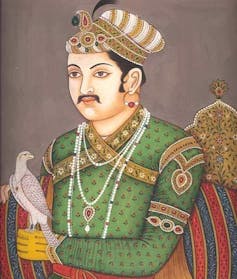 Emperor Akbar the Great.
Wikimedia
The Mughals had a more than 300-year presence on the subcontinent and exerted a significant influence on Indian art, architecture, language and cuisine.
Allahabad’s Mughal history begins with the Emperor Akbar (1542-1605). Akbar was struck by the natural setting and serenity of Prayag and commissioned the old settlements on either side of the Ganges and their adjoining villages to erect a new city. He named it Illahabas, adding the Hindustani word basa (home or abode) to ilahi, the Arabic word for “divine”.
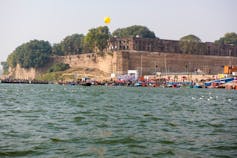 Allahabad Fort on the banks of the Yamuna river.
Arun Sambhu Mishra/Shutterstock
Akbar secured the city with an imposing fort overlooking the sacred waterway and put an end to the long-established practice of ritual suicide by penitent Hindus. They would typically jump into a well or into the torrents of the river from a giant and auspicious banyan tree. The tree was now placed inside the fort in a chamber that became known as the Patalpuri Temple, where Hindu pilgrims continued to offer their devotions.
During the reign of Akbar’s grandson, Shah Jahan, best known for building the Taj Mahal, the city became popularly known as Allahabad.
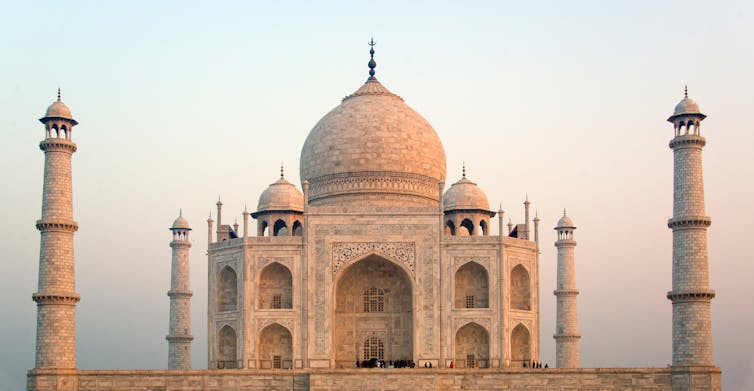 The Taj Mahal is the most iconic example of Mughal architecture.
JTang/Shutterstock
The rise of Hindu nationalism
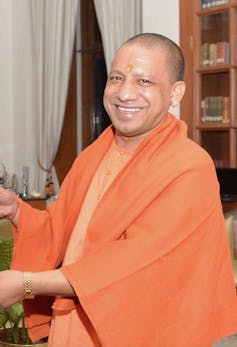 Yogi Adityanath.
Wikimedia
The campaign to rename Allahabad was led by the Hindu priest and activist Yogi Adityanath, who rose to fame as the founder of a militant Hindu youth-wing group. Adityanath is now chief minister of Uttar Pradesh (UP), India’s most populous northern state.
As one of the most outspoken members of the ruling party, he has repeatedly indulged in vitriol against religious minorities, especially Muslims. According to Adityanath, the identity, history and traditions of India must be salvaged from the taint of alien, Muslim invaders.
The rechristening of Allahabad reflects a strident demand of Hindu militants at the helm of Indian politics to reclaim towns, streets, airports and railway stations which are seen as reminders of India’s “Muslim” past. These calls have grown louder and more insistent during Narendra Modi’s tenure as prime minister and leader of the BJP.
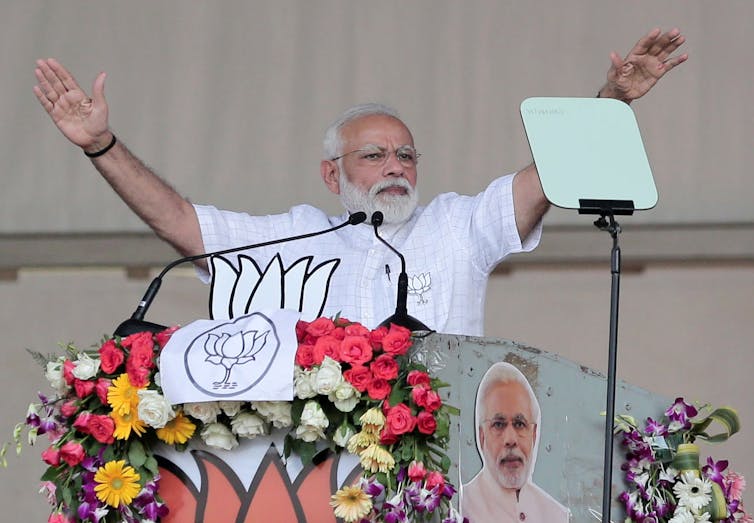 Narendra Modi on the 2019 campaign trail. As prime minister he has overseen a troubling rise in Hindu nationalism.
EPA/AAP
Read more: Why giant statues of Hindu gods and leaders are making Muslims in India nervous
Rewriting history
Another notable case is the recent renaming of the British-era railway junction of Mughalsarai. The word sarai denotes a rest house or inn. Mughalsarai, less than 20km from the sacred Indian city of Varanasi, is one of the busiest railway yards in the country. It is located along the historic Grand Trunk Road, one of the oldest roads in Asia, which connects Northern India to Central Asia.
The Indian government’s nod to the proposal to rename the station came, again, from Adityanath who wanted to claim it in the name of Deendayal Upadhyaya (1916 –1968). Upadhyaya, a leader of the Jan Sangh Party, was an early ideologue of Rashtrya Swayamsevak Sangh (RSS), the parent organisation of the BJP.
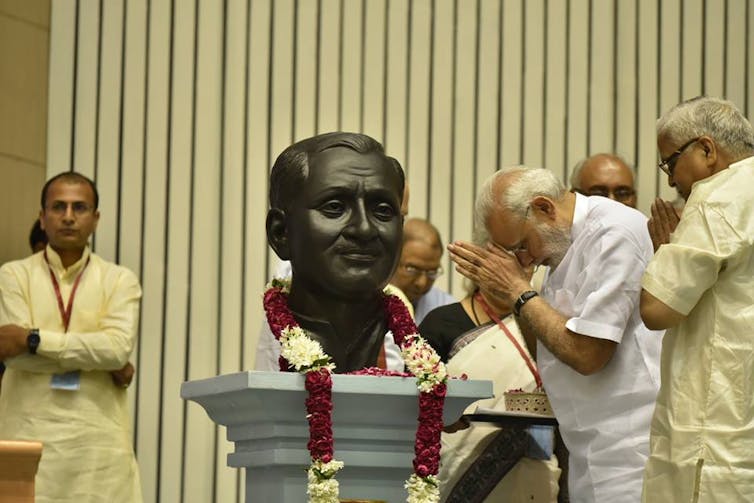 Prime Minister Narendra Modi pays tribute to the memory of Deendayal Upadhyaya.
Wikimedia
The move led to an uproar in the Rajya Sabha, the upper house of the Indian parliament. Opponents of this proposal argued that Upadhyaya was not a “freedom fighter” or a truly national figure. Other critics see this move to commemorate an early proponent of right-wing Hindu nationalism as the BJP’s attempt to elevate its leaders to national prominence.
In the popular imagination, the early leaders of the Congress Party (the BJP’s main opposition) are still seen as the key architects of India’s freedom struggle. The memory of Congress leaders such as Mahatma Gandhi and Jawarhalal Nehru is honoured throughout India in the form of public monuments and landmarks. The BJP’s move to elevate Upadhyaya is an attempt to insert one of the founders of its political creed into the public memory of India’s independence struggle.
Read more: India Tomorrow part 2: the politics of Hindu nationalism
From decolonisation to erasure
What we are witnessing is not simply a facile attempt by a majoritarian government to strip facets of the popular memory of the northern Indian plains and its shared, historical landscape. It is also the extension of a patriotic animus once directed at the historic markers of the British colonial era that found recompense and solace in changing place names such as Bombay to Mumbai and Madras to Chennai.
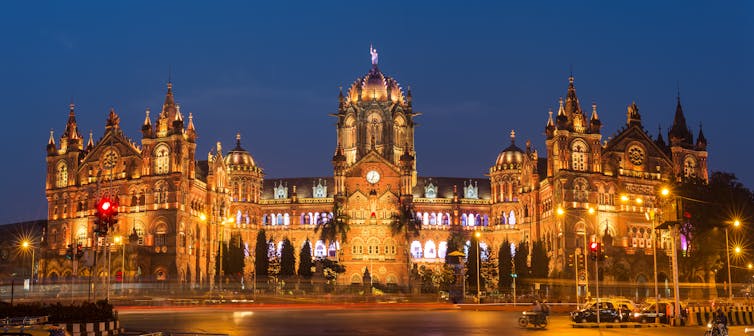 Decolonising Mumbai. In 1996, the Victoria Terminus in Mumbai was renamed Chhatrapati Shivaji Terminus after a local warrior king.
Mazur Travel/Shutterstock
The new dispensation targeting places like Allahabad and Mughalserai sends clear signals to multitudes of the Indian nation that, much like the British, the Mughals who shaped more than 300 years of Indian history were also outsiders and should not feature in the story of India’s one true national heritage.
Authors: Sudipta Sen, Professor of History, University of California, Davis


 Daily Bulletin


