

James Dyson Award announces its 2024 global winners: Hair-loss prevention device for chemotherapy patients and Sustainable ‘maple seed’ weather balloon
- Written by: Daily Bulletin
- Published in News from Asia
HONG KONG SAR - Media OutReach Newswire - 13 November 2024 - Today, the James Dyson Award unveils its two global winners, each receiving £30,000 for solving significant problems of global importance in medicine and sustainability:
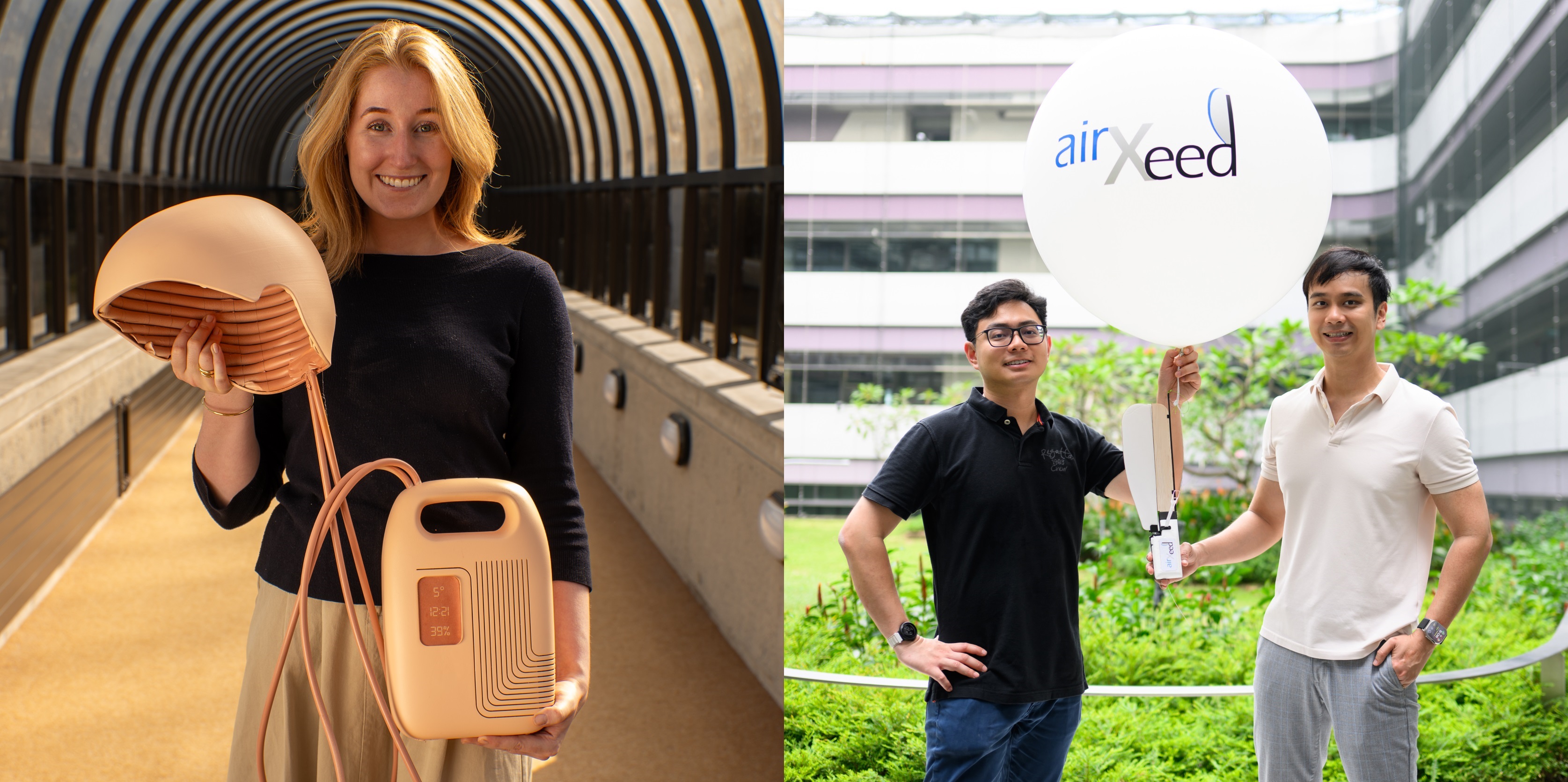
- Athena is the global Medical Winner.
The international student design competition, which has now supported more than 400 problem-solving inventions from young engineers and scientists worldwide, received nearly 2,000 entries this year.
Speaking of the 2024 winners, James Dyson said: "We started the James Dyson Award nearly 20 years ago to encourage students at university to solve problems. And we've had thousands and thousands of entries since. It's wonderfully encouraging to see how many students have solutions to severe global problems. Instead of sitting back and talking about it, they're doing something about it – and that's what the James Dyson Award encourages. We've got two brilliant winners this year which we're thrilled to support, and I hope the Award will give them a springboard to future success."
James Dyson surprised Olivia, Shane and Danial with the exciting news during an online video call. Watch how it went down on YouTube.
Medical Winner – Athena:
A Portable, Affordable, and Patient-Centric Solution to Chemo-Induced Hair Loss.
The problem
Some 65-99% of patients going through chemotherapy will be affected by chemo-induced hair loss[1]. Current hair-loss prevention techniques commonly use scalp cooling, a method which involves applying ice cold temperatures to the scalp before, during, and after chemotherapy, which can be very painful for patients. It mitigates hair loss by shrinking blood vessels and limiting blood flow to the scalp. After chemotherapy, cooling can also help hair grow back faster and stronger[2].
However, the availability of scalp cooling is limited due to its high costs. This year's Medical Winner is from Ireland where the Minister for Health estimated the total cost of installing a scalp cooling machine at €216,000[3], with additional costs needed for staffing as the treatment requires additional help to operate the equipment.
The solution
Olivia Humphreys, a 24-year-old product design and technology graduate, invented Athena to tackle these issues after witnessing the impact of chemotherapy-induced hair loss when her mother was diagnosed with cancer in 2019. Having spent time with her mother during treatment, Olivia was inspired to reimagine hair-loss prevention technology.
Athena is a portable, thermoelectric hair-loss prevention device that uses scalp cooling. It's more cost effective and timesaving than current hospital models, without compromising on the quality of treatment.
With Athena, patients can start and end the scalp-cooling process themselves from wherever they wish, such as the comfort of their own home. At full power, it can run for 3.5 hours, allowing the patient to commute to and from the hospital while cooling, and move around during infusion, such as for bathroom visits. Athena aims to give control back to patients during a time when they usually have little of it. Athena is patient-centric and so Olivia also chose bright colours for the device's materials as a change from conventional, clinical colours found in hospitals. Taking its name from the powerful Greek Goddess of wisdom and battle strategy, for Humphreys, Athena is a symbol of resilience, which is a quality often seen in those living with an illness as serious as cancer and going through the necessary treatments.
The estimated cost for Athena would be around €1,000, according to Olivia, which is significantly less than industry machines which start at around €20,000. Athena has the potential to make hair-loss prevention more accessible and affordable for both patients and healthcare providers.
James Dyson, Founder of Dyson, said: "I haven't had cancer, but members of my family have had cancer and hair loss is a particularly depressing and debilitating part of chemotherapy treatment. You can freeze your scalp which you have to do in special facilities, but these aren't always available, are costly and it's very painful. This year's Medical Winner, Olivia Humphreys, has tackled this problem by designing Athena, for portable scalp cooling. You can wear it while you travel, you can wear it in the car to and from hospital, you can use it at home – it's a low-cost alternative available to everybody, with the potential to make a real difference."
On winning the James Dyson Award, Olivia said: "I'm incredibly proud of the hard work, ambition, and commitment that went into creating Athena. The recognition from the James Dyson Award validates not just my efforts, but also the stories and insights shared by people who've experienced cancer treatment. My mum inspired this journey, and it's incredibly emotional and rewarding to have my project reach this level. The Award has motivated me to recognise my potential, and it opens up exciting opportunities for me as a young designer and innovator."
Sustainability Winner – AirXeed Radiosonde:
Revolutionising Weather Forecasting with Reusable, Eco-Friendly Technology Inspired by Nature.
The problem
Every day, weather stations worldwide launch devices via weather balloons that gather critical atmospheric data for accurate weather forecasting. These small devices, called radiosondes, measure air pressure, temperature, humidity, wind speed and direction and transmit this data back to ground stations, helping meteorologists track weather patterns and forecast conditions. However, current devices are single-use and contribute to tonnes of plastic and e-waste globally.
After reaching high altitudes, the balloon carrying the device bursts, and the sensor descends rapidly, often crashing in remote and costly-to-retrieve locations[4], without collecting further atmospheric data as it falls.
These devices are crucial to the rapidly growing weather forecasting industry, valued at over $2.25 billion in 2023[7] and projected to reach approximately $5.23 billion by 2032[8]. This growth is driven by the rising demand for precise weather forecasting across sectors like agriculture, energy, transportation, and aviation. Extreme weather events have increased the demand for better forecasting systems too.
This year's global Sustainability Winner aims to make weather forecasting more eco-friendly. AirXeed Radiosonde is a reusable device tackling the amount of e-waste created by single-use radiosondes on the market. It also aims to increase the amount of atmospheric data these devices collect, improving quality of forecasting.
Young engineers Shane Kyi Hla Win and Danial Sufiyan Bin Shaiful, from the Singapore University of Technology and Design, drew inspiration from nature to create airXeed Radiosonde. Their focus was to improve the descent and end-of-life of a radiosonde to make them reusable, reducing e-waste and minimising pollution in remote areas.
The team used the autorotation of maple seeds in their solution. A maple seed's asymmetrical shape creates lift and drag, allowing it to spin like a helicopter as it falls. Shane and Danial applied this principle to their radiosonde design, enabling it to spiral during descent. This not only slows the device, preventing damage upon impact with the ground, but also increases the likelihood of it landing in an accessible location, making retrieval and reuse easier. The team used machine learning to optimise this design for the best flight performance. AirXeed's controlled descent allows it to collect and transmit more atmospheric data to weather stations, as traditional radiosondes cannot do this.
Shane and Danial prioritised sustainability in their material choice, using balsa wood and foam for the lightweight wing and cowling. Modular components allow for easy replacement and recycling of worn parts, catering to industry needs.
On what's next for the team, Danial said: "With the Award's recognition, we hope to connect with experts in the weather industry, secure partnerships and attract funding to further test and develop our design. It's a huge boost in our journey towards turning airXeed Radiosonde into a fully realised solution that can reduce electronic waste and make weather monitoring smarter and more sustainable."
Sources used throughout this release were provided by the winners and used in their research.
Hashtag: #dyson
The issuer is solely responsible for the content of this announcement.
NOTES TO EDITORS
The James Dyson Award forms part of a wider commitment by Sir James Dyson, to demonstrate the power of engineers to solve the world's problems. The competition has supported more than 400 inventions with prize money and a chance to gain global media exposure, and is run by the James Dyson Foundation. Founded in 2002, the Foundation is an international education charity whose mission is to inspire the next generation of engineers. The Foundation also invests in medical research and has donated more than £145m to charitable causes to date.
PREVIOUS GLOBAL WINNERS
2023 International Winner – The Golden Capsule
A hands-free IV device for disaster zones.
2023 Sustainability Winner – E-COATING
A sustainable exterior wall coating with a high cooling effect, reducing environmental costs of air conditioning.
2023 Humanitarian Winner – The Life Chariot
An off-road trailer ambulance for universal towing.
2022 International Winner – SMARTHEAL
A smart sensor for dressings which indicates how well a wound is healing by measuring its pH level.
2022 Sustainability Winner – Polyformer
A machine that recycles plastic bottles into affordable 3D printer filament for developing nations.
ABOUT THE COMPETITION
The brief. Design something that solves a problem. This problem may be a frustration that we all face in daily life, or a global issue. The important thing is that the solution is effective and demonstrates considered design thinking. Unlike other competitions, participants are given full autonomy over their intellectual property.
The process. Entries are judged first at the national level by a panel of external judges and a Dyson engineer. Each operating market awards a National winner and two National runners-up. From these winners, a panel of Dyson engineers then select an international shortlist of 20 entries. The top 20 projects are then reviewed by Sir James Dyson who selects his global winners.
The 2024 prizes
- The Medical Winner and Sustainability Winner each receive a prize of £30,000.
- Each National winner receives £5,000.


 Daily Bulletin


