

George Bush Sr could have got in on the ground floor of climate action – history would have thanked him
- Written by: Marc Hudson, PhD Candidate, Sustainable Consumption Institute, University of Manchester
Among the tributes, critiques and personal reminsces on the life of former US president George H.W. Bush, there has been plenty of reflection on his war record – but less on how he handled himself during the early skirmishes of the climate battle.
Scientists had been warning of potential problems from the buildup of greenhouse gases for a decade before Bush took office. The warnings culminated in 1988, when NASA climatologist James Hansen, after testifying to a Senate panel, uttered the famous words:
It is time to stop waffling so much and say that the evidence is pretty strong that the greenhouse effect is here.
By then, Bush’s presidential run was gaining steam. After eight years as vice-president to Ronald Reagan, he wanted the top job, and in Michael Dukakis he faced a Democrat opponent with relatively strong environmental credentials.
Read more: Why we'll miss George H.W. Bush, America's last foreign policy president
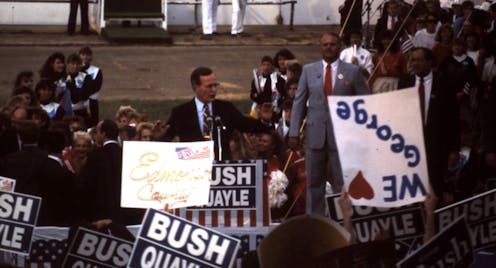
On August 31, 1988, on the campaign trail, Bush promised:
Those who think we are powerless to do anything about the ‘greenhouse effect’ are forgetting about the ‘White House effect’. In my first year in office, I will convene a global conference on the environment at the White House. It will include the Soviets, the Chinese… The agenda will be clear. We will talk about global warming.
Bush won the election, and hosted his promised summit in April 1990. But he fudged his promise for a clear and open discussion of global warming.
Bert Bolin, the “father of climate science” and founding chair of the Intergovernmental Panel on Climate Change, found himself mysteriously not invited to the summit. Leaked briefing papers showed the Bush administration’s line was that it was “not beneficial to discuss whether there is or is not warming… In the eyes of the public we will lose this debate.”
Denial and obfuscation
In May 1989, Al Gore, who had unsuccessfully sought the Democratic presidential nomination the previous year, accused the president of seeking to dodge the climate issue, after it emerged that the Bush Administration had censored Hansen’s Congressional testimony, altering his conclusions about global warming data to make them seem less certain.
Meanwhile, climate deniers were becoming increasingly active, including in the Bush White House. A coal industry-sponsored documentary titled The Greening of Planet Earth began circulating, while Bush’s chief of staff John Sununu became a vocal roadblock to climate policy, throwing up bureaucratic obstacles and winning Cabinet battles against those who wanted a stronger policy. Bush himself reportedly had no strong interest in global warming and was largely briefed on it by non-scientists.
Yet the world pressed on with the climate issue, setting the June 1992 Rio Earth Summit as the deadline for completing a new United Nations treaty that would formalise the global negotiation process. The US administration said that Bush – up for re-election in November – would refuse to attend if the treaty text included targets and timetables for emissions reductions. Bush’s words were: “The American way of life is not up for negotiations. Period.” It’s a sentiment we’re still used to hearing from many of today’s politicians.
The major dilemma facing international negotiators was whether to accommodate the United States and have a weak treaty, or push ahead without them. The fate of the Convention on the Law of the Sea – which languished for almost a decade without ratification because of US opposition – pushed them towards compromise. It took a British initiative – with UK Environment Secretary Michael Howard flying to the US to convince the Americans they could sign on – before Bush would agree to attend.
An October 1992 Washington Post profile paints a picture of a man who was not really engaged in the global warming issue. Based on interviews with more than 20 policy officials and other advisers, Bush was described as being:
…detached, uninterested, and as his brief remarks in the April meeting showed, responsive only to the politics of a complex issue. He never sat for a full-dress scientific briefing on it or exercised control over administration policy, even after infighting among administration officials became public, or leaders of other industrialised nations pledged action.
Historic compromises
The Rio deal – the UN Framework Convention on Climate Change – was quickly signed and ratified by enough countries, including the US, to become international law. The first annual summit was held in Berlin in 1995, and negotiators are currently gathered in Katowice, Poland, for the 24th round of talks. Along the way, the negotiations have delivered the Kyoto Protocol and the Paris Agreement.
But the key battle, which has never been won, was for the implementation of binding targets and timetables for countries, especially wealthy ones, to cut their emissions. The inherent weakness of Paris Agreement, which does not contain binding targets and is not currently on track to meet its stated goals, is the result of compromises made decades ago.
Bush’s son, George W. Bush, had a far worse record on climate action during his own presidency. But Bush senior was in the White House during the formative years of the international climate effort. He had the chance to be a genuine leader, had he seized it. But when we needed decisive, brave and far-sighted leadership, instead we got the same backing-in of corporate interests, and nearsighted defence of the status quo, that we have grown so used to seeing from political leaders.
Read more: 15th-century Chinese sailors have a lesson for Trump about climate policy
There is of course plenty of blame to go around for our species’ failure to address climate change. One of Bush’s oldest friends, who served as secretary of state, James Baker, has tried to get Republicans on board with climate action, including with the recent Baker-Shulz carbon dividend plan. But many high-profile Republicans, the current president included, still wear their climate recalcitrance as a badge of honour.
We are living with the consequences today. And the children who went on strike last Friday, fighting a battle they should not have had to join, will live with them for the rest of their lives.
Authors: Marc Hudson, PhD Candidate, Sustainable Consumption Institute, University of Manchester


 Daily Bulletin


