

I go to the gym every day. Why can’t I lose weight?
- Written by: Tim Olds, Professor of Health Sciences, University of South Australia
Liz is a typical 50-something woman, fit, 70 kg, 30% body fat. She goes to the gym every day, and runs for 35 minutes on the treadmill at 10km/h. But, as she tells me rather often, she can’t lose weight. So what’s going on here: is it Liz, or is it the universe conspiring against her?
How do you actually ‘lose weight’?
Let’s start by considering the body as a store of energy. The body can be divided into two components. One is fat mass, and the rest of the body is called fat-free mass. It’s mostly water, but there’s also bone and muscle protein. Fat contains much more energy (and thus requires more energy to burn).
Like most of the adult population, Liz wants to lose weight. To do this, she has to go into energy deficit: energy out must be greater than energy in. The amount of weight she loses will depend on whether she is losing fat or fat-free mass.
It takes a much bigger energy deficit to lose a kilogram of fat than a kilogram of fat-free mass. We also need a bigger energy deficit per kilogram of weight loss if we are fatter to start with.
Read more: When we lose weight, where does it go?
For most people, it takes an energy deficit of about 27-32 kJ to lose a gram of body weight. If Liz runs for 35 minutes at 10km/h on the treadmill, she has a deficit of about 1500kJ, so she will have lost only 50g in a session. If she does this five times a week for a year, however, she will lose over 12 kg.
Except, of course, she doesn’t. After a year she’s still stuck on 70 kg. Why?
Eating more to compensate for exercise?
The first possibility is that Liz is eating more to compensate for the extra exercise. Her 35 minutes of treadmill running will be entirely undone by a glass and a half of merlot that evening.
There is some evidence people use food to reward themselves for exercising. A recent analysis suggested women may be particularly prone to fuel up after exercise. So Liz may be unconsciously munching or drinking away that energy deficit.
Being less active elsewhere?
A second possibility is that Liz compensates for going to the gym by being less physically active elsewhere. She may flop down in front of the TV rather than busying herself with chores. She may even fidget less.
This theory is known as the “activitystat” hypothesis: the idea that we have a setpoint for energy expenditure like the setpoint on a thermostat. If we increase physical activity in one domain, then there is an automatic compensation in another.
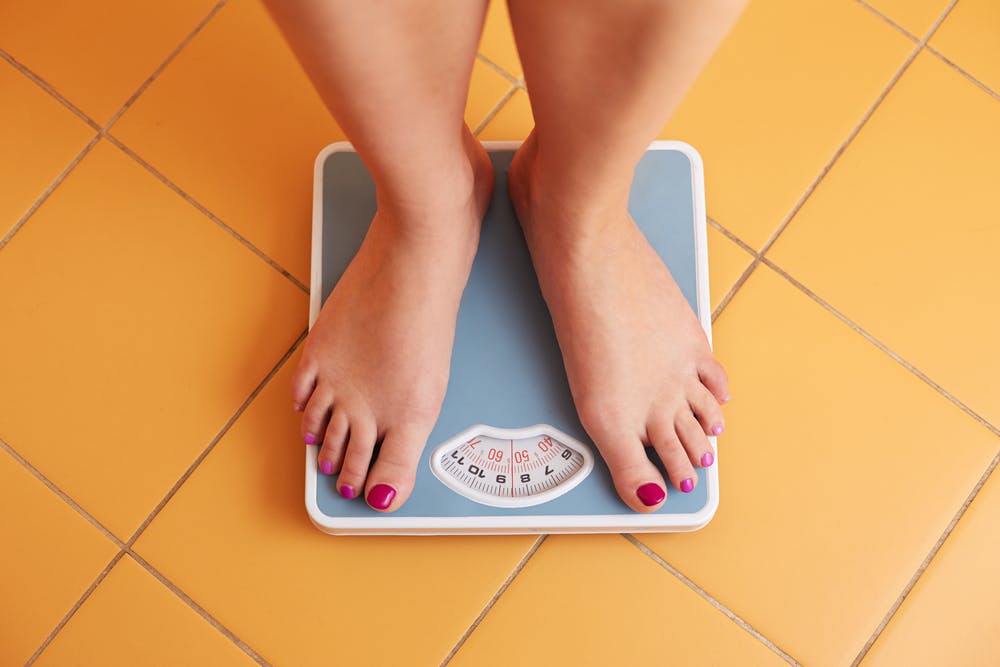 Measuring your waist is a better option.
from www.shutterstock.com
Measuring your waist is a better option.
from www.shutterstock.com
Read more: Four common myths about exercise and weight loss
So is Liz undoing all the good work at the gym by couch-potatoing her way through the rest of the day? We tested this rather depressing theory. Readers will be pleased to know we found no evidence for the activitystat when sedentary adults started an exercise program. They just cranked up the exercise, drawing time from sleep and TV.
A reduction in your resting metabolic rate?
One of the unfortunate side effects of losing weight is resting metabolic rate — the rate at which you use energy when you’re sitting doing nothing — starts to fall (meaning you burn less energy).
A recent study of contestants on The Biggest Loser found their resting metabolic rate was depressed six years after having lost and regained most of the weight.
So Liz could, in principle, be exercising and not have changed her diet or her activity pattern, and yet still not be losing weight because of her lower resting metabolic rate. However, when weight is lost by exercising (as opposed to diet), resting metabolic rate is generally maintained.
Maybe you’re gaining muscle
A sunnier prospect may be that while she has not lost weight, she has lost body fat, and that body fat has been replaced by fat-free mass. A kilogram of fat occupies more space (about 1.1 litres) than a kilogram of fat-free mass (about 0.9 litres), so Liz would not only be leaner, but smaller.
We can calculate that if fat mass is entirely replaced by fat-free mass, after 12 weeks Liz will have lost 2.6 kg of body fat, and gained 2.6 kg of fat-free mass.
This sounds good, but does it really work like this? A reasonable rule of thumb is that about 75% of the weight you lose will be fat, and the rest fat-free mass. But things may go better if weight training is involved.
Read more: Eight diet myths – busted!
One analysis of previous studies found strength training (using weights or your own body weight) increased fat-free mass by about 2 kg in overweight men and about 1 kg in women, even though weight remained unchanged.
A good test of whether you’re swapping fat mass for fat-free mass is just to measure your waist girth. If it’s getting smaller while your weight is stable, then you’re probably losing fat and gaining fat-free mass.
So what’s happening with Liz?
Is it gluttony or sloth, or is she losing fat and replacing it with fat-free mass? Liz likes this last possibility, but I don’t know. She certainly looks more toned, but the bottle of merlot is emptier than I thought.
Authors: Tim Olds, Professor of Health Sciences, University of South Australia
Read more http://theconversation.com/i-go-to-the-gym-every-day-why-cant-i-lose-weight-94206


 Daily Bulletin


