

Colorbond Fencing in Australia: Costs, Colours, Rules and What Actually Lasts
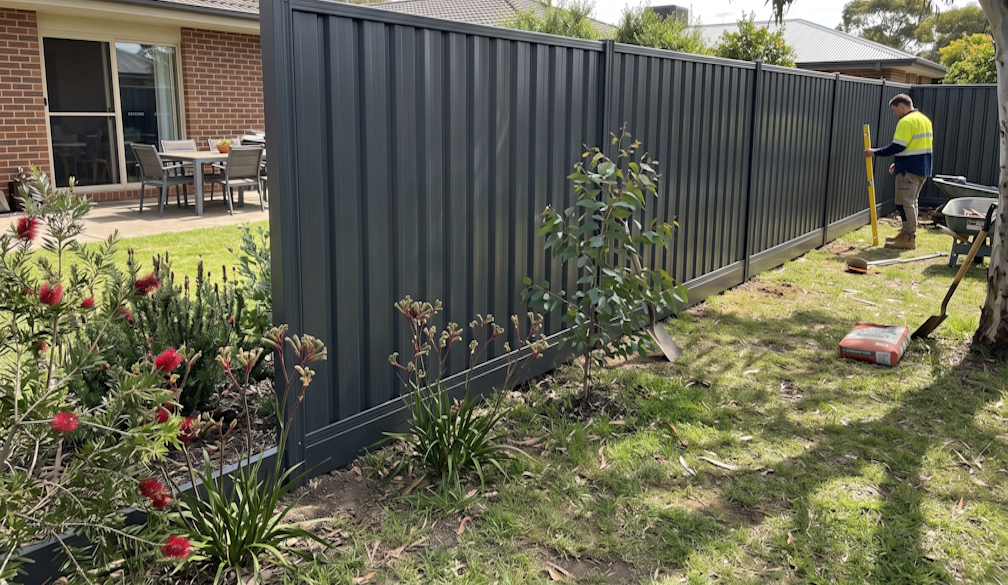
Drive through almost any Australian suburb built in the last thirty years and you are looking at the same fence. Colorbond steel has become the default boundary across most of the country, to the point where many homeowners never seriously consider an alternative. They ring a fencer, pick a colour, and the job is done.
That familiarity hides a surprising amount of variation. Two Colorbond fences on the same street, installed the same year at similar cost, can be in markedly different condition a decade later. The difference is rarely the sheet steel. It is the post spacing, the footing depth, the colour choice, the ground preparation and whether anyone thought about where the water goes.
Here is what actually matters when you are paying for one.
Why Colorbond Became Australia's Default Fence
The dominance is not marketing. Colorbond solved several problems that timber fencing never did in Australian conditions.
It does not rot, which matters in a climate that alternates between long dry spells and heavy downpours. It does not feed termites, which in most of the country is a genuine consideration rather than a theoretical one. It arrives pre-finished, so there is no painting at installation and no repainting cycle afterwards. It is non-combustible, which carries weight in bushfire-prone areas, though a fence alone is not a bushfire strategy.
It also installs fast. A standard residential boundary that would take days in timber can often be completed in a day, which keeps labour costs down and is why it tends to be the cheapest durable option rather than merely the most convenient one.
The trade-off is that it looks like what it is. A Colorbond fence reads as a functional boundary, not a feature. On a project where the fence is meant to be part of the architecture, that is a real limitation, and it is the main reason slat and blade systems have taken share at the upper end.
What Colorbond Fencing Costs, and What Moves the Price
Quoted prices vary widely by state, by site and by contractor, and any single figure you read online will be wrong for your block. What is more useful is understanding which variables move the number, because that is what explains why three quotes for the same fence can differ by thousands.
The main cost drivers:
- Height. The step from 1.8 metres to 2.1 metres costs more than the extra sheet, because taller fences need deeper footings and sometimes closer post spacing.
- Ground conditions. Sand, reactive clay, limestone and rock each demand different footings. Rock or limestone means coring, which is slow and charged accordingly.
- Access. A boundary a machine can reach is far cheaper than one that must be dug and barrowed by hand. Narrow side access on an infill block is a significant cost.
- Removal and disposal of the old fence. Routine, but frequently excluded from the cheapest quote.
- Level changes. A fence stepping down a slope needs more posts and either stepping or a plinth, both of which add cost.
- Retaining interaction. If the fence sits on top of a retaining wall, the wall has to carry the fence's wind load, and that may require engineering.
- Gates. A single pedestrian gate is minor. A double driveway gate, particularly an automated one, can approach the cost of a substantial run of fence.
What a Square Metre Rate Usually Excludes
Per-metre pricing is how the industry quotes, and it invites apples-to-oranges comparison. Before accepting the cheapest number, confirm in writing whether it includes demolition and disposal of the existing fence, excavation and spoil removal, concrete footings to a stated depth, plinths where ground falls away, gates and hardware, and any council or crossover requirement.
A quote missing three of those is not cheaper. It is incomplete.
Choosing Colorbond Fence Colours
Colour is the decision homeowners spend the most time on and get the least guidance about. A few things make it easier.
Choose it against the roof, not in isolation. The Colorbond fencing range is designed to coordinate with the roofing and guttering range, which is genuinely useful: you can match, or deliberately contrast, rather than guess. Holding a fence sample next to a roof sample takes two minutes and avoids the most common regret.
Matching the fence exactly to the roof often looks flatter than people expect. A tone from the same family, a step lighter or darker, usually reads better and gives the house some depth.
Consider what the fence is a backdrop for. Darker colours recede, make planting in front of them look luminous, and hide marks well. Lighter colours bounce light into narrow side yards and make small spaces feel larger, but show dirt and scuffing.
Finally, talk to the neighbour before ordering. On a shared boundary both parties see the fence, and a colour chosen unilaterally is a common source of friction even when the legal position is clear.
Dark Colours, Heat and Fade
Dark colours absorb more heat, which means more thermal movement and more work for the coating. Modern Colorbond finishes handle this far better than older generations, and the product carries a manufacturer warranty, but on a west-facing boundary in a high-UV part of the country a very dark colour is working harder than a mid-tone.
This is not a reason to avoid dark colours, which are popular for good aesthetic reasons. It is a reason to buy genuine product with a warranty you can read, rather than an unbranded steel fence sold as equivalent.
Dividing Fence Rules: Who Pays for a Boundary Fence
Most Australian states have legislation governing dividing fences. In Western Australia it is the Dividing Fences Act 1961. The principle is broadly similar across jurisdictions: neighbours share the cost of a sufficient dividing fence, usually in equal parts, with a notice process for proposing the work and a mechanism for resolving disagreement.
Three points that cause most of the disputes:
"Sufficient" sets the ceiling on cost sharing. The framework contemplates a reasonable, standard boundary fence. If you want extra height, a premium material or a particular colour, the difference above the standard is ordinarily yours alone. Presenting a neighbour with an upgraded quote and expecting a straight 50-50 split is where these conversations usually break down.
Give written notice. The process exists to protect you. Verbal agreement with a neighbour who later sells leaves you with nothing.
Retaining walls are generally separate. A retaining wall on a boundary normally falls outside dividing fences legislation, with responsibility instead tending to follow whoever caused the change in ground level. If your boundary involves both a fence and retaining, treat them as two conversations.
Because the rules differ between states and turn on specific facts, this is general information rather than legal advice. Anyone in an active dispute should get proper guidance.
Fence Heights, Council Approval and Pool Barriers
Standard residential boundary height across most of Australia is 1.8 metres, and fences at or below that height on a side or rear boundary generally do not need approval. Front boundaries are treated differently, with lower height limits inside the setback and sight-line restrictions on corner blocks.
Going above standard height, or building in a front setback, can trigger a planning requirement. So can a fence on a heritage-listed property or in a design-controlled estate. Local government rules vary, so check your specific council rather than a general guide.
Pool barriers are a separate and stricter regime, governed in Australia by AS 1926.1 and enforced through periodic mandatory inspection in most states. A boundary fence that forms part of a pool barrier has to satisfy those requirements as well as the ordinary ones, including height measured from the outside, no gaps a small child could pass through, and no climbable features within the non-climbable zone. If your pool is anywhere near a boundary, confirm the barrier position before the fence is ordered.
What Separates a Good Colorbond Install From a Cheap One
The sheet steel is the same product regardless of who installs it. Everything that determines how the fence looks in ten years is in the parts you cannot see once the job is finished.
Footing depth and diameter, matched to the soil and the fence height. Undersized footings are the single most common cause of a fence going out of plumb, and sandy or reactive soils are far less forgiving than the generic depths many quotes assume.
Post spacing, which should tighten on taller fences and exposed sites. A solid fence is effectively a sail, and wind load is what bows a top rail.
Plinths and ground clearance where the ground falls. A fence stepping down a slope with a growing gap underneath is a dog-containment and drainage problem as well as an eyesore.
Gate framing and hardware, which is where cheap jobs show first. A sagging gate within two years is almost always under-specified framing or hinges rather than a worn-out gate.
Because so much of this depends on reading the actual site rather than applying a standard detail, it is worth using an installer who quotes from the ground rather than from a length measurement. In Perth, for example, FencrGatr quotes Colorbond fencing with footing depth set against the local sandy profiles and any plinth or retaining interaction resolved before installation, which is the difference between a straight fence and one that needs attention in five years. Wherever you are, ask what footing depth is allowed for, what the post spacing is, and whether plinths are included.
Maintenance, Coastal Corrosion and Repainting
Colorbond is low maintenance, not no maintenance, and two things shorten its life more than anything else.
The first is sprinklers. Reticulation hitting a steel fence daily, particularly with bore water, is the most common cause of premature staining and corrosion in Australian suburbs. Bore water carries iron that marks the coating badly and is difficult to remove. Adjusting sprinkler throw away from the fence costs nothing and genuinely extends its life.
The second is salt. Within a few kilometres of the coast, salt deposits accelerate corrosion at cut edges and fixings. A periodic fresh-water rinse makes a measurable difference, and in severe marine environments it is worth asking whether a higher-specification coating is available for your location.
Otherwise, an occasional wash is the whole maintenance schedule. Colorbond can be repainted when the colour dates or the finish eventually dulls, which requires proper preparation and an appropriate primer, but most owners replace rather than repaint because the labour cost narrows the gap.
When Colorbond Is Not the Right Choice
It is worth being honest about the limits.
If the boundary is a visible part of the architecture, particularly on a compact site where it is seen from inside the house, Colorbond will read as a functional fence no matter which colour you choose. Slat, blade or composite systems cost more and look it.
If you need airflow, a solid fence will create a still, hot pocket on its lee side, which matters in warm climates and on exposed sites. A permeable boundary performs better.
If the fence has to follow a curve, Colorbond does not. It steps.
And if the fence sits within a pool barrier with climbable features nearby, or above a retaining wall not designed for its wind load, the answer may be a different system entirely.
Colorbond Fencing Checklist
Before you sign anything: get three quotes that each state footing depth, post spacing, demolition and disposal, plinths and gate hardware, so you are comparing the same job.
Before you choose a colour: hold the sample against the roof, and talk to your neighbour.
Before you commit to height: check your council's rules for front boundaries and confirm whether any part of the fence forms a pool barrier.
Before you share the cost: give written notice under your state's dividing fences legislation, and be clear about which part of the cost is the standard fence and which part is your upgrade.
And after it goes in: point the sprinklers somewhere else. It is the cheapest thing on this list and it will add years.


 Daily Bulletin


