

Low Water Pressure in Sunbury: Is the Problem Inside Your Home or Outside It?
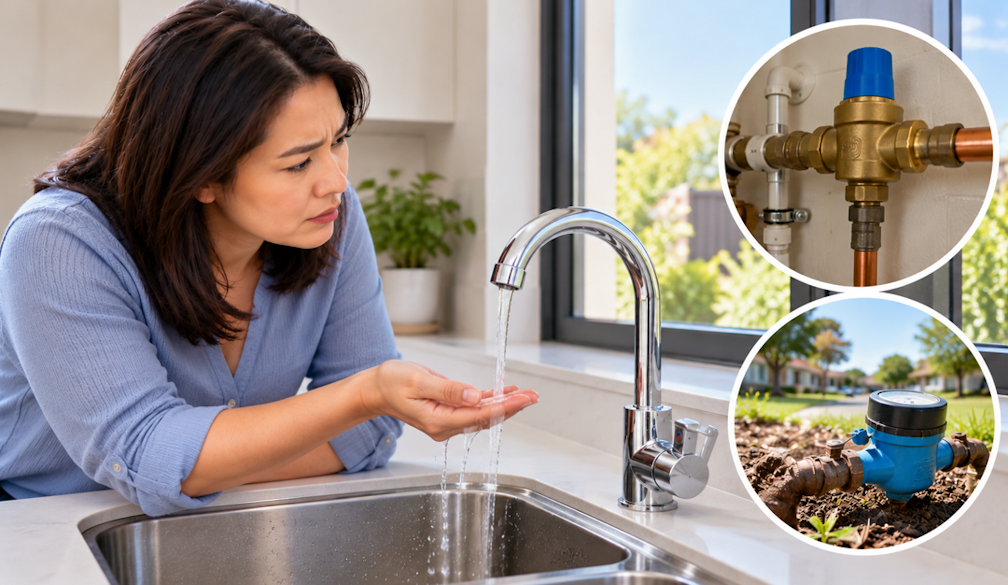
Low water pressure is one of those problems that can send a homeowner in the wrong direction. A weak shower might suggest a blocked tap. Several weak taps might suggest old pipework. But if the problem affects the whole property, the cause may lie before the water meter rather than inside the house.
For Sunbury residents, the first step is working out where the pressure changes.
A few simple comparisons can tell you whether to look at a single fixture, the property's private plumbing or the water supply coming into the property.
Start with one question: is every outlet weak?
If only one tap or shower has poor flow, the fault is usually local.
A blocked aerator, worn mixer cartridge, shower head, kinked flexible hose, or partly closed fixture valve can make one outlet feel weak while the rest of the house remains normal.
Test another tap nearby. Then test a cold tap in a different part of the home. If those are strong, there is little reason to blame the incoming water supply.
If every cold outlet is weaker than usual, the problem is broader. That is when the meter, main stop tap, private service pipe and local network become more relevant.
A Plumber Sunbury homeowner can investigate the private side, but it is worth checking whether the water authority has reported local works or a burst before paying for an unnecessary callout.
Sudden low pressure and gradual low pressure tell different stories
Timing is a valuable clue.
If pressure dropped suddenly this morning, consider what changed recently. Planned or emergency water works, a burst main, a partly closed stop tap after maintenance, or a fresh leak on the property can cause an abrupt change.
If pressure has been declining gradually for months or years, ageing private pipework, internal corrosion, scale or a long-term restriction becomes more plausible.
Renovations can change the pattern too. A new bathroom or additional outlet does not usually reduce static pressure by itself, but simultaneous use can expose a service pipe that is too restricted to deliver the flow the household now expects.
Write down when the problem began and whether it is constant or worse at certain times. That history can save a lot of trial and error.
Compare hot and cold before blaming the mains.
If cold water is strong but hot water is weak, the incoming supply is probably not the main problem.
The restriction may sit around the hot-water system, its valves, tempering equipment or hot-side pipework. If only the shower is weak on hot, the mixer or shower fitting may be responsible.
If both hot and cold are weak at every outlet, attention shifts back toward the property's incoming service or the local network.
This hot-versus-cold comparison helps separate general supply issues from hot-side restrictions.
Check the main stop tap and visible leaks
The main stop tap near the water meter should be fully open during normal operation. If plumbing work has recently been completed, it may have been left partly closed.
Do not force a seized valve. If it does not move normally, leave it for a plumber.
Look around the property for signs of leakage. A wet patch in dry weather, water running near the meter, unusually green grass along a service route or the sound of water when no fixtures are operating can indicate a concealed leak.
A leak does not always create a dramatic flood. Water escaping underground can reduce available flow at the house while remaining largely invisible from inside.
If the water meter continues moving when every tap and appliance is off, that can be a useful sign that water is going somewhere it should not.
The water authority can help separate supply problems from property problems
Yarra Valley Water advises customers with changed pressure to first check for reported bursts and planned works. It also describes a simple bucket test at the tap closest to the meter to help work out whether the issue appears to be before or after the meter.
The principle is straightforward: measure flow close to where water enters the property. If it is poor there, the issue may sit upstream. If it is adequate there but weak deeper inside, private plumbing becomes the stronger suspect.
This is far more informative than testing only the upstairs shower, where pipe length, valves and fixtures can all affect what you feel.
Older or restricted private pipework can reduce flow
A property can have adequate supply at the meter and still perform poorly at the taps because of corroded pipework, deposits, a damaged service line or undersized plumbing.
The effect often becomes clearer during peak household demand. One tap may seem acceptable, but opening a second outlet causes both to drop sharply.
A plumber can measure pressure and flow at different points rather than assuming the entire system has one value. That helps distinguish a local restriction from a service-pipe problem.
Do not try to fix low pressure by adjusting random valves
Pressure-control devices and valves may be installed for safety and system protection. Turning unfamiliar components can create leaks or excessive pressure elsewhere.
The correct solution depends on the cause. A blocked shower head needs a different repair from a leaking underground service. A partly closed stop tap needs a different response from a water-main issue.
A plumber can investigate private restrictions, while weak supply before the meter belongs with the water authority.
Build the diagnosis from comparisons
Before making the call, collect a few observations.
Is one outlet affected or all of them? Are hot and cold equally weak? Did the change happen suddenly? Is the pressure worse when two taps are used? Have there been recent works in the street or on the property? Is the meter moving when everything is off?
Those answers help identify which side of the meter deserves attention.
Low water pressure in a Sunbury home does not automatically mean the house needs new pipes, and it does not automatically mean the water network is at fault. The practical goal is to find where strong flow becomes weak.
Once that point is known, the right next step becomes much clearer: a fixture repair, private plumbing investigation or a call to the water authority rather than a costly guess.


 Daily Bulletin


