

The social factors that influence whether you’ll use your wearable device
- Written by: Deborah Lupton, Centenary Research Professor, University of Canberra
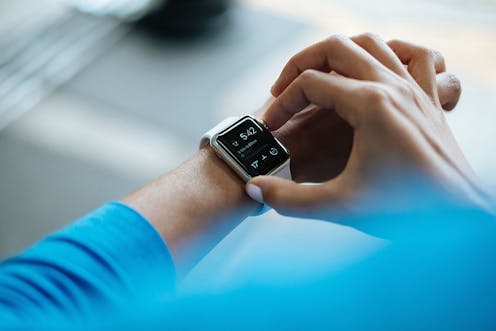
Christmas is upon us, and the New Year fast approaching. Many of us are buying wearable self-tracking devices for loved ones, or as part of our own New Year self-improvement regimes.
Wearable devices, as the name suggests, are technologies with digital sensors that can be worn in various ways on the body. It’s estimated that worldwide shipments of wearables this year will reach 125 million.
But how useful are they, and what benefits do they provide to users?
Read more: Fitbit’s decline is a reflection of the end of the over-hyped promise of wearables
The wearable craze
There is a now huge range of wearable devices available: smart sneakers to analyse your walking pattern, smartwatches to count your calories, wristbands to assess your sleep quality, and smart gloves to help you with your golf swing.
It makes sense that the companies that sell wearables, and the entrepreneurs who develop them, talk up these devices. However, industry blogs and market research suggest the excitement is beginning to wear off.
While sales for smartwatches, such as the Apple Watch, are healthy, Fitbit – one of the market leaders – has seen its fortunes decline.
Most research into wearable use involves surveys. For example, a 2016 survey of the Australian market showed that fewer than one in five respondents used wearables.
Colleagues and I have conducted three different qualitative studies with Australians aged from 18 to 75 years old about their use of wearables and smartphone apps for health and fitness.
The first study involved ten male and eight female cyclists who used digital devices to monitor their rides. The second study included 40 people (split evenly by gender) who were self-tracking for any purpose. The final study involved 55 women using a range of digital health technologies.
The research revealed some of the key reasons people use wearables and health apps, and why they give them up.
What wearables are good for
Taking control over health and wellbeing
Michael, a 35-year-old father, uses apps to track his food intake and physical activity. In his interview, he said,
To be a responsible husband, father and son, I need to track things, whether it be health or finances.
Providing motivation to achieve personal bests
Damon, 48, is a keen cyclist who uses a bike computer to monitor his cycling trips and he uploads his data to the cycling platform, Strava. In his interview, he confessed that,
I’m kind of obsessed with going for local course records or testing myself on certain courses.
Spurring healthy competition
Embarking on fitness tracking together with others can also increase motivation. Valerie, 62, uses the same type of fitness band as her husband. She commented that,
It’s fair to say that we engage in a little friendly competition.
This may mean that one of them sets out for a late-night walk, just to reach their target for the day.
Giving real-time feedback
Fitness trackers that allow users to review data in real-time can spur them to work harder to improve their numbers. Valerie said that,
If I actually get up to my 10,000 steps, you get the buzz and the flashing lights….So that’s pretty exciting!
Learning healthy behaviours
Some fitness trackers are useful for a limited time while they teach users healthy behaviours.
Jessica, 22, is a keen team sports player, and uses a calorie-counting app to help her lose weight and eat better. She commented that after using the app for some months,
I can now take a look at a plate of food and pretty accurately guess how many calories it has.
Creating a sense of community
Devices that plug into an online community of fellow fitness trackers can support efforts to improve fitness. Danielle, 35, shares her Fibit and Strava data and photos of her cycling trips with her friends. She said,
All my friends are very encouraging and I’m encouraging of them, particularly when they’re getting into cycling.
Read more: Downside of fitness trackers and health apps is loss of privacy
Why people give up on wearables
Goals feel unachievable
At times, fitness trackers can become a source of negativity by reminding users of what they’re failing to achieve.
Carolyn, 33, is a new mother who used to wear a Fibit to track physical activity, energy expended and sleep patterns. However, now that she has a small baby, she doesn’t want a device to make her feel even worse about her poor sleep and lack of exercise through detailed monitoring. She said,
My baby’s having a clingy day today - I could barely put him down this morning. As if I’m going to get 10,000 steps!
Reminders can become annoying
If circumstances prevent users from reaching fitness targets, constant alerts can prompt them to switch off. Valerie has a demanding desk-bound job and can’t easily jump to her feet just because her device is asking her to. She describes her wearable as sometimes “pestering” her.
Lack of community support
If friends, partners or family members aren’t supportive, this can make a big difference to success with wearables.
Friends of sportswoman Jessica sometimes criticise her for paying so much attention to her diet and weight using a calorie-counting app. She said,
I think there’s a real stigma about calorie counting. It’s like a bad thing and it means you’re preoccupied with the way you look or you’re not happy within yourself.
Read more: The way we walk can be used to power and secure our devices
As these participants’ stories show, people’s social networks, employment conditions and life stages are integral to their use of wearable devices. Understanding how these factors have an impact on the use of fitness trackers can help you make the best use of your wearable device.
So if you’re considering buying a Fitbit for a relative who’s a new mother, you should think about whether she has the time or inclination for self-tracking right now. If you’re chained to a desk job, you might choose a device that won’t send you alerts during the day. And if your friends and family won’t support your self-tracking activities, you might want to join an online community that will.
Authors: Deborah Lupton, Centenary Research Professor, University of Canberra


 Daily Bulletin


