

Grattan on Friday: Migration debate deserves better policy approach and less politicking from Liberals
- Written by: Michelle Grattan, Professorial Fellow, University of Canberra
An effective opposition is good at policy. Last term and so far this term, the Coalition has been very poor at policy formulation.
Remember Peter Dutton’s defence policy? If you don’t, it’s probably because it was just a commitment to spend a lot more. No flesh on that bone. On the controversial nuclear policy, Liberals will admit they erred in not having costings much earlier.
Now the opposition is at high risk of making a hash of producing an immigration policy, an issue it’s putting at the centre of its (still to come) suite of offerings to voters.
“We are a serious party that needs to provide serious policy alternatives,” home affairs spokesman Jonno Duniam said on Wednesday when trying to defend Opposition Leader Angus Taylor’s Tuesday announcement of a get-tough-on-values sliver of the policy.
Taylor’s speech has been widely seen as a bid to attract voters back from One Nation, especially with the Farrer byelection looming. Clearly, as a first instalment of the Coalition’s immigration blueprint, it has been driven primarily by politics.
So what should be the approach to crafting and presenting a sound policy on immigration which, despite Labor’s 2023 Review of the Migration System report, requires reform?
Such a policy should be multi-tiered, and all of it should be released together because in immigration, as the old saying goes, everything is connected to everything else.
The first tier is the desirable overall intake. The latest net overseas migration (NOM) number was 311,000 in the year to the end of September, which the government is committed to reducing. The opposition wants a lower, as yet unspecified, number.
What would be the best level is contested among experts and stakeholders, with debate about the implications for economic growth and pressures on infrastructure, housing and services.
In deciding the appropriate level of temporary migration, the importance of our education export industry and the implications of cuts for the higher education sector, as well as the needs of agriculture, must be considered.
Having decided on numbers, the next tier should look at how to get the best out of our skilled intake.
Former treasury secretary Martin Parkinson, who led the government’s review, recently highlighted the economic waste we are allowing by failing to properly use the skills of people coming at present. Parkinson said almost half of all permanent migrants were working below their skill level.
He argued for an independent skills and qualifications commissioner to oversee an end-to-end recognition system, from visas to occupational licences to employment.
Another issue that should be addressed is the composition of the skilled intake, to tilt further towards people qualified in occupations we require. There is also the question of shortages in unskilled and semiskilled labour for the care economy.
The third tier goes to Taylor’s concerns regarding “values”. At one level this is about specifics: making sure the security checks are rigorous enough, and dealing more toughly with lawbreakers who are on visas.
But at another level, coming to grips with the “values” debate is wrestling with a puff of smoke.
How does one judge whether someone really believes in democracy and free speech, let alone “a fair go for all” – some of the commitments set out in the Australian Values Statement that immigrants sign, which the opposition now wants to make legally binding. What would breaches look like? Anyway, what precisely are some of these values in practice? For instance, the political class is currently debating the concept of “free speech” in the context of anti-hate laws.
As for Taylor’s point that people from liberal democracies are more likely to share or accept our values than those from “places ruled by fundamentalists, extremists and dictators”: this is a sweeping generalisation. Exceptions spring readily to mind. One of the Bondi gunmen came from India, the world’s largest democracy. We have admirable migrants from Russia.
Taylor is preoccupied with the cohort who arrived from Palestine after the start of the Middle East conflict, and wants them all reassessed. But does ASIO have current concerns that these people pose a threat? If not, calling for comprehensive reassessment is just stirring.
The issue of values merges into the fourth tier of a comprehensive immigration policy: better tending our multicultural garden. This means improving migrants’ integration into the wider community, while recognising they will continue to value their heritages and maintain their links to their individual communities.
Assistant Citizenship and Multicultural Affairs Minister Julian Hill, in a February speech, highlighted the important balance that must be sought.
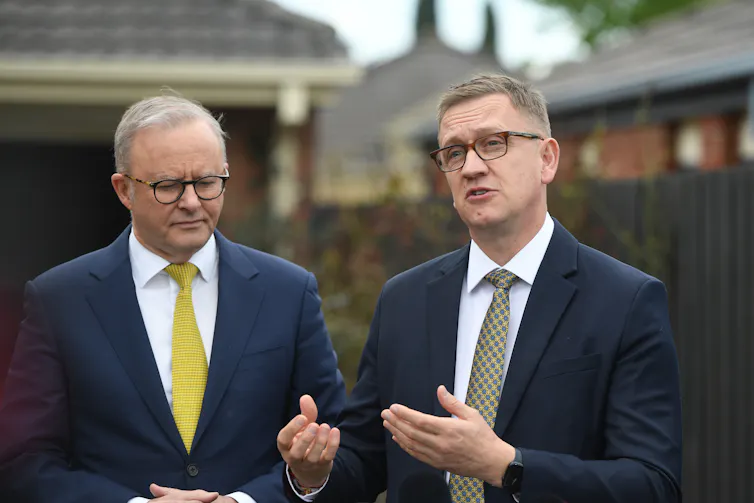
Hill said people’s right to express their cultural identities was not absolute. “Obligations for everyone include: one, a shared and unifying commitment to Australia first and foremost; two, acceptance of the basic structures and principles of Australian society including the constitution, tolerance, parliamentary democracy, equality and English as the national language; and three, accepting the right of others to express their views and values.”
Hill, from Labor left and with a message for the left generally, said, “One challenge for the progressive Left with our instinctive values-based focus on rights, is to remember that there are limits to cultural expression, and to champion the obligations that come with being Australian”.
“Successful multiculturalism means cherishing communal identities, building bridges between diverse groups and celebrating things we all have in common,” Hill said.
Labor has fallen down in reinforcing Australian multiculturalism, the Liberals are divided about multiculturalism itself, while One Nation rejects it.
As they finalise the rest of their immigration policy, the Liberals need to resolve the internal ambiguities they have on macro questions, including the value of migration in general and whether the opposition is committed to sticking by and improving multiculturalism, as well as myriad details such as how to make better use of the skills of migrants.
As things stand, the Liberals sound like they are primarily about exploiting the inflammatory politics of migration rather than doing the grunt work to produce a policy that attacks the obvious problems in the present system.
Authors: Michelle Grattan, Professorial Fellow, University of Canberra


 Daily Bulletin


