

Read The Times Australia

Daily Bulletin

Natural hydrogen can make decarbonising industry cheaper – NZ’s turbulent geology could give it an edge

  • Written by: Ian Wright, Professor in Marine Geology, University of Canterbury

Hydrogen is emerging as a critical part of the low-carbon transition for industries where electrification is not a straightforward solution.

This includes the production of steel, fertiliser and methanol as well as long-haul transport. In New Zealand, these industries account for about 17% of total emissions.

Hydrogen could replace these emissions but this would require annual production of 600,000 to one million tonnes. The cost of producing low-carbon hydrogen is a critical factor.

Currently, “green” hydrogen – made by splitting water with renewable electricity – costs more than NZ$12 per kilogram.

Long-haul transport companies have already invested in green hydrogen, but it remains too expensive for heavy industry or large-scale chemical production. For these industries, the tipping point for economic viability is closer to $4–5 per kilogram.

But New Zealand could be uniquely placed to explore a potentially cheaper option – “natural” or geological hydrogen which the Earth produces and, in some cases, traps in underground reservoirs.

Around the world, researchers and companies are already turning their attention to natural hydrogen.

Near-pure hydrogen has been extracted at a single gas field in Mali, attracting interest from governments in the United States, Canada and Australia.

There is also interest from major international resource companies. By the end of 2023, 40 companies were exploring natural hydrogen globally.

One key process in the accumulation of natural hydrogen is “serpentinisation” – a reaction between water and iron-rich ultramafic rocks. When water alters these minerals, it converts ferrous iron to ferric iron, releasing hydrogen in the process.

The richer the rock is in iron, the more hydrogen is produced. Under the right conditions, these rocks can generate hydrogen at potentially economic scales.

Laboratory-based research shows that at the right temperature and pressure conditions, up to 0.6 kilograms of hydrogen can be released from a cubic metre of ultramafic rock (if it contains the right iron-rich minerals).

New Zealand’s turbulent geological history provides an unusual advantage.

The landscape has been shaped by major episodes of tectonic collision. Rapid and complex uplift of mountain ranges, active plate subduction and regular ruptures of faults that penetrate through the crust create exactly the kinds of geological settings where natural hydrogen can potentially form and accumulate.

Four promising geological situations stand out.
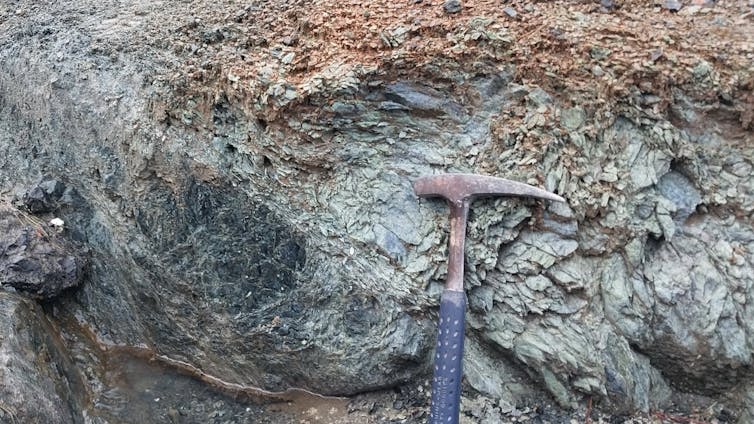
Exposed ultramafic rocks within the West Dome quarry.
Ultramafic rocks, such as this exposed within the West Dome quarry in the South Island, can be a source of hydrogen. Paul Viskovic, CC BY-NC-ND

1. Belts of ancient ultramafic rock have been pushed up from deep in the Earth’s crust on both islands. In the North Island, many of these rocks lie beneath major industrial centres, raising the possibility of local “on-demand” hydrogen production close to where it would be used.

2. High-temperature geothermal systems drive powerful circulations of groundwater, enabling the generation and transport of hydrogen from magma.

3. Off the east coast of the North Island, the Pacific plate is being forced under New Zealand in a region known as the Hikurangi subduction zone. As it sinks, chemical reactions including serpentinisation produce methane and hydrogen.

Observed phenomena of this process include the presence of methane hydrates and seeps as well as plume emissions, mud volcanoes, hot springs and localised seeps of hydrogen.

Natural hydrogen can make decarbonising industry cheaper – NZ’s turbulent geology could give it an edge
Hyper-saline seep and mud volcano at Glenburn along the Hikurangi subduction margin. Paul Viskovic, CC BY-NC-ND

4. Major faults in the South Island, including the Alpine Fault, act as deep conduits, allowing water to interact with ultramafic rocks.

In Fiordland, a remarkable site has vented gas that is 76% hydrogen for at least 40 years. This is one of the more notable seeps of natural hydrogen known worldwide.

These factors make New Zealand unusually well suited to natural hydrogen exploration. The country’s active geology, often thought of as a hazard, could also be a critical resource.

Researchers and industry are beginning to investigate whether these sources could provide hydrogen at $4–5 per kilogram or less. If natural hydrogen proves viable, New Zealand’s unique geology could put the country at the forefront of a new global energy frontier.

The authors acknowledge contributions by University of Canterbury colleagues David Dempsey, Jannik Haas, Rebecca Peer and Matt Watson.

Authors: Ian Wright, Professor in Marine Geology, University of Canterbury

Read more https://theconversation.com/natural-hydrogen-can-make-decarbonising-industry-cheaper-nzs-turbulent-geology-could-give-it-an-edge-273210

Business News

How Telematics Helps Australian Companies Improve Productivity

Operating a commercial fleet in Australia is a uniquely demanding endeavour. Between the sprawling urban sprawl of cities like Sydney and Melbourne and the immense, unforgiving stretches of the Outb...

Daily Bulletin - avatar Daily Bulletin

Inside the Icon: The BridgeMuseum Officially Opens at the Sydney Harbour Bridge

A bold new way to experience one of Australia’s most recognisable landmarks has arrived, with BridgeClimb Sydney officially opening the all-new BridgeMuseum.  Located inside the Sydney Harbour Brid...

Daily Bulletin - avatar Daily Bulletin

Is Your Brand Showing Up in AI Search? Most Melbourne Brands Aren't.

The New Front Door Nobody Told You About Something changed. Quietly. Without a press release. The way buyers find businesses in Australia has been rewired. Not replaced, rewired. Google isn't dead...

Daily Bulletin - avatar Daily Bulletin

How Australian Businesses Can Measure SEO ROI

SEO can feel vague when you are staring at a dashboard full of numbers that do not clearly connect to revenue. The key is to measure the right signals in the right order, then tie them back to outcome...

Daily Bulletin - avatar Daily Bulletin

How Commercial Roller Shutters Improve Site Security Without Slowing Operations

Security upgrades can be frustrating when they make everyday work harder. A door that takes too long to open, creates bottlenecks at shift change, or fails at the worst time can turn “better protectio...

Daily Bulletin - avatar Daily Bulletin

Why a Document Destruction Service Still Matters for Modern Businesses

Businesses generate large volumes of information every day, from staff records and contracts to invoices, reports and customer files. While attention often focuses on how documents are stored, the way...

Daily Bulletin - avatar Daily Bulletin

Bicycle Rack Safety and Space-Smart Storage

Bike storage problems usually show up as small annoyances first: tangled handlebars, scratched frames, and bikes that topple when you pull one out. Over time, those issues become safety risks, especia...

Daily Bulletin - avatar Daily Bulletin

How to Tell if a Childcare Centre Is a Good Fit for Your Child

Choosing childcare can feel like you’re making a huge decision with limited information. Tours are short, centres are often on their best behaviour, and your child might act differently in a new space...

Daily Bulletin - avatar Daily Bulletin

Car Import Timeline: What Usually Happens at Each Stage

Importing a car into Australia can feel confusing because multiple agencies and checkpoints are involved, and the timeline is shaped as much by paperwork quality as it is by shipping speed. The most u...

Daily Bulletin - avatar Daily Bulletin

The Daily Magazine

Gold Migration Lawyers in Liquidation: How the Closure Affects Your ART Appeal

If your appeal was with Gold Migration Lawyers, a recent change to how the Tribunal decides cases ...

The pressure cooker: life in urban Australia in 2026

Australian cities have always been demanding. Long commutes, rising housing costs, busy schedules a...

What Actually Makes a Good Criminal Lawyer in Melbourne

Most people only think about this question once. That is usually too late. Most people charged wi...

Why Working With A Chatswood Tutor Can Improve Academic Performance

Academic expectations continue increasing for students across primary school, high school, and senio...

Is It Worth Getting Solar Panels in Melbourne?

The real question is not whether solar works in Melbourne. It works. The question is what it is co...

How A Diploma Of Project Management Builds Practical Skills For Modern Work Environments

Developing the ability to plan, execute, and deliver outcomes efficiently is a key requirement in to...

How to Choose the Right Football for Every Level

Choosing a football may seem straightforward, but the right option depends on who will be using it a...

What to Ask a Wedding Photographer Before You Book

Booking a wedding photographer can feel deceptively simple: you like the photos, you like the vibe...

Why Stress Relief For Dogs Is Essential For Emotional Balance And Long-Term Wellbeing

Managing emotional health is just as important as physical care when it comes to pets, which is why ...