

Read The Times Australia

Daily Bulletin

12,000-year-old rock art marked ancient water sources in Arabia’s desert

  • Written by: Maria Guagnin, Director, Ha’il Archaeology Identification Project, University of Sydney; Max Planck Institute of Geoanthropology
12,000-year-old rock art marked ancient water sources in Arabia’s desert

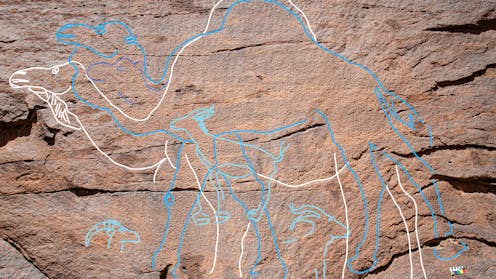
About 12,000 years ago, high up on a cliff in the desert of northern Arabia, an artist – or perhaps artists – was hard at work.

Standing on a narrow ledge and with primitive tools, they engraved into the rock an image of a life-sized camel. This wasn’t the first artwork of its kind: in fact, there was already an entire row of fresh camel engravings on the 39-metre-high cliff face, below which a shallow lake sparkled in the sunshine.

Over thousands of years, these engravings weathered the elements. They gradually eroded until they were almost invisible and had been forgotten.

That is, until our international team discovered them and more than 170 others while on a field trip to the region, which sits near the southern edge of the Nefud Desert in Saudi Arabia, roughly two years ago.

As we explain in a new study, published today in Nature Communications, the engravings would have marked important desert water sources – and demonstrate the resilience and innovation of people who lived in such a harsh, arid environment.

A barren, rocky desert under a clear blue sky.
The engravings are near the southern edge of the Nefud Desert in Saudi Arabia. Sahout Rock Art and Archaeology Project

Searching for clues

Our earlier research had shown that between 10,000 and 6,000 years ago Arabia was much wetter than it is today.

Grasslands had spread into areas that are now desert, and cattle herders used these pastures for their herds.

The rock art they left behind is well known from two UNESCO World Heritage sites.

We could see there was also older rock art at these UNESCO sites. It was much larger and more detailed, showing life-sized and naturalistic camels and wild donkeys. But it was not clear how old it was. So in May 2023 we set out to find more of this ancient rock art in the hope of finding clues about its age.
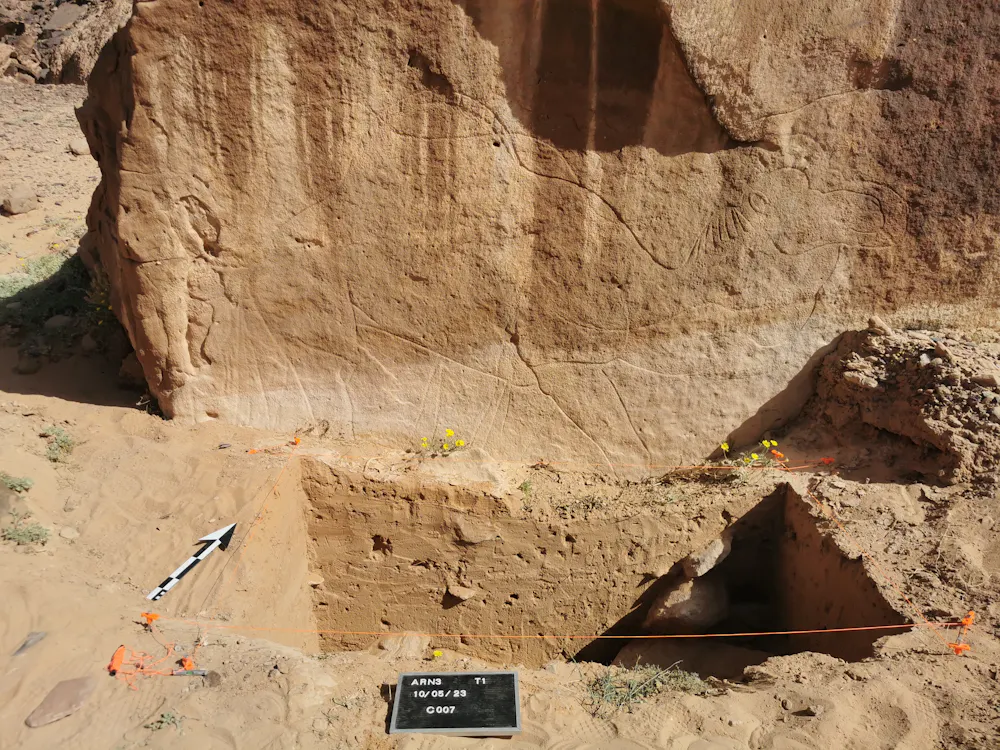
A sand-coloured rock face, featuring an engraving of a large camel.
The newly discovered engravings include 130 images of large, life-sized animals – camels, ibex, wild donkeys, gazelles and aurochs. Sahout Rock Art and Archaeology Project

Life-sized engravings

In total, we identified more than 60 rock art panels containing 176 engravings in three previously unexplored areas – Jebel Arnaan, Jebel Mleiha and Jebel Misma. The engravings include 130 images of large, life-sized animals – camels, ibex, wild donkeys, gazelles and aurochs. Some are almost three metres long and more than two metres high.

We reached the first panel via a long off-road track which cut through a beautiful mountain landscape. A cool breeze made the heat of the emerging Saudi summer bearable.

The rock art panel showed two large camels, one on top of the other. The older camel looked as though it was in motion and about to stand up, the other like it was striding across the rock surface.

We were excited to find undisturbed archaeological layers directly beneath the engraved camels. In one sealed layer we even found an engraving tool that was once used to make rock art.

Luminescence dating – a dating method that measures when sediment was last exposed to sunlight – revealed the layer in which the tool was found is about 12,000 years old.

The same layer also contained artefacts that are typical for this time, including small arrowheads, stone beads and even a bead made from a seashell.

A hand holding a small arrowhead. An arrowhead uncovered during excavations. Michael Petraglia

A far-reaching network

These artefacts tell us the people who made the rock art were part of a far-reaching network. They used the same stone tools and jewellery as communities in the Levant, 400 kilometres further north.

Significantly, our team also discovered the rock art was placed near ancient seasonal lakes.

At the end of the last ice age, during the Last Glacial Maximum, the climate was extremely dry.

These lakes, dated at roughly 15,000 years, are the first evidence of surface water returning to Arabia following the extremely arid period. And they move the timeline of the returning humid conditions back thousands of years, enlarging the opportunity window for humans to settle in these dry inland conditions.

Our results show 12,000 years ago, humans were able to use these seasonal lakes to survive in the desert. They marked these water sources, and the paths leading to them, with monumental rock art.

We don’t know why they did this. But even for us today, the camel is a striking symbol for survival in the desert.

Authors: Maria Guagnin, Director, Ha’il Archaeology Identification Project, University of Sydney; Max Planck Institute of Geoanthropology

Read more https://theconversation.com/12-000-year-old-rock-art-marked-ancient-water-sources-in-arabias-desert-266144

Business News

How Immigration Lawyers Can Help

Introduction Visa decisions can shape employment, family life, study plans, travel, and future residence. A small omission can lead to delay, added expense, or refusal. Immigration lawyers assess l...

Daily Bulletin - avatar Daily Bulletin

How Industrial Drying Equipment Supports Efficient Processing

Many industrial processes require moisture to be removed from compressed air, products or process materials before they move to the next stage. Excess moisture can affect equipment performance, produc...

Daily Bulletin - avatar Daily Bulletin

Practical Ways a Whiteboard Can Improve Workplace Communication

Effective communication helps teams stay organised, share ideas and keep track of important information. While digital tools are now common in many workplaces, a whiteboard continues to provide a simp...

Daily Bulletin - avatar Daily Bulletin

Designing Eco-Friendly Custom Water Bottles for Your Next Event

The Evolution of Sustainable Event Merchandise Event planning has undergone a massive transformation over the last decade. Gone are the days when organizers could hand out cheap, single use plastic...

Daily Bulletin - avatar Daily Bulletin

Why Choosing a Professional Florist Melbourne Makes Flower Delivery Impactful

Flowers have a great power to speak when humans cannot express their feelings with right words. Flowers are the best gifts when you are celebrating a birthday or welcoming a newborn child into your fa...

Daily Bulletin - avatar Daily Bulletin

The Business Case for Choosing Australian Fabricators Over Imported Alternatives

For a long time, you might have defaulted to overseas suppliers when sourcing fabricated metal components for a project. The unit price was lower on paper, and the maths seemed straightforward. That...

Daily Bulletin - avatar Daily Bulletin

Australian organisations are relying on business continuity plans built for a far more predictable world

Tariff escalations, supply chain fragility, geopolitical events, and the ongoing threat of cyber disruption have reshaped the risk environment facing Australian organisations. The problem is that ma...

Daily Bulletin - avatar Daily Bulletin

How to Rent a Car for Uber in Melbourne: What Every New Driver Needs to Know

Starting out as an Uber driver in Melbourne is not as complicated as it sounds but getting the vehicle right is where most new drivers get stuck. Uber has strict requirements around vehicle age, condi...

Daily Bulletin - avatar Daily Bulletin

When Should You Speak to a Lawyer About a Legal Issue?

Legal issues can begin with a simple question, then become harder to manage once formal steps are involved. Many people wait until a matter feels urgent before seeking guidance, even though earlier ...

Daily Bulletin - avatar Daily Bulletin

The Daily Magazine

How Long Does Interstate Freight Take in Australia?

If you have ever arranged for stock, equipment or materials to travel from one Australian state to a...

How AEC Firms Can Scale Faster Without Sacrificing Project Quality

Growth presents a fundamental dilemma for architecture, engineering, and construction firms: expan...

What Makes an Aesthetic Clinic Worth Going Back To?

Trying an aesthetic clinic for the first time can feel like a bit of a gamble. You can read review...

Elevate Your Morning Routine with Cafe-Style Coffee at Home with the Right Coffee Machine

There's something magical about that first sip of coffee in the morning. It’s more than just a bev...

Top Garment Steamers for Busy Professionals in Australia

The gap between garment steamers built for a quick touch-up and ones built to keep pace with a wor...

Correct Sleeping Posture to Minimize Back Strain

Most people don’t pay much attention to how they sleep until they start waking up with a stiff bac...

Why Product Longevity Matters for Sustainable Australian Buildings

Sustainability in building design is often associated with recycled materials, renewable resources a...

NDIS Support Coordination Explained: What Does a Support Coordinator Actually Do?

NDIS support coordination explained means understanding how a professional can help participants n...

When Should You Speak with Divorce Lawyers in Sydney?

Divorce involves more than completing an online application. It can affect parenting arrangements, p...