

Explainer: what mental health support do refugees and asylum seekers get in Australia?
- Written by: Philippa Specker, Postdoctoral Research Fellow at the Refugee Trauma and Recovery Program, School of Psychology, UNSW Sydney
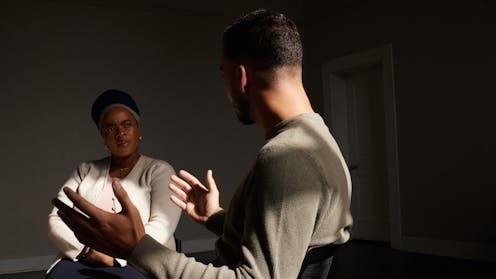
When Australia signed the United Nations 1951 Refugee Convention, it committed to providing protection to people who have fled war, persecution and human rights violations.
Refugees have often experienced severe traumatic events. This can include war, torture, kidnapping and witnessing the murder of loved ones.
Understandably, refugees are more likely than the general population to experience mental health problems. About 27% of adult refugees suffer from post-traumatic stress disorder (PTSD) and 30% from depression. Only 5.6% of Australians experience PTSD and 6.4% experience depression.
Australia has a humanitarian and legal responsibility to support the mental health of refugees and asylum seekers so they can recover and thrive.
Mental health problems are highly treatable when people have access to effective treatment. Addressing key barriers to accessing mental health services is in everyone’s best interest.
So, what mental health support is available for refugees when they arrive in Australia?
Different pathways
Much depends on how the person came to Australia and through which scheme they applied to be recognised as a refugee.
First, there are people who apply for and are granted refugee status by the United Nations High Commissioner for Refugees (UNHCR) or Australia’s humanitarian program before arriving in Australia.
These people, often termed “humanitarian entrants”, represent the largest cohort of Australia’s refugees.
They are provided with permanent visas and join the government-run Humanitarian Settlement Program upon their arrival.
Humanitarian Settlement Program caseworkers can refer these people to internal or external mental health support services.
Importantly, people under Australia’s humanitarian program can also access vital services such as:
- Medicare
- Centrelink
- English-language classes.
They also have the right to work and study. This helps promote recovery, adjustment and wellbeing.

Second, there are people who sought asylum via alternate pathways.
This often means they arrived in Australia without a valid visa. Or, they may have held a non-refugee visa and subsequently applied for refugee status after arriving in Australia.
These people, termed “asylum seekers”, are in a much more precarious situation.
They face lengthy visa processing times, the possibility of being held in detention, and a greater likelihood of being granted only temporary visas.
Many people in this situation are restricted from accessing government-run settlement support, such as the Humanitarian Settlement Program and Centrelink.
This is a problem, because research shows people seeking asylum or holding temporary visas in Australia are especially likely to be experiencing mental health problems.
A range of services
That said, Australia has a range of mental health support services available to all refugees and asylum seekers.
This includes the Forum of Australian Services for Survivors of Torture and Trauma (FASSTT), a network of rehabilitation centres in every state and territory.
These specialised services provide holistic support including:
Organisations such as Settlement Services International, Australian Red Cross, AMES and Beyond Blue also provide refugee-specific mental health supports and resources.
And some community-run social programs, such as Football United, focus on increasing social inclusion, which can help boost mental health.

Barriers to access
Demand for specialised mental health services is high. That can mean long waiting times for all Australians, including refugees and asylum seekers.
Research has identified a number of barriers that especially affect refugees and asylum seekers. These include:
- stigma around mental health problems and help-seeking
- lack of knowledge on mental health
- language and cultural barriers, and
- logistical barriers (such as cost and travel distance).
Finally, some refugees (particularly asylum seekers or people with temporary visas) may not be as aware of mental health services as humanitarian entrants. The latter group are often connected with such services while part of the Humanitarian Settlement Program.
This puts the onus on such individuals to independently research what services are available and refer themselves.
That’s a tough ask for people also busy finding housing, learning English, enrolling children in school, and progressing their visa applications.
Why does this matter?
Refugees represent a significant portion of our society. By the end of this year, Australia will have welcomed 1 million refugees since the end of World War II.
International law dictates that survivors of torture and other forms of persecution under Australia’s protection have access to effective rehabilitation services.
More broadly, the psychological cost of trauma can make it harder for some refugees to adapt to life in Australia. PTSD and depression can be chronic conditions. Without effective treatment, mental health challenges can persist for decades.
Helping refugees recover from the psychological effects of trauma and displacement also promotes the prosperity of the wider community. That’s because refugees enrich Australian society by establishing local businesses, working, facilitating new trade links, volunteering and contributing to the community.
When refugees thrive, we all do.
Authors: Philippa Specker, Postdoctoral Research Fellow at the Refugee Trauma and Recovery Program, School of Psychology, UNSW Sydney


 Daily Bulletin


