

Why film and TV creators will still risk it all for the perfect long take shot
- Written by: Kristian Ramsden, PhD Candidate, University of Adelaide
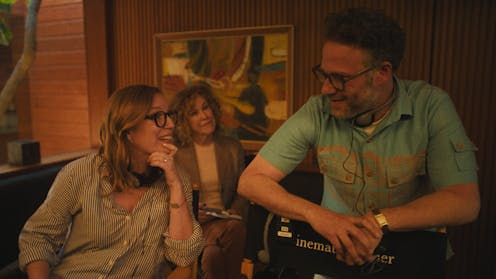
In the second episode of Apple TV’s The Studio (2025–) – a sharp satirical take on contemporary Hollywood – newly-appointed studio head Matt Remick (Seth Rogen) visits the set of one of his company’s film productions.
He finds the crew anxiously attempting to pull off an extremely audacious and technically demanding shot known as a “oner”, or “long take”. Chaos ensues.
But despite the difficulties associated with it, the long take has a long history and continues to be a promising creative choice in contemporary film and television.
High stakes on the set
The long take is a shot which captures a scene in a single, unbroken take.
It’s a risky endeavour. While most film and TV production is constructed through the use of coverage – different shots edited together – the long take can’t hide behind the editing process. Every minute detail needs to be perfectly planned, executed and captured.
As a result, the oner is often associated with big, ostentatious, showstopping set pieces that exemplify technical and directorial prowess. Think of the “Copacabana” sequence from Goodfellas (1990), or the opening scene of Children of Men (2006).
The shot has gained a cultish type of reverence among film enthusiasts, with countless online articles and videos counting down the “best long takes in film history”.
Yet the practice also has its detractors. Film critic A.A. Dowd’s recent article for The Ringer says that “to the unimpressed, oners often come across as an act of glorified self-glorification”.
This dichotomy is also highlighted in The Studio, when one executive complains long takes are just directors showing off. Rogen’s character counters the oner is, in fact, “the ultimate cinematic achievement”.
A theory of the long take
The long take has existed in nearly every stage of film history – from silent films to sound, from Asian films to European, and from art-house to mainstream.
The greatest advocate of the long take was arguably French film theorist André Bazin. In his piece The Evolution of Film Language, Bazin argued cinema’s greatest asset was its ability to capture reality – and the long take was central to his understanding of how film achieved that.
For Bazin, editing “did not show us the event, but alluded to it”. To illustrate his point, he examines a scene from Robert Flaherty’s controversial silent documentary Nanook of the North (1922), in which a hunter patiently waits for his prey.
The passage of time could have been suggested by editing but, as Bazin notes, Flaherty “confines himself to showing the actual waiting period”. If the act of editing creates a synthetic manipulation of space and time, then the long take does the opposite – bringing us closer to a true representation of reality. For Bazin, the length “is the very substance of the image”.
The tradition of the long take – of showing “reality” – is perhaps most upheld in the world of art-house cinema. Directors such as Chantal Akerman, Béla Tarr, Hou Hsiao-Hsien and Tsai Ming-liang have used the long take to “de-dramatise” narrative, creating a deliberately slow pace to prompt audiences to contemplate aspects of existence traditional narratives usually ignore.
Mainstream cinema also uses the long take to show “reality”, albeit in a different manner. Here, the long take has often been used as a mark of authenticity for the amazing feats of practical performers, whether this is the wild stunts or camera trickery of Buster Keaton, the balletic graces of Fred Astaire and Ginger Rogers or this white-knuckled fight scene from The Protector (2005), starring Thai martial artist Tony Jaa.
However, our strong association between the oner and a distinct directorial vision likely began with Citizen Kane (1941). In this film, screen reality itself is manipulated, as director Orson Welles and cinematographer Gregg Toland liberated the camera to move as if it was its own player in the drama.
In the below example, the camera starts outside, before reversing backwards through a window and two different rooms. The actors are constantly repositioning themselves around the camera for dramatic impetus, rather than for reality.
Bazin would refer to this as “shooting in depth”. Subsequent auteurs also embraced this technique, including William Wyler, Max Ophüls, Stanley Kubrick and Steven Spielberg.
Many viewed it as a chance to up the ante from Welles, something the director did himself with the remarkable opening sequence of his 1958 film Touch of Evil.
The future of the long take
There are far too many oners for me to list here, and they seem to only be increasing. It’s now common to see entire films seemingly shot in one take, such as Russian Ark (2002), Birdman (2014), 1917 (2019) and Boiling Point (2021), to name a few.
Technological advancements have made the long take more achievable. Camera stabilisers enable greater freedom of movement, while digital camera tech allows us to record for longer durations.
Furthermore, digital compositing has made it easier to fake the long take, such as in Birdman and 1917. Both of these films use multiple long takes that are strategically edited to look like a single shot. Impossible-to-see cuts may be hidden in dark moments, or through fast whip pans.
Prestige television has also lifted the oner practice, with examples from shows such as Mr. Robot (2015-19), True Detective (2014–), The Bear (2022-), Severance (2022) and, of course, The Studio.
But perhaps the most remarkable recent example comes from Netflix’s Adolescence (2025), a show in which four separate standalone episodes are all shot in a single long take.
In the age of TikTok and shortening attention spans, it should strike us as positive to see a resurgence of the long take as a creative choice in so much contemporary film and TV.
Authors: Kristian Ramsden, PhD Candidate, University of Adelaide


 Daily Bulletin


