

Sniping koalas from helicopters: here’s what’s wrong with Victoria’s unprecedented cull
- Written by: Liz Hicks, Lecturer in Law, The University of Melbourne
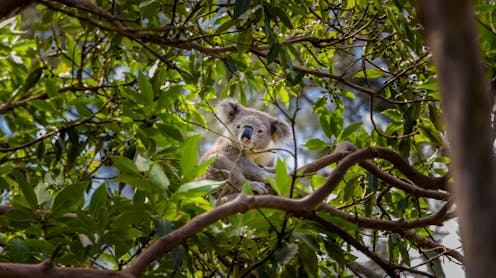
Snipers in helicopters have shot more than 700 koalas in the Budj Bim National Park in western Victoria in recent weeks. It’s believed to be the first time koalas have been culled in this way.
The cull became public on Good Friday after local wildlife carers were reportedly tipped off.
A fire burned about 20% of the park in mid-March. The government said the cull was urgent because koalas had been left starving or burned.
Wildlife groups have expressed serious concern about how individual koalas had been chosen for culling, because the animals are assessed from a distance. It’s not clear how shooting from a helicopter complies with the state government’s own animal welfare and response plans for wildlife in disasters.
The Victorian government must explain why it is undertaking aerial culling and why it did so without announcing it publicly. The incident points to ongoing failures in managing these iconic marsupials, which are already threatened in other states.

Why did this happen?
Koalas live in eucalypt forests in Australia’s eastern and southern states. The species faces a double threat from habitat destruction and bushfire risk. They are considered endangered in New South Wales, Queensland and the Australian Capital Territory.
In Victoria, koala population levels are currently secure. But they are densely concentrated, often in fragments of bush known as “habitat islands” in the state’s southwest. Budj Bim National Park is one of these islands.
Over time, this concentration becomes a problem. When the koalas are too abundant, they can strip leaves from their favourite gums, killing the trees. The koalas must then move or risk starvation.
If fire or drought make these habitat islands impossible to live in, koalas in dense concentrations often have nowhere to go.
In Budj Bim, Victoria’s Department of Energy, Environment and Climate Action and Parks Victoria have tackled koala overpopulation alongside Traditional Owners by moving koalas to new locations or sterilising them.
But Budj Bim is also surrounded by commercial blue gum plantations. Koalas spread out through the plantations to graze on the leaves. Their populations grow. But when the plantations are logged, some koalas have to return to the national park, where food may be in short supply.

Animal welfare groups say logging is one reason Budj Bim had so many koalas.
It’s hard to say definitively whether this is the case, because the state environment department hasn’t shared much information. But researchers have found habitat islands lead to overabundance by preventing the natural dispersal of individuals.
So why was the culling done? Department officials have described the program as “primarily” motivated by animal welfare. After the bushfire last month, koalas have been left starving or injured.
Why shooters in helicopters? Here, the justification given is that the national park is difficult to access due to rocky terrain and fire damage, ruling out other methods.
Euthanising wildlife has to be done carefully
Under Victoria’s plan for animal welfare during disasters, the environment department is responsible for examining and, where necessary, euthanising wildlife during an emergency.
For human intervention to be justified, euthanasia must be necessary on welfare grounds. Victoria’s response plan for fire-affected wildlife says culling is permitted when an animal’s health is “significantly” compromised, invasive treatment is required, or survival is unlikely.
For koalas, this could mean loss of digits or hands, burns to more than 15% of the body, pneumonia from smoke inhalation, or blindness or injuries requiring surgery. Euthanised females must also be promptly examined for young in their pouches.
The problem is that while aerial shooting can be accurate in some cases for larger animals, the method has questionable efficacy for smaller animals – especially in denser habitats.
It’s likely a number of koalas were seriously injured but not killed. But the shooters employed by the department were not able to thoroughly verify injuries or whether there were joeys in pouches, because they were in the air and reportedly 30 or more metres away from their targets.
While the department cited concerns about food resources as a reason for the cull, the state’s wildlife fire plan lays out another option: delivery of supplementary feed. Delivering fresh gum leaves could potentially have prevented starvation while the forest regenerates.
What should the government learn from this?
The state government should take steps to avoid tragic incidents like this from happening again.
Preserving remaining habitat across the state is a vital step, as is reconnecting isolated areas with habitat corridors. This would not only reduce the concentration of koalas in small pockets but increase viable refuges and give koalas safe paths to new food sources after a fire.
Future policies should be developed in consultation with Traditional Owners, who have detailed knowledge of species distributions and landscapes.
 The South Australian model could help avoid similar cases. Pictured: a volunteer wildlife carer helping a burned koala after fires on Kangaroo Island in 2020.
David Mariuz/AAP
The South Australian model could help avoid similar cases. Pictured: a volunteer wildlife carer helping a burned koala after fires on Kangaroo Island in 2020.
David Mariuz/AAP
We need better ways to help wildlife in disasters. One step would be bringing wildlife rescue organisations into emergency management more broadly, as emphasised in the 2009 Victorian Bushfires Royal Commission and the more recent Royal Commission into National Natural Disaster Arrangements.
This latter report pointed to South Australia’s specialised emergency animal rescue and relief organisation – SAVEM – as an effective model. Under SA’s emergency management plan, the organisation is able to rapidly access burned areas after the fire has passed through.
Victoria’s dense communities of koalas would be well served by a similar organisation able to work alongside existing skilled firefighting services.
The goal would be to make it possible for rescuers to get to injured wildlife earlier and avoid any more mass aerial culls.
Authors: Liz Hicks, Lecturer in Law, The University of Melbourne


 Daily Bulletin


