

‘They are like my children’: research reveals 4 types of indoor plant owners. Which one are you?
- Written by: Brianna Le Busque, Lecturer in Environmental Science, University of South Australia
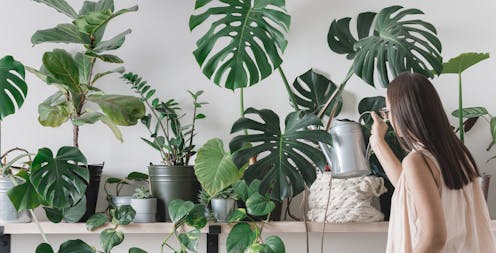
Walk into any home or workplace today, and you’re likely to find an array of indoor plants. The global market for indoor plants is growing fast – projected to reach more than US$28 billion (A$44 billion) by 2031.
People keep indoor plants inside for a variety of reasons, including as decoration, to clean the air and for stress relief. But my colleagues and I wanted to delve further. What sort of relationships do people have with indoor plants? And what can this tell us about ties between humans and nature?
We surveyed indoor plant owners in Australia, and found many of us form highly meaningful connections with our leafy companions. Some people even consider their plants as family, get anxious about their health and mourn a plant when it dies.
A blooming hobby
People have grown plants inside for thousands of years.
Evidence suggests Egyptians brought plants indoors in the 3rd century BC. The remains of the former city of Pompeii reveal indoor plants used there more than 2,000 years ago, and in medieval England, indoor plants were used in medicine and cooking.
The keeping of indoor plants became widespread across the world in the second half of the 20th century. The practice was particularly popular during the COVID-19 pandemic, likely due to a desire to connect with nature when access to outdoor green spaces was limited.
The benefits of indoor plants go beyond nature connection. Studies show they can increase positive emotions, reduce stress, enhance productivity, and even decrease physical discomfort such as pain.
However, people have varying levels of connection to their plants, as research by my colleagues and I shows.
Why we love indoor plants
We surveyed 115 Australian adults, recruited through social media posts and poster advertisements at the University of South Australia. Participants were roughly 69% female, 30% male and 1% non-binary, and ranged in age from 18 to 69.
On average, participants owned 15 indoor plants. Some owned a single indoor plant and one person owned a whopping 500!
Between them, respondents kept 51 varieties of house plants. The most common were succulents, devil’s ivy and monstera. They most commonly kept the plants in the living room, kitchen or bedroom.
Across all participants, 11 benefits of having indoor plants were reported.
Half the respondents described the aesthetic appeal of indoor plants. Comments included that indoor plants were “nice to look at”, “soften rooms” and “add colour”. Participants also reported air quality benefits, and that they found indoor plants calming.
Other less commonly reported benefits were that the plants helped the respondents set habits, improved their physical health, provided distraction, relieved fatigue and had a pleasant smell.
4 types of relationships with indoor plants
Our research identified four types of relationships people have with their indoor plants:
1. Highly connected (14% of respondents)
These people typically described a deep personal connection to their plants. Comments included:
They are like my children. (male, 28)
I often water them and take care of them as family members. (female, 26)
Well I cried over my plants leaf getting broken off today, so you could say I’m pretty attached to her. (female, 21)
I feel terrible if one dies, I feel as though I have let it down and generally bury it in the garden. (female, 34)
2. Engaged (42% of respondents)
These people enjoyed and tended to their plants, but without deep emotional attachment. For example:
Watering them and watching them grow is exciting, I feel proud to keep them alive so long (female, 22)
I get sad when one dies or is looking droopy, I feel happy when they look alive and freshly watered. (female, 22)
3. Limited engagement (23%)
These respondents enjoyed having indoor plants but spent minimal time caring for them and reported little emotional connection to them. One participant said:
Feel like indoor plants are fine but through our large windows we can see our outdoor plants and that’s more important to us. (female, 45)
4. No relationship (12%)
Participants who did not have a relationship with their indoor plants said:
Hardly watered it as it’s a succulent. (male, 21)
They are all gifts rather than something I’ve gone out to buy. (male, 21)
(For the remaining 9% of participants, their responses to the question of their relationship with house plants were invalid and not included.)
Unlocking the potential of indoor plants
Our research suggests indoor plants can enrich our lives in ways we are only beginning to understand.
It’s important to note that data for our study were collected in 2020, during the COVID-19 pandemic. This context may have influenced our results. For example, some participants may have felt particularly connected to their indoor plants because their access to outdoor green space was curtailed. So, further research is needed in the post-pandemic context.
Human–nature relationships are an emerging field of research. By understanding the relationship between people and plants, we may help unlock the potential for nature to improve our health and wellbeing.
Authors: Brianna Le Busque, Lecturer in Environmental Science, University of South Australia


 Daily Bulletin


