

Read The Times Australia

Daily Bulletin

Tim Winton goes cli-fi – his dystopian novel Juice breaks new ground to face the climate emergency

  • Written by: Per Henningsgaard, Senior Lecturer, Professional Writing and Publishing, Curtin University
Tim Winton goes cli-fi – his dystopian novel Juice breaks new ground to face the climate emergency

When I got my first job in publishing in New York City, the managing editor offered me the following advice about reading the slush pile for potential new acquisitions: “Imagine you acquire the manuscript and publish the book. Now, can you think of five people you would recommend this book to because you know they would enjoy reading it, and what would you say to get them interested?”

It turns out, coming up with compelling reasons for five people is harder than it sounds. Ever since, this has been one of my benchmarks for judging a book’s worthiness. It reminds me to think about how real readers might respond to a book and the varied reasons that compel them.

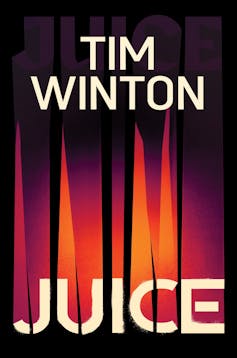
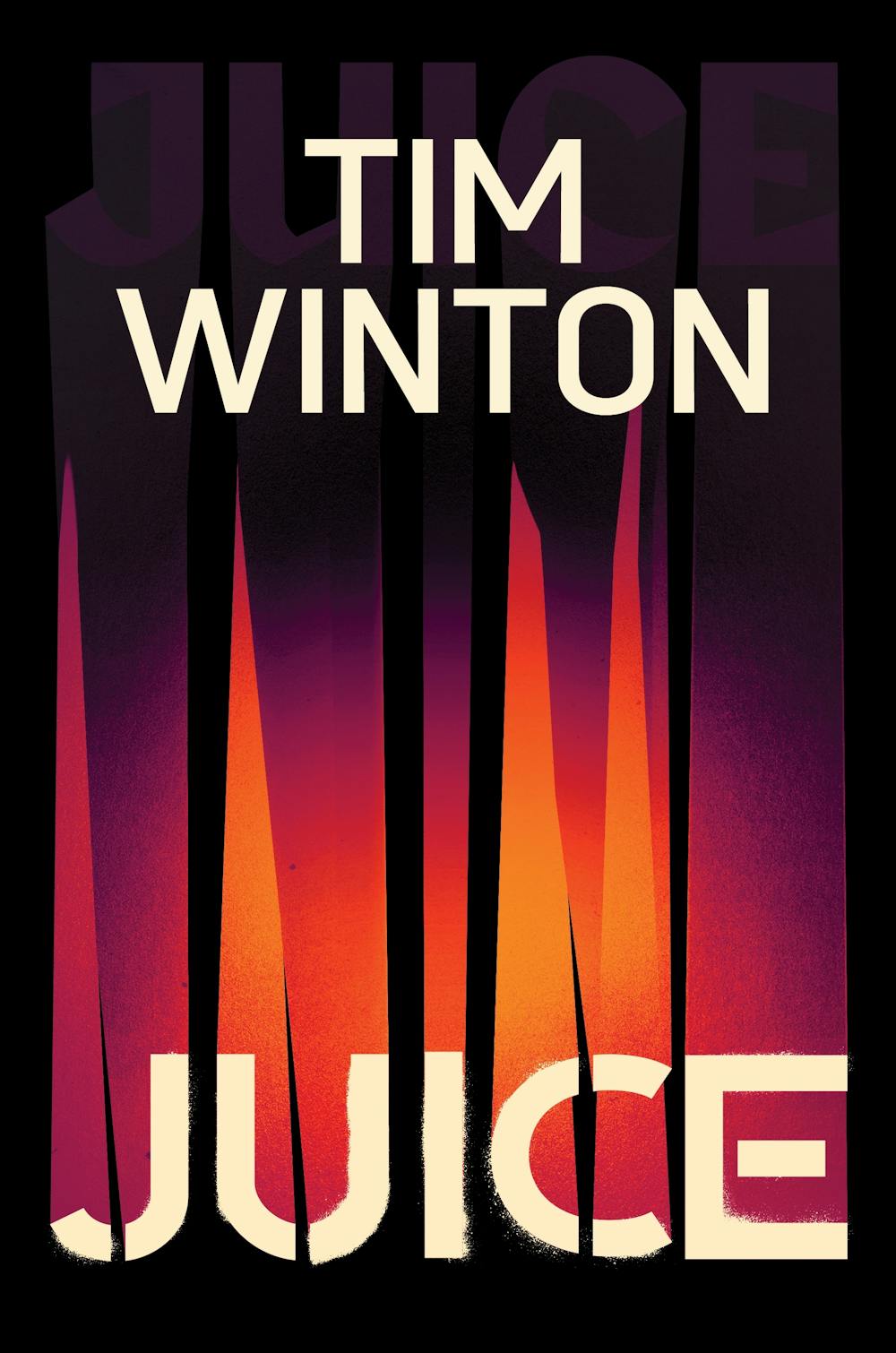
Since finishing Tim Winton’s ambitious and surprising new novel Juice, I have found reasons to recommend it to my rock-climbing buddy, a poet, my mother-in-law, a university colleague who teaches creative writing, and a geologist who works in Western Australia’s resources industry.

Review: Juice – Tim Winton (Hamish Hamilton)

It has been six years since Tim Winton’s last novel. In that time, he has published only one book: a collection of scripts titled Three Plays. That is a remarkably quiet period for Winton, who published his first book in 1982 and more than 30 books since, averaging a book every 1.4 years.

He has won Australia’s highest literary honour, the Miles Franklin Literary Award, four times – tying with Thea Astley for the most wins (though two of Astley’s wins were shared; Winton’s were all solo wins). He first won the award in 1984 for Shallows, and most recently in 2009 for Breath. His last novel, The Shepherd’s Hut, was shortlisted for numerous awards and won the Voss Literary Prize, which is judged by the Australian University Heads of English.
Clearly, Winton has a sustained record of excellence as a writer that merits attention from any reader interested in the great works of Australian literature. Will Juice be judged among these? I think it’s very good but not great, though many readers will want to judge for themselves. Winton has a reputation for writing books containing certain subject matter and stylistic features. His previous books display a strong attachment to the coastal regions of WA and associated activities, including surfing, fishing and diving. There is also a strong thread of young men coming of age, which has led some to judge his work as too blokey, and a concern with the themes of Christianity and spirituality. In terms of style, Winton is known for his use of Australian vernacular. Juice contains few of these themes. It is a work of dystopian fiction, which is a sub-genre of science fiction. You heard that right: Tim Winton has written a science fiction novel. Moreover, he has embraced many of the genre’s conventions. It is exciting to see a writer of Winton’s longevity doing something new. His attempt to break new ground will be reason enough for many readers to pick up this book. The novel is set hundreds of years in the future. Climate change has rendered large parts of the globe uninhabitable. The narrator lives with his mother in a remote outpost halfway up Australia’s west coast, where it is too hot to go outside during the day, so most activities are conducted during the night or early morning. In the summer, they must live underground for months at a time. Much of what we would regard as modern technology has been erased by the collapse of civilisation, for reasons now mostly forgotten. However, the narrator learns that some of the powerful families from the 21st century have retained this technology and used it to retreat into hidden fortresses. He joins a resistance movement with the mission to wipe these families from the earth. Winton leans into the futuristic elements of the novel to the extent that even familiar elements – such as the Western Australian setting and the focus on environmental concerns – feel thoroughly foreign. Notably, there are few traces of Australian speech patterns. Even the boundaries of the nation have ceased to be meaningful. The pivot to science fiction is largely convincing, though Winton proves reluctant to embrace one science-fiction trope in particular: mostly absent from Juice are detailed explanations of technologies and social structures. Maybe this was a bridge too far for a writer new to the genre. Tim Winton. Penguin Random House The vision of the future presented in Juice is harrowing, perhaps because it is so believable. In a scene where the narrator is learning about human history from the resistance movement, Winton writes of a world “rotten to the core”, destroyed by powerful but selfish people who “knew what was coming, what it was costing”. Neither the book’s characters nor readers know the full story of society’s collapse, due to the destruction of historical records, but Winton sprinkles enough details to make it clear who is to blame. For example, some of the powerful families that have retreated to their hidden, high-security compounds share the names of real-life mining companies. Juice is a thought-provoking novel that is guaranteed to stick in the mind of anyone who reads it, especially those who are concerned about our environmental future. But I suspect it is unlikely to win many literary awards, and not just because it is a work of science fiction. The opening two chapters of the book are a thrilling chase scene, featuring the middle-aged narrator fleeing danger in the company of a young child. But from that point on, the narrator is captured and imprisoned, so he proceeds to tell his life story – starting from his teenage years – to his captor. While there is something interesting about a man telling a story to save his life while he still can – an extended metaphor for Winton writing this novel – the structural choice does not ultimately serve the generic elements of the narrative. The decision to have the narrator relate his own history means that readers are never as deeply embedded in the action as they might otherwise be. It is too simplistic to say this is exclusively a problem of show versus tell, but that is certainly part of the issue. There is a tension between Winton’s writerly instincts about the moments that deserve elaboration and remaining true to the narrator’s personal investments. The structure has arguably impeded Winton’s ability to write a truly great work of science fiction. I will, nevertheless, continue to recommend Juice to friends and colleagues. I am excited for the many discussions I know it will spark – especially about morality and the future. But I also recommended it to my mother-in-law for the sole reason that she will read anything and everything, as long as it tells a good story. Juice undoubtedly succeeds at this, though I imagine Winton is hoping it will do much more. I suspect he hopes – and I know that I hope – it will inform new ways of thinking about how our present actions impact the planet. That is a bold and worthwhile ambition for a novel. Authors: Per Henningsgaard, Senior Lecturer, Professional Writing and Publishing, Curtin University

Read more https://theconversation.com/tim-winton-goes-cli-fi-his-dystopian-novel-juice-breaks-new-ground-to-face-the-climate-emergency-238769

Business News

How Telematics Helps Australian Companies Improve Productivity

Operating a commercial fleet in Australia is a uniquely demanding endeavour. Between the sprawling urban sprawl of cities like Sydney and Melbourne and the immense, unforgiving stretches of the Outb...

Daily Bulletin - avatar Daily Bulletin

Inside the Icon: The BridgeMuseum Officially Opens at the Sydney Harbour Bridge

A bold new way to experience one of Australia’s most recognisable landmarks has arrived, with BridgeClimb Sydney officially opening the all-new BridgeMuseum.  Located inside the Sydney Harbour Brid...

Daily Bulletin - avatar Daily Bulletin

Is Your Brand Showing Up in AI Search? Most Melbourne Brands Aren't.

The New Front Door Nobody Told You About Something changed. Quietly. Without a press release. The way buyers find businesses in Australia has been rewired. Not replaced, rewired. Google isn't dead...

Daily Bulletin - avatar Daily Bulletin

How Australian Businesses Can Measure SEO ROI

SEO can feel vague when you are staring at a dashboard full of numbers that do not clearly connect to revenue. The key is to measure the right signals in the right order, then tie them back to outcome...

Daily Bulletin - avatar Daily Bulletin

How Commercial Roller Shutters Improve Site Security Without Slowing Operations

Security upgrades can be frustrating when they make everyday work harder. A door that takes too long to open, creates bottlenecks at shift change, or fails at the worst time can turn “better protectio...

Daily Bulletin - avatar Daily Bulletin

Why a Document Destruction Service Still Matters for Modern Businesses

Businesses generate large volumes of information every day, from staff records and contracts to invoices, reports and customer files. While attention often focuses on how documents are stored, the way...

Daily Bulletin - avatar Daily Bulletin

Bicycle Rack Safety and Space-Smart Storage

Bike storage problems usually show up as small annoyances first: tangled handlebars, scratched frames, and bikes that topple when you pull one out. Over time, those issues become safety risks, especia...

Daily Bulletin - avatar Daily Bulletin

How to Tell if a Childcare Centre Is a Good Fit for Your Child

Choosing childcare can feel like you’re making a huge decision with limited information. Tours are short, centres are often on their best behaviour, and your child might act differently in a new space...

Daily Bulletin - avatar Daily Bulletin

Car Import Timeline: What Usually Happens at Each Stage

Importing a car into Australia can feel confusing because multiple agencies and checkpoints are involved, and the timeline is shaped as much by paperwork quality as it is by shipping speed. The most u...

Daily Bulletin - avatar Daily Bulletin

The Daily Magazine

Gold Migration Lawyers in Liquidation: How the Closure Affects Your ART Appeal

If your appeal was with Gold Migration Lawyers, a recent change to how the Tribunal decides cases ...

The pressure cooker: life in urban Australia in 2026

Australian cities have always been demanding. Long commutes, rising housing costs, busy schedules a...

What Actually Makes a Good Criminal Lawyer in Melbourne

Most people only think about this question once. That is usually too late. Most people charged wi...

Why Working With A Chatswood Tutor Can Improve Academic Performance

Academic expectations continue increasing for students across primary school, high school, and senio...

Is It Worth Getting Solar Panels in Melbourne?

The real question is not whether solar works in Melbourne. It works. The question is what it is co...

How A Diploma Of Project Management Builds Practical Skills For Modern Work Environments

Developing the ability to plan, execute, and deliver outcomes efficiently is a key requirement in to...

How to Choose the Right Football for Every Level

Choosing a football may seem straightforward, but the right option depends on who will be using it a...

What to Ask a Wedding Photographer Before You Book

Booking a wedding photographer can feel deceptively simple: you like the photos, you like the vibe...

Why Stress Relief For Dogs Is Essential For Emotional Balance And Long-Term Wellbeing

Managing emotional health is just as important as physical care when it comes to pets, which is why ...