

Why don’t people care about Australia’s native rodents? The problem could be their ugly names
- Written by: Steve Morton, Honorary Fellow, Charles Darwin University
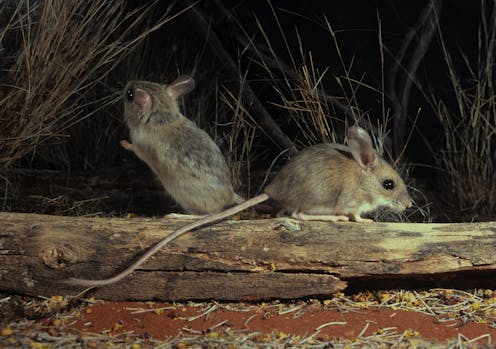
The common names of Australian animals often originate in Aboriginal languages, and beneficially so. Continuing use of names such as kangaroo and kookaburra helps to honour the wealth of knowledge possessed by First Nations peoples, to appreciate the natural heritage of a place more deeply, and to naturalise English to this continent.
Some 30 years ago, I and colleagues published a paper calling for this naming practice to extend to native rodents. This group of animals contains many handsome and fascinating animals among its many species.
But sadly, native rats and mice don’t usually evoke sympathy among the Australian public. The unappealing common names for the species – such as swamp rat or long-haired rat – do little to help the problem.
Public sentiment towards an animal matters. It can affect whether their habitat is protected, if they are prioritised for research and conservation, and the amount of funding devoted to protecting them. So among the many other good reasons to ascribe Aboriginal common names to our species, it might mean the difference between their survival and extinction.
What’s in a name?
Of the 60 Australian rodent species, nearly 20 are extinct or greatly diminished in range.
As with other threatened mammals, desert-dwelling rodents have suffered most. For example among hopping mice, five of ten species are extinct. Those still remaining could do with our attention – and naming them may help.
Research has shown common names of species are an important tool when seeking to increase community support for conservation.
One study by Australian researchers analysed the common names of almost 27,000 animals from the IUCN Red List of threatened species. It found frequent words in animal common names that produced strong positive or negative sentiment.
Common words driving positive sentiment included “golden” and “great”. Words driving negative sentiment included “rat”, “lesser” and “blind”.
The research found many words were also associated with human emotions. For example, “dove” was associated with joy, anticipation and trust. “Rat” was associated with fear and disgust, probably due to its associations with disease, uncleanliness and deceitfulness, the study found.
The researchers said strategic name changes may improve public engagement and support for species and therefore provide effective, low-cost conservation benefits.
How about ‘pakooma’ and ‘palyoora’?
So where might we find new, more appealing monikers for our maligned rodents? Our 1995 paper suggested selecting common names from relevant Aboriginal words that might readily be pronounced by English speakers.
At the time, we checked our document before publication with offices of the then-current Aboriginal and Torres Strait Islander Commission. Should Aboriginal words be used to rename species today, agreement should be sought from the relevant language group.
The brush-tailed rabbit-rat, Conilurus penicillatus, is an example of a rodent ripe for renaming. It’s a striking and vigorous animal of northern Australia, which became extinct in Kakadu National Park in the 2000s and now persists in only a handful of isolated regions. How unfair it is that this splendid creature should be thought of as a mere rat – as well as bearing the nomenclatural burden of Australia’s worst vertebrate pest? Perhaps it could be renamed pakooma, from the East Arnhem languages.
Another sad example is provided by Xeromys myoides, an inhabitant of coastal swamps and mangroves. It is known as the false water rat, a name which could barely be improved upon if the aim is to demean. The animal could well be called yirrkoo, from the Kunwinjku/Mayali language.
And consider the graceful Pseudomys australis, an animal of the outback Channel Country in Queensland and South Australia. The species is of conservation concern, but public attention is hardly likely when the animal is called a plains rat. It deserves better – perhaps the lovely name palyoora, from the Wangkangurru language.
Read more: Ghost rodents: get ready to fall in love with Australia's albino rats and mice
The tide may be turning
Back in the 1990s, our rodent-renaming initiative sank almost without trace. Only one Aboriginal name – rakali, from Murray River languages – took something of a hold, replacing the common name water rat (Hydromys chrysogaster). In the intervening years, two authors of the paper, Dick Braithwaite and John Calaby, have passed away. Time has moved on.
But there have been flickers of encouragement. Western Australia’s 1997 recovery plan for the Shark Bay mouse, Pseudomys fieldi, used the name djoongari (Luritja/Pintubi). When Tim Bonyhady in 2019 published his unusual and matchless book, The Enchantment of the Long-haired Rat: A Rodent History of Australia, he used the name mayaroo throughout (Rattus villosissimus, from Wangkangurru).
And now interest may be resurgent. In the Threatened Species Action Plan 2022–2032, federal environment authorities adopted names of Aboriginal origin wherever possible. This included antina (Zyzomys pedunculatus, central rock-rat, Arrernte), pookila (Pseudomys novaehollandiae, New Holland mouse, Bugila/Ngarigu), and woorrentinta (Notomys aquilo, northern hopping-mouse, from Lardil, the language of Mornington Island).
Read more: 'Impressive rafting skills': the 8-million-year old origin story of how rodents colonised Australia
A timely, much-needed change
Zoologists are rightly conservative about scientific naming conventions, in line with commitment to the principles of biological nomenclature. However, we are free to modify common names – and should, if there are good reasons to do so.
And so, 30 years after my colleagues and I first issued the call, Indigenous names for Australian rodents are commended to you once more. It is timely that the extensive Aboriginal knowledge of our continent be so honoured, that the wider culture be enriched – even if in such a tiny way – and that mayaroo and pookila should live in the English language.
The 1995 paper referred to in this article, Australian Names for Australian Rodents, was authored by R.W. Braithwaite, S.R. Morton, A.A. Burbidge and J.H. Calaby. It was published by the Australian Nature Conservation Agency, Canberra. With thanks to Andrew Burbidge, one of the original authors, for giving his blessing to this article.
Authors: Steve Morton, Honorary Fellow, Charles Darwin University


 Daily Bulletin


