

Temu: China's answer to Amazon is already Australia's most popular free app. What makes it so addictive?
- Written by: Shasha Wang, Senior lecturer, Queensland University of Technology
If you spend much time online you’ve probably seen one of Temu’s colourful ads – punctuated by its catchy tagline: “shopping like a billionaire”.
Temu specialises in selling various everyday items, including clothing, toys and household goods, for extremely low prices. Shanghai-based company PDD Holdings launched the online marketplace late last year (initially in the United States) to cater to overseas customers.
Since then, Temu’s reach has skyrocketed. The total value of products sold went from US$3 million in September last year, to US$400 million in April. At the time of publishing this article, Temu was the most popular free iPhone app in the US, United Kingdom, Australia and Germany.
Why has Temu been such a massive success? It’s safe to say the platform has some winning strategies that keep consumers coming back. But beyond that, similar to other e-commerce platforms, using it isn’t entirely risk- or guilt-free. Here are some things to consider if you’re thinking of giving it a shot.
What are Temu’s secrets to success?
1. Value
Many Australians might associate “made in China” with cheap price tags and low quality. However, Temu’s consumers are beginning to view it as offering affordable products that do not necessarily compromise on quality. In some cases, 10–20 products will only set you back US$20–30.
Temu claims it can offer these prices as a result of cutting out the middlemen in the supply chain. While the manufacturers provide the product details and the products themselves, Temu handles everything else – from customs processing to international shipping. This streamlining helps reduce unit costs.
Nonetheless, achieving such value doesn’t come without a cost. Concerns are rising that Temu and its suppliers may be operating at a loss. However, it’s common for startups to experience negative cash flow in their initial years due to heavy marketing investments, including offers of competitive prices and marketing campaigns – all of which is done to build brand awareness and gain acceptance.
This is especially true in the fast-paced e-commerce sector, where success and failure happen swiftly. Temu and its suppliers, who are mainly from Temu’s sister e-commerce platform Pinduoduo, are likely aware of this dynamic.
2. An effective marketing strategy
Unlike other e-commerce platforms that focus on functional benefits such as saving money, Temu caters to consumers’ emotional needs. It overlays the shopping experience with the idea of “shopping like a billionaire” – which also aligns with its value-based strategy.
Temu entered the market at a time when consumers were grappling with global inflation, leading them to seek “value”. In the first month after its launch in the US, Temu invested some US$200 million in advertising and planned a US$2 billion budget for the year.
Given China’s leadership in live-streaming influencer marketing, Temu is now recruiting social media influencers, suggesting it might leverage its Chinese expertise to explore a social-commerce strategy. Social commerce harnesses a sense of “friendship” conveyed by influencers, making the online shopping experience more engaging and product recommendations more convincing. It also works especially well with sales promotions.
Sales promotion tactics
While Temu employs common sales tactics seen on other e-commerce platforms, it uses what is arguably the broadest array of these techniques. Here are just some examples:
- Gamified experiences. Gamified advertising hinges on two core elements: challenge and reward. Interacting with Temu’s spinning wheel is a minor challenge, but the substantial discount offered is a major reward. Such “games” create the illusion of getting lucky, and therefore generate positive emotions in consumers – while the reward gives them an incentive to engage more seriously with their browsing, increasing the likelihood of spending.
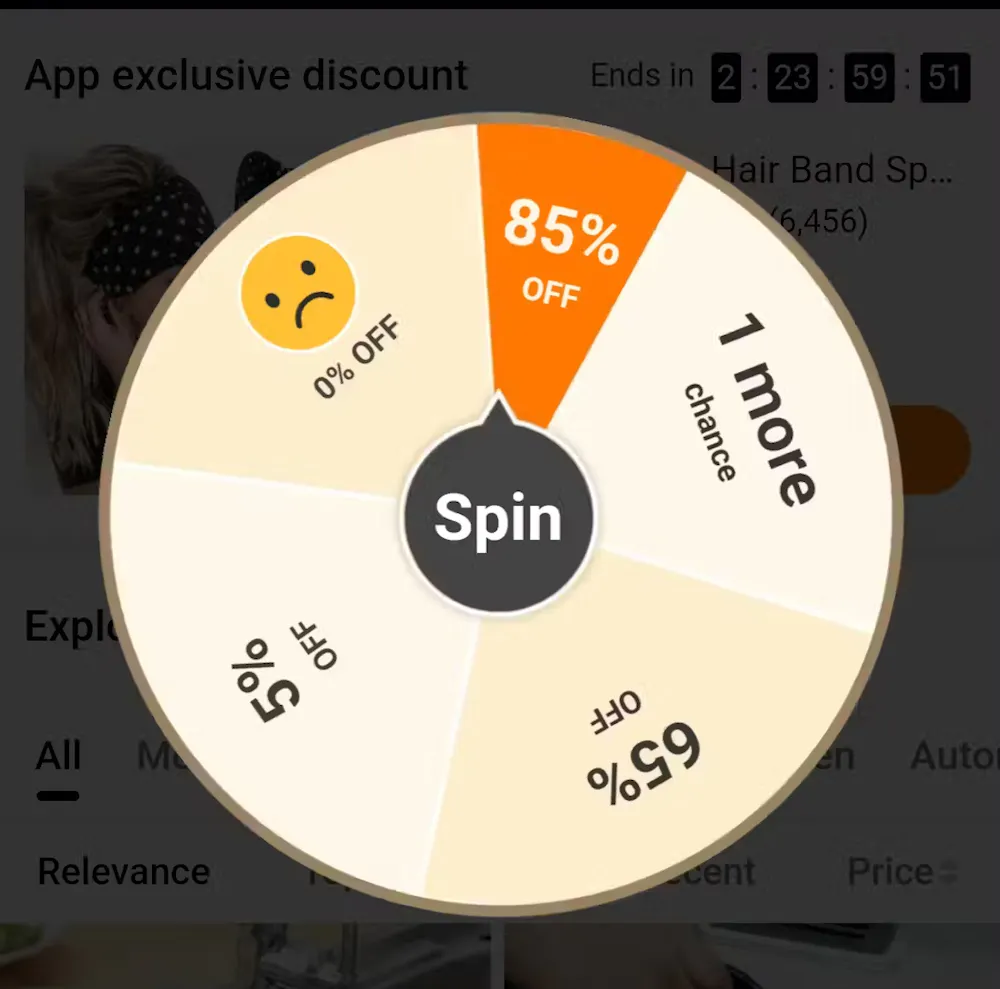
- Lightning deals and limited-time offers. One commonly used promotion tactic involves creating the illusion of scarcity through supposedly “exclusive” offers that are time-sensitive and won’t come by again. This can trigger a fear of missing out in consumers.
 Promotions that are timed create a sense of urgency; customers are more likely to pay up if they’re scared of missing out.
Shasha Wang
Promotions that are timed create a sense of urgency; customers are more likely to pay up if they’re scared of missing out.
Shasha Wang
Discounts and free shipping Offering simple price reductions and very affordable sales is a time-honoured way of securing a loyal customer base. In addition, Temu has the allure of offering free shipping on orders with a very low minimum spend.
Loyalty program. Consumers can opt in to Temu’s marketing emails in exchange for receiving more promotional content, including email-only promotions. E-commerce companies often have access to your personal information (such as your name, address, age and phone number) and behavioural data (such as from your search history and online sessions). With this data, the company can build your user profile and target you with personalised promotions and content to encourage spending.
Search engine marketing. Many consumers will see Temu ads at the top of their search results on Google (in the form of “sponsored” posts) when they search for a product.
An AI-powered promotional strategy. Temu’s sister company operating in China, Pinduoduo, is renowned for its AI-driven recommendation system. It’s likely Temu uses similar AI algorithms, drawing on users’ browsing and purchase history to provide personalised recommendations (a practice Amazon also partakes in).
Defending against manipulation
Temu’s greatest benefit to consumers lies in its offer of value. It may still have lower-quality items, but this is common among all e-commerce platforms.
Also, Temu’s business model is built around emphasising top-selling products, which helps filter out low-quality products. Its 90-day free return policy further acts as a buffer for unsatisfactory purchases.
Nonetheless, Temu’s value-oriented approach may not be a good thing for consumers on all fronts. Exposed to such a wide array of marketing tactics, users might become more prone to overconsumption – which leads to environmental waste and post-purchase regret.
It’s worth considering your actual needs before using an e-commerce platform such as Temu. You should also familiarise yourself with the sales promotion tactics being used. Research suggests understanding these tactics, as well as advertisers’ intentions, can even empower young children to be sceptical and form a cognitive defence against them.
Also, in light of Temu’s gamified advertising strategy, consumers ought to temper their enthusiasm for rewards. Moving forward, one useful approach may be for schools and governments to introduce educational programs or social marketing campaigns that teach advertising tactics, and recommend coping strategies.
Temu didn’t respond to The Conversation’s request for comment.
Read more: Blind bags: how toy makers are making a fortune with child gambling
Authors: Shasha Wang, Senior lecturer, Queensland University of Technology


 Daily Bulletin


