

Read The Times Australia

Daily Bulletin

Creating ‘sponge cities’ to cope with more rainfall needn't cost billions – but NZ has to start now

  • Written by: Timothy Welch, Senior Lecturer in Urban Planning, University of Auckland
Creating ‘sponge cities’ to cope with more rainfall needn't cost billions – but NZ has to start now

Tune into news from about any part of the planet, and there will likely be a headline about extreme weather. While these stories will be specific to the location, they all tend to include the amplifying effects of climate change.

This includes the wildfire devastation on the island of Maui in Hawaii, where rising temperatures have dried vegetation and made the risk that much greater. In Italy, summer temperatures hit an all-time high one week, followed by massive hail storms and flooding the next.

Flooding in Slovenia recently left three people dead and caused an estimated €500 million in damage. At the same time, rainfall in Beijing has exceeded a 140-year record, causing wide-scale flooding and leaving 21 dead.

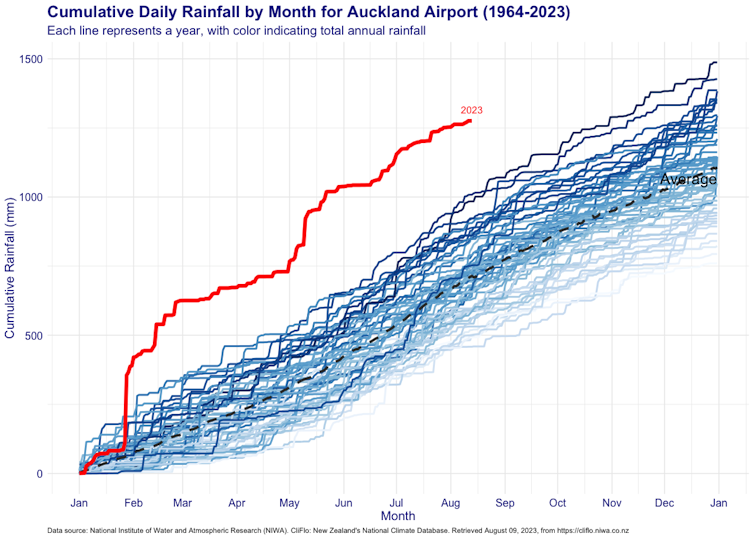
These northern hemisphere summer events mirror what happened last summer in Auckland, classified as a one-in-200-year event, and elsewhere in the North Island. So far this year, rainfall at Auckland Airport has surpassed all records dating back to 1964.

Given more rainfall is one of the likeliest symptoms of a changing climate, the new report from the Helen Clark Foundation and WSPSponge Cities: Can they help us survive more intense rainfall? – is a timely (and sobering) reminder of the urgency of the challenge.

NIWA, CC BY-NC-ND Pipe dreams The “sponge city” concept is gaining traction as a way to mitigate extreme weather, save lives and even make cities more pleasant places to live. This is particularly important when existing urban stormwater infrastructure is often already ageing and inadequate. Auckland has even been cutting spending on critical stormwater repairs for at least the past two years. Read more: Auckland floods: even stormwater reform won’t be enough – we need a ‘sponge city’ to avoid future disasters Politically at least, this isn’t surprising. Stormwater infrastructure, as it is currently built and planned, is costly to develop and maintain. As the Helen Clark Foundation report makes clear, New Zealand’s pipes simply “were not designed for the huge volumes they will have to manage with rising seas and increasing extreme rainfall events”. The country’s current combined stormwater infrastructure involves a 17,000 kilometre pipe network – enough to span the length of the country ten times. The cost of upgrading the entire water system, which encompasses stormwater, could reach NZ$180 billion. This contrasts starkly with the $1.5 billion councils now spend annually on water pipes. The report makes clear that implementing sponge city principles won’t wholly solve flooding, but it can significantly reduce flood risks. Trees and green spaces The real bonus, though, lies in the potential for sponge city design to reduce dependence on expensive and high-maintenance infrastructure. There are already examples in Auckland’s Hobsonville Point and Northcote. Both communities have incorporated green infrastructure, such as floodable parks and planted wetlands, which kept nearby homes from flooding. But the report’s recommendations are at odds with some of the current political rhetoric around land use policy – in particular “greenfields” development that encourages urban sprawl. Read more: National’s housing u-turn promotes urban sprawl – cities and ratepayers will pick up the bill The report urges that cities be built upwards rather than outwards, and pushes back on residential infill development encouraged by the Medium Density Residential Standards. Citing a recent report on green space from the Parliamentary Commissioner for the Environment, the Helen Clark Foundation report argues for the preservation of urban green spaces – like backyards – as part of the flood mitigation approach. Preserving tree cover is another urgent priority. Trees help absorb rainfall, reduce erosion and provide essential shade and cooling in urban areas – counteracting the dangerous urban “heat island” effect. Citing data from Global Forest Watch, the report states: Auckland has lost as much as 19% of its tree cover in the past 20 years, Dunedin a staggering 24%, Greater Wellington around 11% and Christchurch 13%. Read more: Planting more trees could reduce premature heat-related deaths in European cities by a third – new research Incentives for homeowners Making Aotearoa New Zealand more resilient to extreme weather, the report says, need not break the bank. It recommends raising the national minimum standards governing the percentage of the total area of new developments that must be left unsealed. This would ensure the implementation of sponge city concepts, and see buildings clustered to maximise preserved green space. The government should also require local councils to plan for and provide public green spaces, and to develop long-term sponge city plans – just as they do for other types of critical infrastructure. Read more: We’re building harder, hotter cities: it’s vital we protect and grow urban green spaces – new report Neighbourhoods could be retrofitted to include green roofs, permeable pavements and unsealed car parks. Land use and zoning could also encourage more vertical development, rather than sprawl or infill housing. The government could also provide incentives and education for homeowners to encourage minimising sealed surfaces, unblocking stormwater flow paths, and replacing lawns with native plants and rain gardens. More extreme weather and intense rainfall is a matter of when, not if. As the Helen Clark Foundation report makes clear, spending future billions is less of a priority than acting urgently now.

Authors: Timothy Welch, Senior Lecturer in Urban Planning, University of Auckland

Read more https://theconversation.com/creating-sponge-cities-to-cope-with-more-rainfall-neednt-cost-billions-but-nz-has-to-start-now-211181

Business News

Is Your Brand Showing Up in AI Search? Most Melbourne Brands Aren't.

The New Front Door Nobody Told You About Something changed. Quietly. Without a press release. The way buyers find businesses in Australia has been rewired. Not replaced, rewired. Google isn't dead...

Daily Bulletin - avatar Daily Bulletin

How Australian Businesses Can Measure SEO ROI

SEO can feel vague when you are staring at a dashboard full of numbers that do not clearly connect to revenue. The key is to measure the right signals in the right order, then tie them back to outcome...

Daily Bulletin - avatar Daily Bulletin

How Commercial Roller Shutters Improve Site Security Without Slowing Operations

Security upgrades can be frustrating when they make everyday work harder. A door that takes too long to open, creates bottlenecks at shift change, or fails at the worst time can turn “better protectio...

Daily Bulletin - avatar Daily Bulletin

Why a Document Destruction Service Still Matters for Modern Businesses

Businesses generate large volumes of information every day, from staff records and contracts to invoices, reports and customer files. While attention often focuses on how documents are stored, the way...

Daily Bulletin - avatar Daily Bulletin

Bicycle Rack Safety and Space-Smart Storage

Bike storage problems usually show up as small annoyances first: tangled handlebars, scratched frames, and bikes that topple when you pull one out. Over time, those issues become safety risks, especia...

Daily Bulletin - avatar Daily Bulletin

How to Tell if a Childcare Centre Is a Good Fit for Your Child

Choosing childcare can feel like you’re making a huge decision with limited information. Tours are short, centres are often on their best behaviour, and your child might act differently in a new space...

Daily Bulletin - avatar Daily Bulletin

Car Import Timeline: What Usually Happens at Each Stage

Importing a car into Australia can feel confusing because multiple agencies and checkpoints are involved, and the timeline is shaped as much by paperwork quality as it is by shipping speed. The most u...

Daily Bulletin - avatar Daily Bulletin

Portable Toilet Hygiene Standards Explained: Clean vs Sanitised vs Disinfected

In portable toilet servicing, the words clean, sanitised, and disinfected often get used as if they mean the same thing. They don’t. And that difference matters because a unit can look tidy and still ...

Daily Bulletin - avatar Daily Bulletin

Options Available When a Company Faces Financial Distress

Financial distress can develop gradually or arrive suddenly, and when it does, the decisions made in the early stages often determine what options remain available later. Directors who act promptly ...

Daily Bulletin - avatar Daily Bulletin

The Daily Magazine

What Actually Makes a Good Criminal Lawyer in Melbourne

Most people only think about this question once. That is usually too late. Most people charged wi...

Why Working With A Chatswood Tutor Can Improve Academic Performance

Academic expectations continue increasing for students across primary school, high school, and senio...

Is It Worth Getting Solar Panels in Melbourne?

The real question is not whether solar works in Melbourne. It works. The question is what it is co...

How A Diploma Of Project Management Builds Practical Skills For Modern Work Environments

Developing the ability to plan, execute, and deliver outcomes efficiently is a key requirement in to...

How to Choose the Right Football for Every Level

Choosing a football may seem straightforward, but the right option depends on who will be using it a...

What to Ask a Wedding Photographer Before You Book

Booking a wedding photographer can feel deceptively simple: you like the photos, you like the vibe...

Why Stress Relief For Dogs Is Essential For Emotional Balance And Long-Term Wellbeing

Managing emotional health is just as important as physical care when it comes to pets, which is why ...

Australia’s Best Walking Trails and the Shoes You Need to Tackle Them

Australia is not short on spectacular walks. You can follow ocean cliffs in Victoria, cross ancien...

Why Pre-Purchase Building Inspections Are Essential Before Buying a Home in Australia

source Have you ever walked through an open home and started picturing your furniture, family d...