

Urban sprawl is 'not a dirty word'? If the priority is to meet all kids' needs, it should be
- Written by: Hulya Gilbert, Lecturer in Planning and Human Geography, La Trobe University
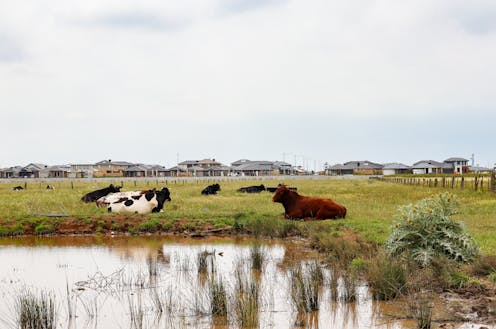
Amid Australia’s housing crisis, land-supply slogans are once again dominating discussions about the solutions. Governments and private developers often blame housing crises on lack of land for new housing. Their solution? Rezone farmland for housing on the suburban fringe.
Earlier this year, the South Australian government announced the state’s largest ever release of land for housing. Some 23,700 houses are to be built on the fringe of Adelaide. SA Premier Peter Malinauskas has even said urban sprawl “is not a dirty word”.
Support for the creation of fringe suburbs, while still business as usual in Australia, reflects outdated views. [Evidence] of the need to halt urban sprawl is now overwhelming. The spruiking of these greenfield developments as affordable and good for young families with children is at odds with their experiences of these developments.
Read more: National’s housing u-turn promotes urban sprawl – cities and ratepayers will pick up the bill
What life is actually like on the suburban fringe
Greenfield developments are often attractive to young families due to the perception of affordable housing and promises of local schools, childcare, shops and public transport. However, these neighbourhoods rarely live up to such expectations. Instead, they often entrench disadvantage due to the neglect of transport costs when assessing how affordable suburban housing is.
Families in Truganina and Tarneit in Melbourne’s west exemplify the daily struggles of outer suburban life. Nearly a decade after moving in, the promises of local schools and public transport had failed to materialise.
Likewise, in the outer suburbs of Western Sydney, Brisbane and Adelaide, families with children struggle to get to the services they need without a car. In South Australia, the Thrive by Five alliance cites transport as the second-biggest barrier (after attendance costs) to early learning.
These suburbs all provide stark reminders to governments of the problems associated with the suburban sprawl they have encouraged.
Suburban sprawl and car dependence go hand in hand
The defining feature of suburban sprawl is car dependence. It’s linked with most of the social and economic downsides of sprawl. Continuing with such developments signals an acceptance of car dependence and the growing social and economic burdens it imposes on future generations.
Life on the fringe without a private car is particularly difficult for families with children due to their complex travel patterns. For example, trip chaining between children’s schools, extra-curricular activities and parents’ workplaces is common.
The harmful impacts of these car-centric suburbs disproportionally affect children.
Read more: Children in the car era: bad for them and the planet
To start with, road deaths are the leading cause of death for children and young adults globally. It’s easily one of the most underestimated issues in our world.
Concerns for children’s safety in car-dominated neighbourhoods and other accessibility issues make the private car “a must use tool” in outer suburbs. We know the rest: the vicious cycle of car dependence and more and more driving.
So suburban sprawl leads to more high-speed roads, longer distances between centres of daily activity and more time in cars. All these factors increase the risk of road deaths and injuries.
Car-dependent neighbourhoods deprive children of opportunities essential for their health and wellbeing. They miss out on physical activity, unstructured play, social interaction and developing social networks. In addition, traffic noise and air pollution expose them to a wide range of environmental and health problems.
Read more: We're still fighting city freeways after half a century
Having a backyard doesn’t meet all children’s needs
What does a truly child-friendly neighbourhood look like? It allows for safe and convenient active travel – walking, cycling and “wheeling” (using mobility devices) – as well as public transport, to conduct daily activities. Child-friendliness is embedded in the everyday places, in streets, parks, square and public transport.
But all too often children’s play opportunities are reduced to the tiny backyards that are now common in fringe suburbs. These suburban restrictions are at odds with globally recognised principles of child-friendliness. Backyards alone cannot make up for the lack of access to child care, schools, shops, recreation and health services.
How can we develop better planning policies to create neighbourhoods that properly meet families’ needs? Some policies already exist, such as 15-minute or 20-minute neighbourhoods, to reduce private car use for daily activities. But these policies get sidelined when governments promote suburban sprawl and build more freeways.
These governments should not dismiss the suitability of higher-density living in well-serviced neighbourhoods for families with children. Yes, some densification policies have been blind to the needs of children and their families. However, when done well, high-density settings can be wonderful communities for such families.
With careful planning, many more families could be housed in established areas without having to significantly increase building heights.
Read more: People love the idea of 20-minute neighbourhoods. So why isn't it top of the agenda?
Car-centric planning has failed families
Car-centric planning dates back to the 1950s. Since then, Australian suburban fringe development has largely failed to create child-friendly neighbourhoods. Given the pro-sprawl political advocacy, the prospects of Adelaide’s largest ever greenfield development being good for children are rather poor, despite some encouraging steps by the government to ensure the new suburbs get adequate infrastructure.
Using aspirations of families with children to justify suburban sprawl is exploitative and misleading. It’s an approach that ignores the real-life challenges residents experience and distracts from government’s responsibility for proper planning.
If governments are serious about the needs of families with children, they could start by acknowledging children’s needs and rights to be able to get to their daily destinations without a car. To deliver neighbourhoods that make this possible, governments need to be bold and decisive in their planning.
Suburban sprawl and car dependence go hand in hand. Our politicians must commit to urban planning where cars are no longer privileged. Otherwise we deny our children basic rights to learn, play and socialise safely in their own neighbourhoods.
Read more: No need to give up on crowded cities – we can make density so much better
Authors: Hulya Gilbert, Lecturer in Planning and Human Geography, La Trobe University


 Daily Bulletin


