

Sorry prime minister, Joe Biden was right – Xi Jinping really is a ‘dictator’
- Written by: Nicholas Khoo, Associate Professor of International Politics, University of Otago
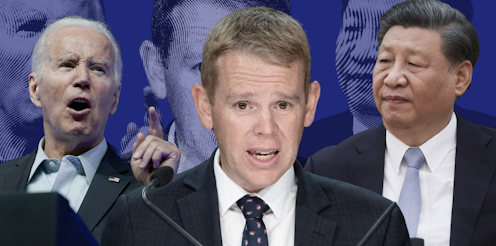
It’s not every day that a New Zealand prime minister takes China’s side in a disagreement between Washington and Beijing over whether the leader of China is a dictator.
But these are extraordinary times.
At a fundraising event on Tuesday, US President Joe Biden found himself talking about the Chinese espionage balloon incident in February. The president was in full voice, claiming, “The reason why Xi Jinping got very upset in terms of when I shot that balloon down with two box cars full of spy equipment in it was he didn’t know it was there.”
He then went on to say, “That’s a great embarrassment for dictators. When they didn’t know what happened. That wasn’t supposed to be going where it was. It was blown off course.”
At a press briefing in Beijing the next day, China’s foreign ministry spokesperson, Mao Ning, called Biden’s comments “irresponsible” and said they “go totally against facts and seriously violate diplomatic protocol, and severely infringe on China’s political dignity”.
But from a strictly factual point of view, Biden’s “dictator” comments were spot on. The Oxford English Dictionary defines a dictator as “an absolute ruler of a state”. Xi Jinping would seem to fit the bill.
He is general secretary of the Chinese Communist Party (CCP), and the 2022 CCP constitution states that the party is committed “to uphold the people’s democratic dictatorship”.
‘Democratic dictatorship’ in theory and practice
The people’s democratic dictatorship concept was formally advanced for the first time in a landmark speech in 1949 by Mao Zedong, who led China from 1949 to 1976.
The concept is a cornerstone of the Chinese political system, and establishes the theoretical basis by which the CCP historically led the various “classes” of people in China – the working class, the peasant class, the petty bourgeoisie and the national capitalists:
to maintain dictatorship over the lackeys of imperialism – the landlord class, the bureaucratic capitalist class and the Kuomintang reactionaries and their henchmen representing these classes – to oppress them, to enable them to behave properly and not permit them to talk and act wildly.
Read more: To understand what Xi Jinping's concentration of power really means, we must turn to history
It also serves as one of the CCP’s “Four Cardinal Principles”. According to the CCP constitution:
The Four Cardinal Principles – to keep to the path of socialism, to uphold the people’s democratic dictatorship, to uphold the leadership of the Communist Party of China, and to uphold Marxism-Leninism and Mao Zedong Thought – form the foundation for building the country.
So far, so theoretical. But how does the people’s democratic dictatorship concept operate in the real world?
In essence, it legitimises Xi’s rule over China (from 2012 to the present). Indeed, it is widely recognised both in and out of China that he is the country’s most powerful leader since Mao.
Dictatorship by any other name
This is where Prime Minister Chris Hipkins comes into the picture. On Thursday he was asked by a reporter in Lower Hutt if he agreed with Biden’s “dictator” comment. His response was: “No, and the form of government that China has is a matter for the Chinese people.”
The obvious response is to observe that, as a matter of law in China, Xi is the leader of a political system where there are no competitive multiparty elections. The seven members of the standing committee of the CCP select the general secretary of the CCP, not the citizens.
Careful planning by the CCP ensures there is zero uncertainty as to who will be selected as leader of China at every party congress, held every five years. If that is not a dictatorship, then what is?
We may debate whether the country has a benign or a malign dictatorship. But a dictatorship it is.
Hipkins was also asked how the Chinese people could actually change the way they are governed. He replied, “That would be a matter for them.” But precisely because China is run by the CCP through the mechanism of a “people’s democratic dictatorship”, the matter is not up to them.
‘Bourgeois liberalisation’
One hopes the prime minister gives serious thought to these issues before his visit to China and meeting with Xi next week. After all, history clearly demonstrates that dictatorships have had an adversarial relationship with liberal democracies.
Former paramount leader Deng Xiaoping characterised liberal democracy as an example of “bourgeois liberalisation” and launched a campaign in 1987 against such unwanted influences.
Read more: New Zealand has just joined an overtly anti-China alliance – are the economic risks worth it?
And the CCP constitution states that the party must not just “uphold the people’s democratic dictatorship” but “oppose bourgeois liberalisation”.
The tangle the prime minister got himself into in Lower Hutt underlines the complex realities of heightened ideological differences underpinned by great-power rivalry in the 21st century.
It also reinforces the point that, in the third decade of the century, New Zealand must have a foreign policy to match those challenges.
Authors: Nicholas Khoo, Associate Professor of International Politics, University of Otago


 Daily Bulletin


