

'Accidental Napalm' turns 50: the generation-defining image capturing the futility of the Vietnam war
- Written by: Chari Larsson, Senior Lecturer of art history, Griffith University
How does an image become an icon? It is estimated that we now produce more images in two minutes than we did in the entire 19th century. How, then, can one image be so powerful it can symbolise the horror of war and help mobilise anti-war sentiment?
June 8 marks the 50 year anniversary since Associated Press photographer Hyung Cong “Nick” Út captured one of the Vietnam War’s defining images.
Titled “Accidental Napalm”, the black-and-white still photograph has since been repeatedly reproduced and continues to survive in collective memory.
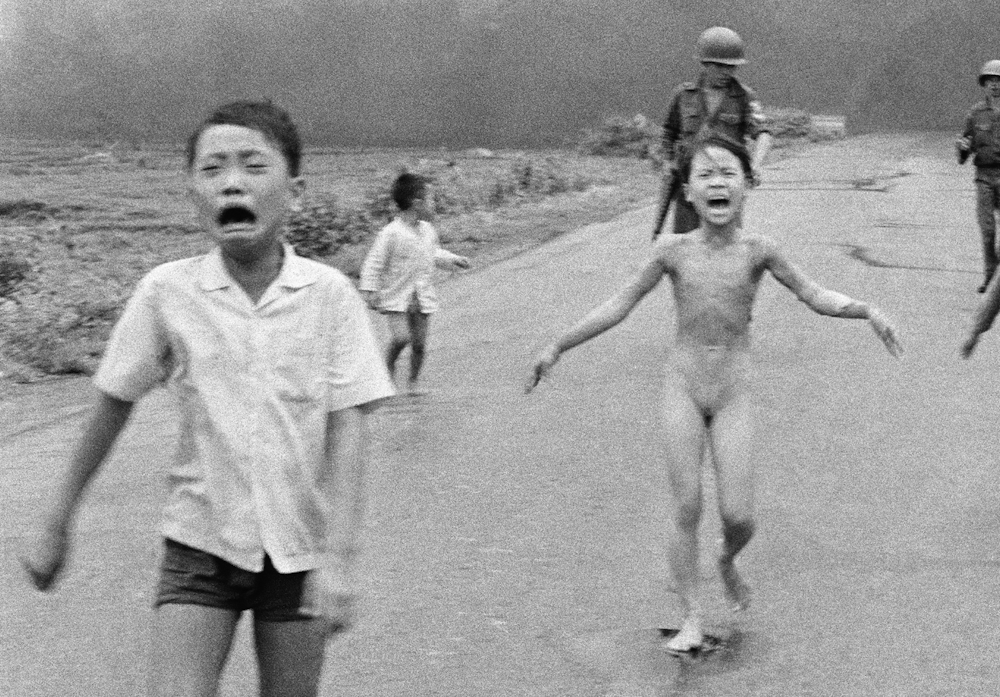
Despite its age, the image continues to retain the capacity to shock. A little girl is naked and running directly towards the spectator. She is leaning slightly forward, and her arms are held out from her body.
Her proximity to the camera’s lens is a direct address to the viewer: her agony and terror is unambiguous.
Phan Thị Kim Phúc
A battle was underway in South Vietnam between the South Vietnamese Army and the Viet Cong.
Several journalists had assembled just outside the village of Trảng Bàng, which had been occupied by North Vietnamese forces. South Vietnamese planes flew overhead and dropped four napalm bombs.
Read more: Explainer: what is napalm?
A few moments later, a group of terrified survivors – including children – came running through the smoke and down the road towards the group of journalists.
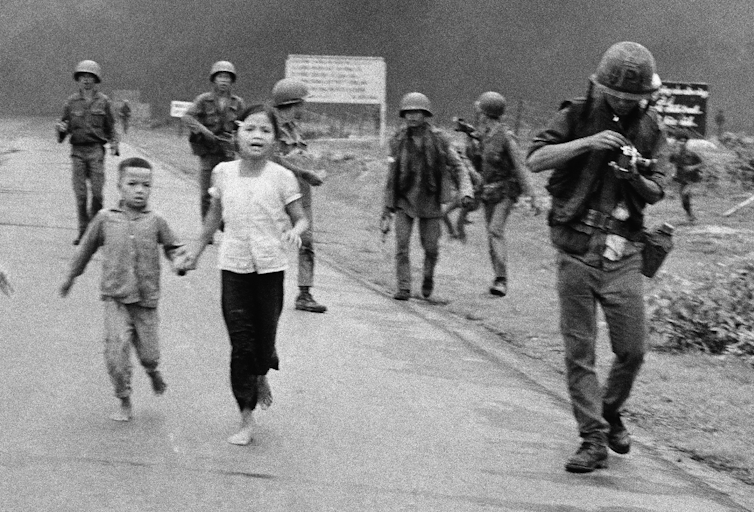
In the immediate left foreground, there is a boy screaming in terror. To the right, holding hands, two more children are running.
The spectator’s eye moves restlessly around the photograph, searching for details. A photographer reloads film into his camera.
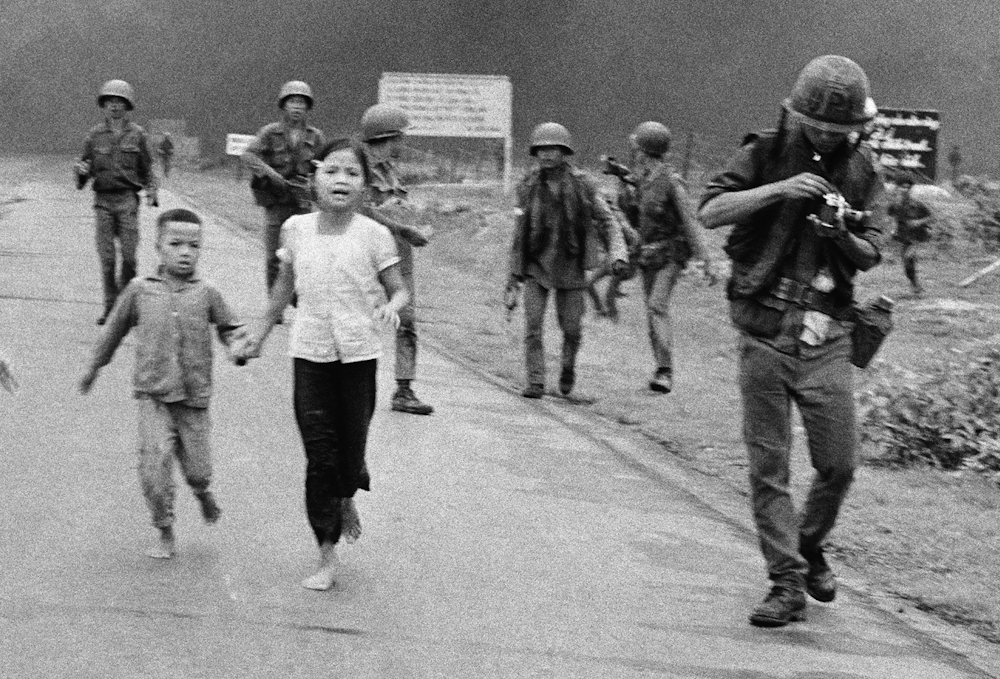
Soldiers are walking casually behind the children, seemingly indifferent to their distress. The juxtaposition is striking and raises the photograph’s emotional register: soldiers are expected to help and provide assistance.
The image has a grainy texture very different to the smoothness of contemporary digital photography. The depth of field is truncated due to the screen of billowing smoke. With no horizon to offer respite, the spectator’s gaze is forced to return to the little girl.
After taking the photographs, Út was able to take the girl to a local hospital where she received treatment for her burns.
Gradually, details surrounding the children began to emerge: the little girl’s name was Phan Thị Kim Phúc and she was nine years old. She had been hiding with her family and other village members. She tore her clothes off when they caught fire in the strike.
 Initially the photograph was rejected because of the girl’s nakedness.
AP Photo/Nick Ut
Initially the photograph was rejected because of the girl’s nakedness.
AP Photo/Nick Ut
Informally known as “Napalm Girl”, the confronting image almost didn’t reach the rest of the world. Initially the photograph was rejected by the Associated Press because of the girl’s nakedness. Newspapers are bound by strict conventions, and frontal nudity was considered a breach in propriety.
A few hours later, this decision overruled by Horst Faas, Associated Press’s chief photo editor in Vietnam and the photograph was reproduced by newspapers across the world.
Read more: The photographer’s war: Vietnam through a lens
Vietnam: the first media war
The war in Vietnam was the first to be televised. Television crews documented Kim Phúc’s escape, but Út’s still image achieved notoriety and became embedded in collective memory.
The photograph had an immediate and widespread impact. It appeared in influential newspapers and magazines including Life and Newsweek. Its place in the history of photojournalism was secured when it won both the Pulitzer Prize for Spot News Photography and the World Press Photo in 1973.
As art historian Julian Stallabrass has observed, very few napalm victims reached a hospital. It was the broad circulation of Út’s photograph that led to Kim Phúc receiving the advanced medical treatment that saved her life.
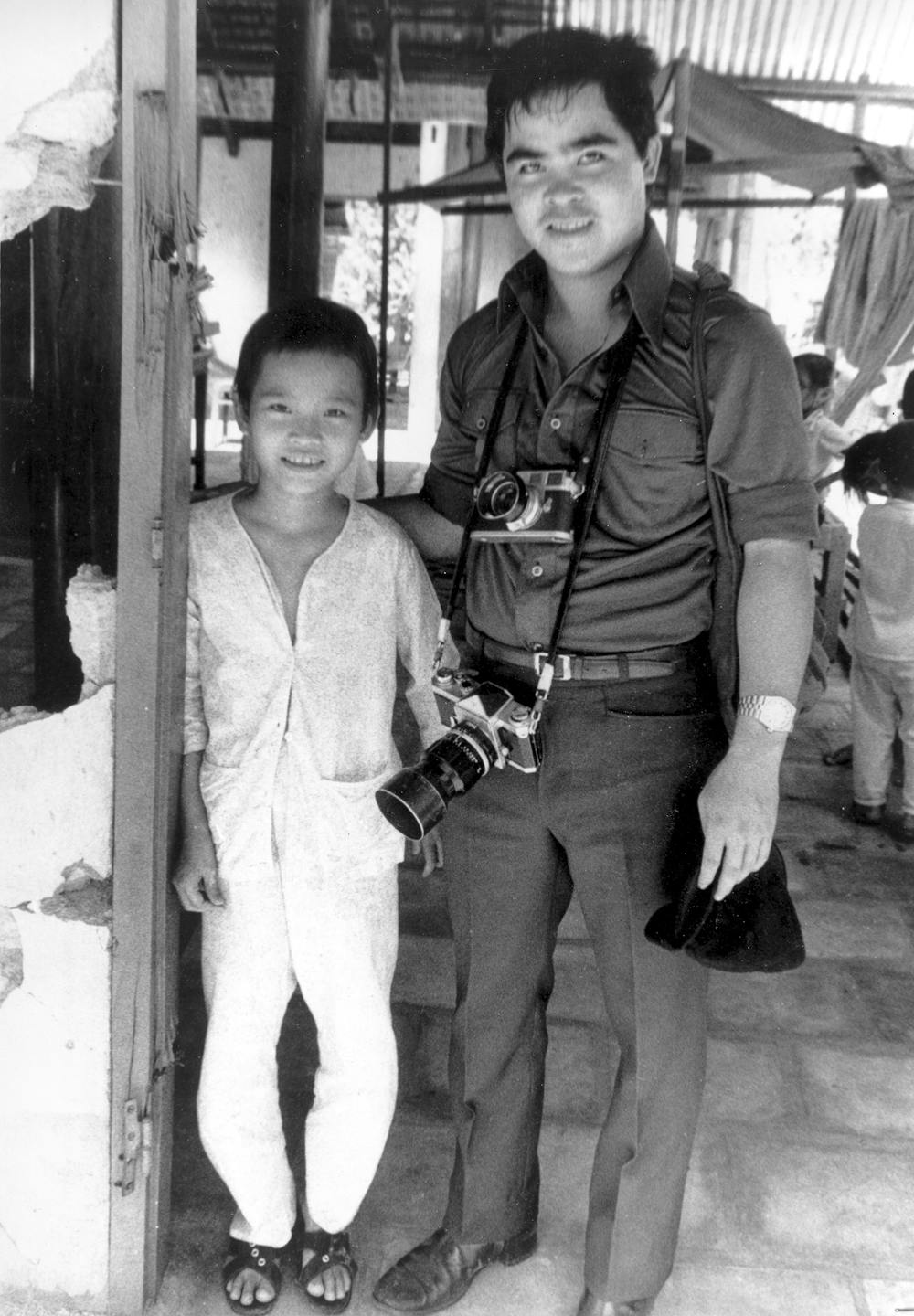 Kim Phúc visited by Associated Press photographer Ut in 1973.
AP Photo
Kim Phúc visited by Associated Press photographer Ut in 1973.
AP Photo
Kim Phúc has become the subject of television documentaries, as well as a biography documenting her life and defection from Vietnam to Canada.
In her book Regarding the Pain of Others Susan Sontag argued the photograph “belongs to the realm of photographs that cannot possibly be posed.”
In the 50 years that have passed, our attitudes towards photography have shifted.
Today, with phone photography so ubiquitous, most of us can take reasonable images. Our trust in photography’s “truth” status has declined. This can partly be attributed to the ubiquity of social media content that is regularly “embellished” or “enhanced”.
In 2016, the photograph was in the news again, this time for violating Facebook’s censorship rules on nudity.
In 1972, “Accidental Napalm” became the generation-defining image that captured the futility of the war in Vietnam.
When we turn our attention to Ukraine, it is perhaps still too early in the conflict for one photograph to emerge as the iconic symbol of Ukrainian resistance to the Russian invasion.
Read more: Photos of wartime Europe still shape views of conflict – here's how we're trying to right the record
Authors: Chari Larsson, Senior Lecturer of art history, Griffith University


 Daily Bulletin


