

Healthy humans drive the economy: we're now witnessing one of the worst public policy failures in Australia's history
- Written by: Jim Stanford, Economist and Director, Centre for Future Work, Australia Institute; Honorary Professor of Political Economy, University of Sydney
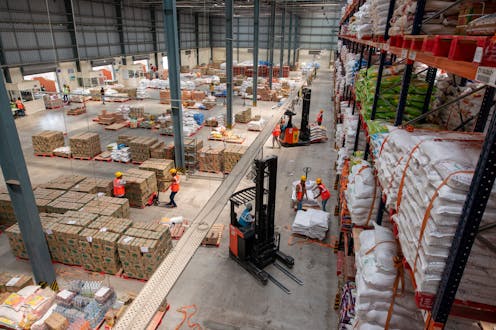
Australians are getting a stark reminder about how value is actually created in an economy, and how supply chains truly work.
Ask chief executives where value comes from and they will credit their own smart decisions that inflate shareholder wealth. Ask logistics experts how supply chains work and they will wax eloquent about ports, terminals and trucks. Politicians, meanwhile, highlight nebulous intangibles like “investor confidence” – enhanced, presumably, by their own steady hands on the tiller.
The reality of value-added production and supply is much more human than all of this. It is people who are the driving force behind production, distribution and supply.
Labour – human beings getting out of bed and going to work, using their brains and brawn to produce actual goods and services – is the only thing that adds value to the “free gifts” we harvest from nature. It’s the only thing that puts food on supermarket shelves, cares for sick people and teaches our children.
Even the technology used to enhance workers’ productivity – or sometimes even replace them – is ultimately the culmination of other human beings doing their jobs. The glorious complexity of the whole economy boils down to human beings, using raw materials extracted and tools built by other human beings, working to produce goods and services.
A narrow, distorted economic lens
The economy doesn’t work if people can’t work. So the first economic priority during a pandemic must be to keep people healthy enough to keep working, producing, delivering and buying.
That some political and business leaders have, from the outset of COVID-19, consistently downplayed the economic costs of mass illness, reflects a narrow, distorted economic lens. We’re now seeing the result – one of the worst public policy failures in Australia’s history.
The Omicron variant is tearing through Australia’s workforce, from health care and child care, to agriculture and manufacturing, to transportation and logistics, to emergency services.
The result is an unprecedented, and preventable, economic catastrophe. This catastrophe was visited upon us by leaders – NSW Premier Dom Perrotet and Prime Minister Scott Morrison in particular – on the grounds they were protecting the economy. Like a Mafia kingpin extorting money, this is the kind of “protection” that can kill you.
Effect as bad as lockdowns
On a typical day in normal times, between 3% and 4% of employed Australians miss work due to their own illness. Multiple reports from NSW indicate up to half of workers are now absent due to COVID: because they contracted it, were exposed to it, or must care for someone (like children barred from child care) because of it. With infections still spreading, this will get worse in the days ahead.
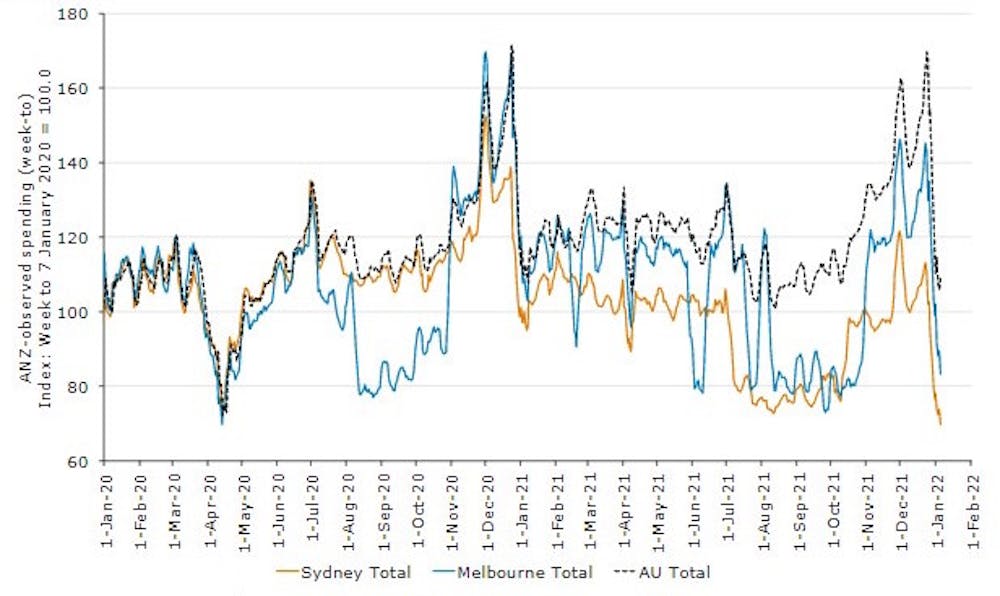
Staffing shortages have left hospitals in chaos, supermarket shelves empty, supply chains paralysed. ANZ Bank data, for example, shows economic activity in Sydney has fallen to a level lower than the worst lockdowns.
Spending in Sydney and Melbourne now near lockdown conditions
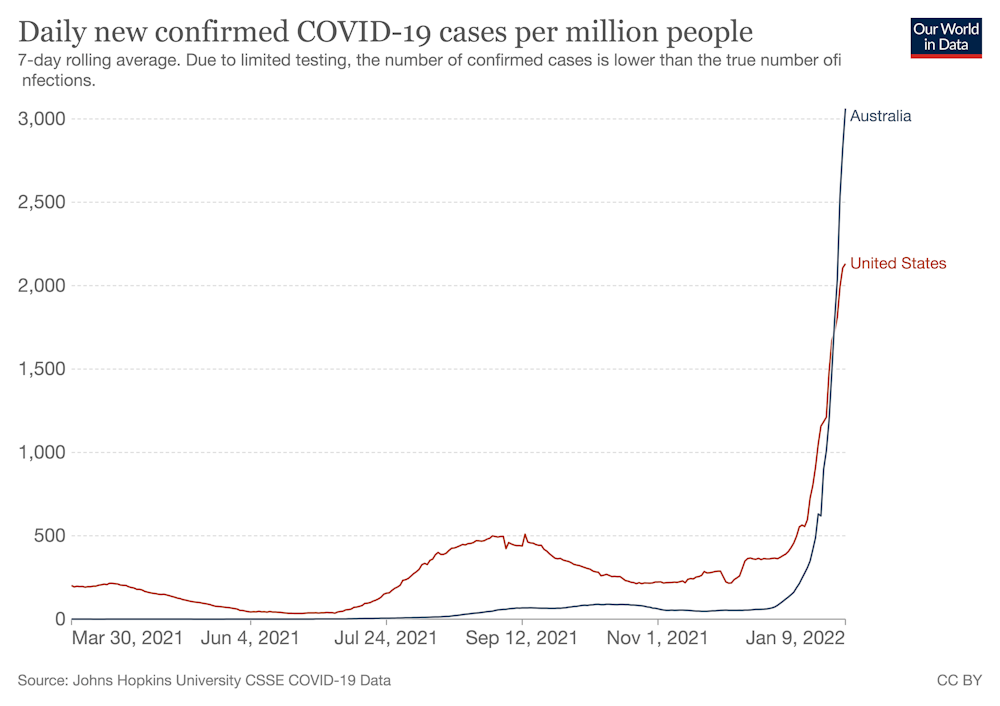 Our Wold in Data, CC BY
From one of the best COVID responses in the world to one of the worst, Australia has snatched defeat from the jaws of victory.
It’s not too late to limit the carnage
The idea that health considerations had to be balanced with economic interests was always a false dichotomy. A healthy economy requires healthy workers and healthy consumers.
The Omicron surge has created an economic emergency that will be difficult to endure.
But it’s not too late to limit further avoidable contagion. Infection prevention practices (including masks, capacity limits, prohibitions on group indoor activities, PPE and distancing in workplaces, and free and accessible rapid tests) must be restored and enforced.
Read more:
From COVID control to chaos – what now for Australia? Two pathways lie before us
Income supports for workers who stay home must be restored. Staffing strategies need to emphasise steady, secure jobs, rather than outsourcing and gig arrangements which have facilitated contagion.
Above all, our policy makers need to remember the economy is composed of human beings, and refocus their attention on keeping people healthy. Protecting people is the only thing that can protect the economy.
Authors: Jim Stanford, Economist and Director, Centre for Future Work, Australia Institute; Honorary Professor of Political Economy, University of Sydney
Our Wold in Data, CC BY
From one of the best COVID responses in the world to one of the worst, Australia has snatched defeat from the jaws of victory.
It’s not too late to limit the carnage
The idea that health considerations had to be balanced with economic interests was always a false dichotomy. A healthy economy requires healthy workers and healthy consumers.
The Omicron surge has created an economic emergency that will be difficult to endure.
But it’s not too late to limit further avoidable contagion. Infection prevention practices (including masks, capacity limits, prohibitions on group indoor activities, PPE and distancing in workplaces, and free and accessible rapid tests) must be restored and enforced.
Read more:
From COVID control to chaos – what now for Australia? Two pathways lie before us
Income supports for workers who stay home must be restored. Staffing strategies need to emphasise steady, secure jobs, rather than outsourcing and gig arrangements which have facilitated contagion.
Above all, our policy makers need to remember the economy is composed of human beings, and refocus their attention on keeping people healthy. Protecting people is the only thing that can protect the economy.
Authors: Jim Stanford, Economist and Director, Centre for Future Work, Australia Institute; Honorary Professor of Political Economy, University of Sydney


 Daily Bulletin


