

We need beach access for everyone, and that includes people with a disability
- Written by: Claire Breen, Professor of Law, University of Waikato
Beach trips are a traditional part of our summers, but for some Kiwis and their family members living with a disability it can be a limiting experience.
Around 1 in 4 New Zealanders have a disability. Their disability arises not from their impairments but from having to live in world designed by people who think everyone is the same.
It is society, not the individual’s impairment, that is disabling. Thus, it is society that should be enabling.
Examples of enabling measures are seen in efforts to provide beach access for those with disabilities with the installation of beach mats for wheelchairs, or the provision of beach wheelchairs.
But after an able-bodied woman suffered a significant leg injury on a beach mat, there are now concerns that Auckland City Council, and other councils across the country, might review the provision of such such mats.
Disabled rights
Any such decisions must take the rights of people with disabilities into account. These rights are to be found in international human rights law, and New Zealand’s own law.
Read more: Bilingual road signs in Aotearoa New Zealand would tell us where we are as a nation
The rights of people with disabilities are protected by international human rights law generally, which recognises that everyone is born equal and all have to the right to be free from discrimination.
More dedicated protection is found in the United Nations Convention on the Rights of Persons with Disabilities 2006, which New Zealand accepted in 2008.
The convention prohibits discrimination on the basis of disability, which it describes as the interaction of people with disabilities and attitudinal and environmental barriers.
It also requires countries should take action to ensure accessibility to a range of spaces and services for people with disabilities on an equal basis with those of non-disabled people.
Let’s be reasonable
These rights, like most other rights, must be weighed up with other considerations. A key concept here is reasonable accommodation.
This means that necessary and appropriate changes should be made that allow people with disabilities to enjoy their rights on an equal basis with others. But such changes should not impose a disproportionate or undue burden.
An Optional Protocol to the convention was also adopted in 2006, which means complaints can be made by individuals to the UN. New Zealand accepted this agreement in 2016.
The New Zealand International Human Rights Action Plan 2019-2023 also prioritises the country’s leadership role in advocacy for the rights of people with disabilities.
At the domestic level, the New Zealand Bill of Rights Act 1990 says everyone has the right to be free from discrimination and the Human Rights Act 1993 prohibits discrimination on the grounds of disability.
Domestic law also includes the Health and Disability Commissioner Act 1994, which established both the role of the Health and Disability Commissioner and a Code of Health and Disability Services Consumers’ Rights.
One of the purposes of the New Zealand Public Health and Disability Act 2000 is to promote the inclusion, societal participation and independence of people with disabilities. The Disability (United Nations Convention on the Rights of Persons with Disabilities) Act 2008 was passed with the aim of giving effect to New Zealand’s obligations under the UN Convention.
The New Zealand Disability Strategy 2016-2026 guides the work of government agencies on disability issues.
The strategy is informed by the the UN Convention. It is also informed by Te Tiriti o Waitangi, reflecting the cultural importance of whānau and a whānau-centred approach of concepts of family and disability.
The Disability Action Plan 2019-2023 seeks to implement the Disability Strategy and the UN Convention.
Design public spaces for all
These legal obligations and policy measures also extend to local authorities. The decisions of such authorities regarding access to public spaces can have a profound impact on the rights of people with disabilities.
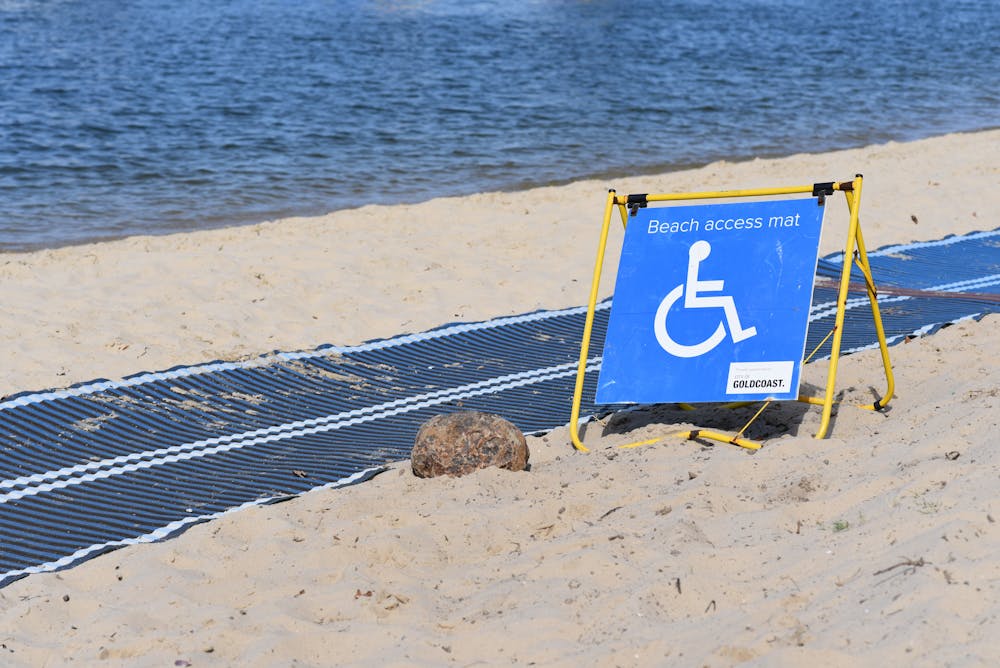 A typical beach mat to help with wheelchair access to the beach.
Shutterstock/Tabatha Del Fabbro
A typical beach mat to help with wheelchair access to the beach.
Shutterstock/Tabatha Del Fabbro
The provision of beach mats and/or wheelchairs is one practical example that provides people with disabilities with access to the sand and the sea.
But councils can think bigger by also providing mobility spaces that fits all users, appropriately designed footpaths and kerb ramps that lead to accessible seating, shade areas and picnic areas, as well as public toilets that can be used by those with disabilities and their carers.
There is particular room for improvement with the latter and calls for councils to build fully accessible bathrooms to cater to people with multiple or complex disabilities.
Cost may well be a concern but access to the beach for people with disabilities should not be presented as an optional extra. Ensuring the safety of all beach users will be a paramount consideration, as will the protection of the natural environment.
A diverse and inclusive society means everyone should be treated with dignity and respect at all times. A failure to do so brings its own costs.
New Zealand Herald readers just voted Ōhope beach as New Zealand’s best beach in 2021. One of the reasons given was that everyone — from paddleboarders to kitesurfers to those in wheelchairs — is welcome at Ōhope.
For many New Zealanders, a dip in the ocean on summer days is a simple pleasure but for some, it is simply life-changing.
Authors: Claire Breen, Professor of Law, University of Waikato


 Daily Bulletin


