

With mass arrests, running for office in Hong Kong is now not only futile, it can be criminal
- Written by: Brendan Clift, Teaching Fellow and PhD candidate, University of Melbourne
Nearly overshadowed by the chaos in the US this week was a dramatic escalation of the crackdown on pro-democracy activists in Hong Kong.
Authorities arrested more than 50 pro-democracy figures in early morning raids under the territory’s six-month-old national security law. The opposition lawmakers, activists and lawyers were accused of subversion for holding primaries for pro-democracy candidates for Hong Kong elections.
The Beijing-drafted law has previously been used to target protesters and the independent media in Hong Kong, but this week’s mass arrests marked a sobering turning point for the city.
They make political participation in Hong Kong not just futile but dangerous, and are likely to render the Legislative Council a rubber stamp along the lines of the National People’s Congress in Beijing, which has never challenged an initiative of China’s ruling party.
Britain’s foreign secretary, Dominic Raab, responded with outrage, saying China
deliberately misled the world about the true purpose of the national security law, which is being used to crush dissent and opposing political views.
Opposition politics now considered ‘subversion’
Those arrested were all linked to informal primaries convened by pro-democracy parties last year ahead of Legislative Council elections, which were ultimately postponed.
At the time, Beijing labelled the primaries “illegal” and Hong Kong authorities said they would investigate whether the opposition’s plan to win a legislative majority that could veto government initiatives violated the national security law. The law provides for penalties up to life imprisonment.
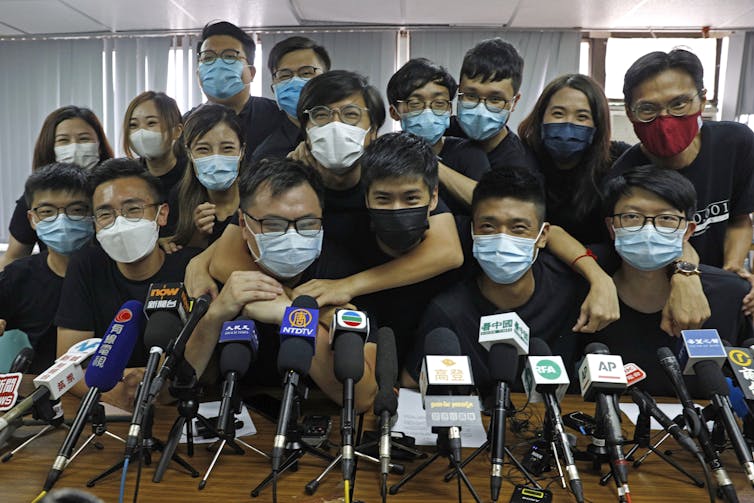 In this July 15 2020 file photo, pro-democracy activists give a press conference after being elected in unofficial pro-democracy primaries.
Kin Cheung/AP
In this July 15 2020 file photo, pro-democracy activists give a press conference after being elected in unofficial pro-democracy primaries.
Kin Cheung/AP
It is unsurprising Beijing views grassroots political organisation with suspicion. Its authoritarian political system precludes any challenge to the Communist Party’s rule.
In Hong Kong, only half of the legislature’s seats are elected by universal suffrage; the others are reserved for members of trades and industries. But it has still been possible for opposition figures to win election and exercise their rights to vote and, where numbers permit, veto actions.
The fact the Hong Kong authorities now classify such acts as “subversion of state power” confirms the national security law has redrawn Hong Kong’s constitutional landscape. Its enforcement is playing out according to the most pessimistic forecasts.
Steady erosion of rights
While Hongkongers nominally enjoy a wide range of rights under the Basic Law, the outline of which was negotiated with Britain before the handover in 1997, some have come under severe pressure following the passage of the security law. These include freedom of speech, assembly and now electoral rights.
A key point of contention has been the progression to full democracy promised in the Basic Law but repeatedly withheld by Beijing. Chinese authorities have persistently misinterpreted the idea of Hong Kong self-government as a challenge to central authority and territorial integrity.
After the 2014 Umbrella Movement, the Hong Kong government told young democracy advocates to take their cause off the streets and into politics. But after many did so with remarkable success, that door has now been slammed shut.
In addition to aggressively prosecuting pro-democracy protesters, the Beijing and Hong Kong governments have orchestrated the disqualification of many pro-democracy candidates and elected officials in recent years. This culminated in the arbitrary removal last November of four sitting legislators, which triggered the resignation of the 15 remaining opposition members.
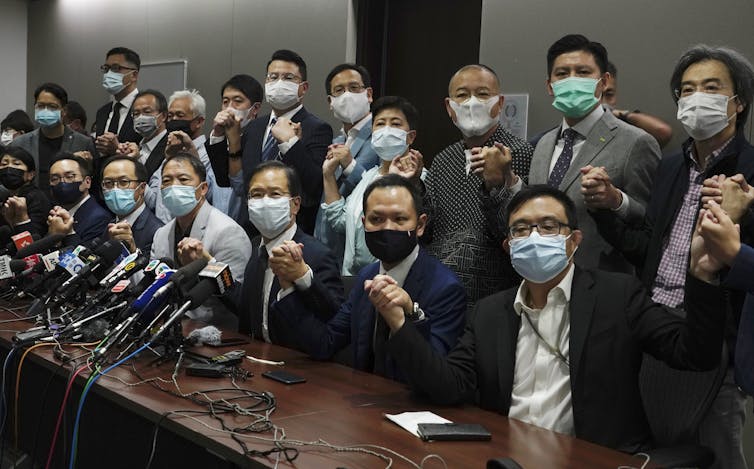 Hong Kong’s pro-democracy lawmakers announce they are resigning en masse.
Vincent Yu/AP
Hong Kong’s pro-democracy lawmakers announce they are resigning en masse.
Vincent Yu/AP
Around two-thirds of those arrested this week were former legislators or current district councillors. Other prominent opposition figures and members of civil society groups were also targeted. Police also reportedly seized documents from media and polling organisations.
Benny Tai, a longtime opposition figure who was among those arrested, said:
Hong Kong has entered a cold winter, the wind is strong and cold.
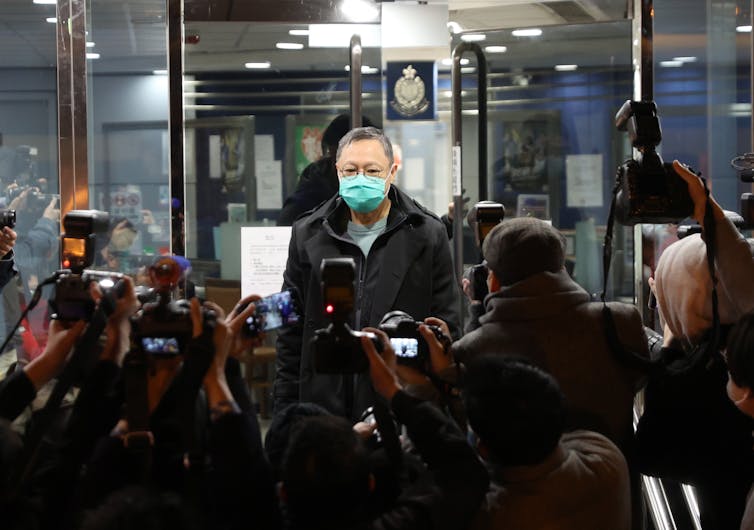 Benny Tai leaves a police station after being released on bail.
Jerome Favre/EPA
Benny Tai leaves a police station after being released on bail.
Jerome Favre/EPA
Why the world hasn’t done more
With rights and freedoms diminishing under Beijing’s vast national security apparatus, the outlook for Hong Kong is indeed bleak.
Hong Kong’s judiciary has been a bulwark against executive overreach, but it has been criticised by all sides for its decisions in political cases.
Its jurisdiction over national security matters is also constrained: judges are vetted by the executive government and can only apply, not interpret, the law. Cases can also be transferred to mainland courts.
The retiring chief justice recently pleaded for Hong Kong’s judicial independence to be respected, but the government’s fallacious insistence that Hong Kong, like China, has no separation of powers is one of several causes for concern as the baton passes to a new top judge.
Beijing has learned the lessons of the Tiananmen Square crackdown and sensibly opted to bring Hong Kong to heel by gradually escalating the authoritarian use of the law, rather than a military crackdown.
This makes the likelihood of international intervention — always a dim prospect — practically negligible.
Western democracies have criticised the erosion of Hong Kong’s democratic principles and rule of law, and Hongkongers can expect easier pathways to residency in some of those countries, but China’s economic power will deter most governments from doing more.
This should not mask the fact that true political repression is taking place in Hong Kong. Key opposition figures have been vilified by pro-establishment media and harassed by law enforcement, leading many to flee overseas. Some have had their assets subsequently frozen by a vindictive government.
The Chinese government’s approach to Hong Kong is consistent with its more assertive approach internationally — it is aggressively pursuing its own interests without apparent regard for the reputational cost.
Once the international community understands how China plays the game, governments can formulate diplomatic and economic policies to deter bad conduct and protect their own national interests, along with the interests of others who fall within China’s sphere of influence.
However, such is China’s determination to crush dissent and opposition that anyone, anywhere in the world who advocates for such policies can be charged under Hong Kong’s national security law.
Read more: Heavy hand of China is prompting fears for Hong Kong's future as a major business hub
Authors: Brendan Clift, Teaching Fellow and PhD candidate, University of Melbourne


 Daily Bulletin


