

'Slow and steady' exit from lockdown as Victorian government sets sights on 'COVID-normal' Christmas
- Written by: Laxman Bablani, Research Fellow, Population Interventions Unit, Centre for Epidemiology and Biostatistics, Melbourne School of Population and Global Health, University of Melbourne
The Victorian government today announced the eagerly anticipated roadmap out of COVID-19 lockdown. It features several steps that reflect a much slower relaxing of restrictions than last time around.
While the government has provided a provisional time frame for the various steps, it is data, not dates, that will determine when restrictions are actually eased.
We applaud this strategy. The virus does not obey a timeline. Rather, we have to beat it down to a level at which easing of restrictions is safer.
What was announced?
Metropolitan Melbourne’s current stage 4 restrictions will be extended for two weeks, to September 27. But from 11:59pm on September 13, there will be a few key changes.
The nightly curfew will be shortened by one hour, and will be in place from 9pm to 5am. Also, two people or a single household can meet outdoors for two hours maximum, up from the previous one hour, for exercise or recreation.
For people living alone, and single parents with children under 18, there will be a “single person bubble” policy that allows them to designate one other person who can visit their home.
Regional Victoria is already faring better than Melbourne, and will have a faster timeline.
Premier Daniel Andrews wants to maximise the chance of getting to Christmas in something like stage 1, while minimising the chance of a third wave of infection that sends the state back into lockdown. This means staying in strict restrictions for longer, and easing out more gradually.
How did data influence the decision?
The Victorian government’s decision was based in part on the output of a model developed by researchers at the University of Melbourne and the University of New England. It simulates population movements in a simplified world, based on parameters that describe the spread of COVID-19 and people’s interactions with each other.
In the real world, these patterns are highly random. So the researchers ran the model 1,000 times, with thresholds for relaxing (or tightening) restrictions set at an average of 25, 10, and 5 cases per day on a fortnightly basis. The model could then report the probability, under a given set of policy settings, of having to lock Victoria down again before Christmas.
Read more: Victoria's path out of COVID-19 lockdown – quick reference guides
Opening up too soon is likely to cause a third wave. In simulations in which restrictions were eased once average daily cases dipped below 25 per day, there was a 62% likelihood of new lockdowns. But with restrictions retained until daily cases dropped below 5 daily cases, the lockdown likelihood was just 3%.
Viewed in that light, it is easy to see why the Andrews government opted to set strict criteria for lifting restrictions, knowing that short-term pain is better than the economic ravages of another lockdown in the long term.
What might hold Victoria back?
First, there’s the elephant in the room — the quality of Victorian contact tracing (especially in comparison to New South Wales). Living with the virus requires high-quality contact tracing. There’s no doubt contact tracing in Victoria has improved since June when our second wave started. There is therefore a real possibility that we may get the case numbers down faster, and hold off resurgences of case numbers more effectively or for longer than the modelling suggests.
Second, infection disease control in health care and aged care has not been up to scratch in Victoria (compared with, dare we say it again, New South Wales). These represent particularly dangerous settings. Older adults are much more likely to become severely ill with COVID-19, whereas health-care workers who become infected with the coronavirus risk infecting the most vulnerable and reduce health capacity when it is most needed.
And of course, health and aged care workers live in the community too, and if community restrictions are relaxed the virus will leak back out through family members and surge again. The Victorian government decided to deal with both community and health-care transmission simultaneously. We think that it is the right approach.
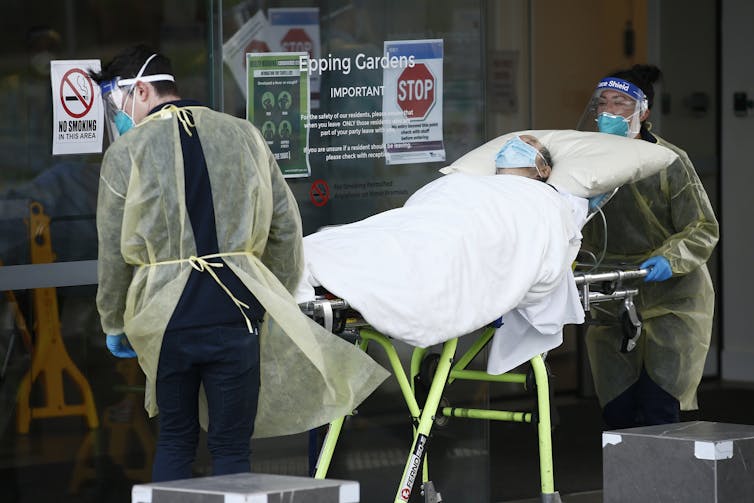 Infection control in health and aged care hasn’t been good enough in Victoria, leading to a surge in infections among health-care workers and aged care residents.
Daniel Pockett/AAP
Infection control in health and aged care hasn’t been good enough in Victoria, leading to a surge in infections among health-care workers and aged care residents.
Daniel Pockett/AAP
Is elimination still possible?
There were strong arguments for an explicit elimination strategy back in early July, requiring “going hard” for a six-week lockdown. Unfortunately, Victoria didn’t go hard early enough. The government waited three weeks, numbers got out of control, and then we went into stage 4. With the benefit of hindsight, it was a huge missed opportunity.
The Grattan Institute is also arguing strongly for an explicit elimination strategy and much longer hard lockdowns. It argues this will result in better economic outcomes in the long run. An impressive modelling paper by Australian National University researchers also supports the theory that elimination is better for both health and the economy in the long run (although this paper has not yet been peer-reviewed).
However, things have changed in the past two months. First, we are now closer to a vaccine, so in theory the long-term payoff for short-term pain will arrive sooner. Second, New Zealand (and Queensland) have taught us that elimination can be lost. Third, NSW has taught us you can live with the virus at low levels (so far). Fourth, the imminent border openings and hotspot strategy are not really consistent with the hard border controls needed to defend elimination in places that achieve it.
Andrews aptly termed the state’s strategy “aggressive suppression”. It may even achieve elimination, as the first wave effort so nearly did. We hope it does – but do not bank on it.
It’s in our hands now, both the government and citizens. With some good luck – and few would begrudge Victorians a little of that – the roadmap will pan out as planned.
Authors: Laxman Bablani, Research Fellow, Population Interventions Unit, Centre for Epidemiology and Biostatistics, Melbourne School of Population and Global Health, University of Melbourne


 Daily Bulletin


