

Settling migrants in regional areas will need more than a visa to succeed
- Written by: John van Kooy, Research Associate & PhD Candidate, Monash Migration and Inclusion Centre, Monash University
Prime Minister Scott Morrison has announced two new regional visas as part of a national population plan. The Skilled Employer Sponsored and Skilled Work regional visas require workers to live outside major cities for three years before they can apply for permanent residency. Morrison said the new visas would benefit communities “looking for more people to come and settle in their districts, to fill jobs, inject more life into their towns, and shore up the important education and health services for the future”.
However, newly released statistics on regional population growth in Australia in 2017-18 show current growth is heavily concentrated in the capitals. People clearly prefer to settle in these cities. So how can migration to the less favoured regional centres be made to work?
POPULATION GROWTH ACROSS AUSTRALIA, 2017-18
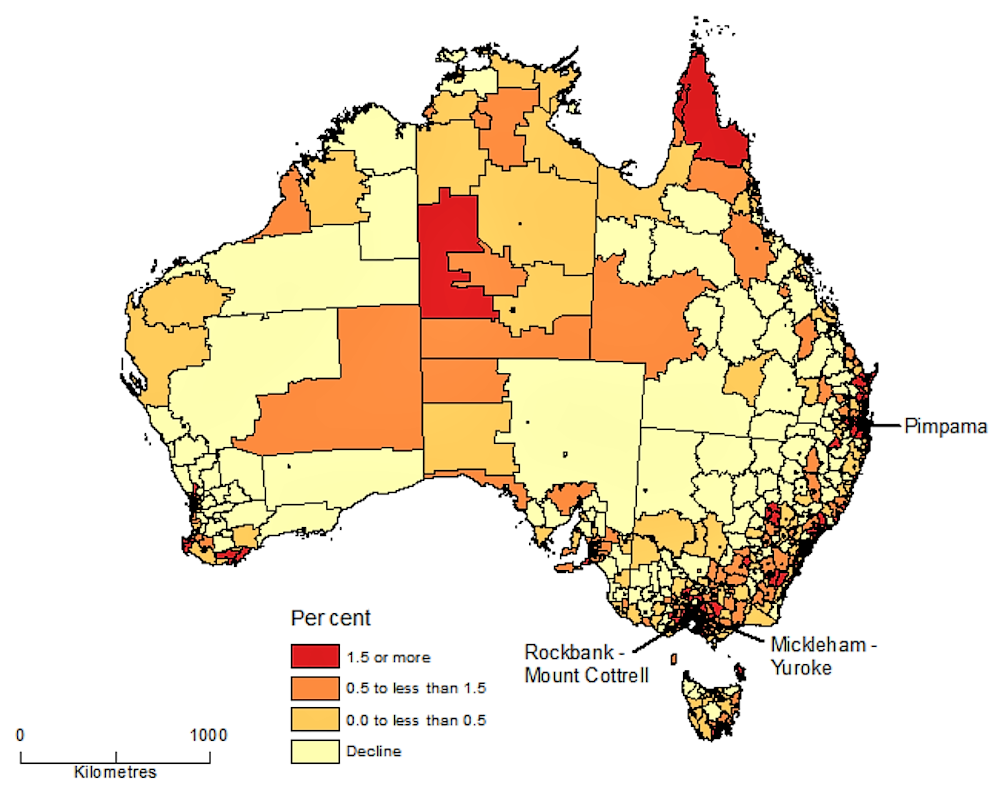 Population change by SA2 (a community that interacts together socially and economically) across Australia in 2017-18.
ABS, CC BY
Population change by SA2 (a community that interacts together socially and economically) across Australia in 2017-18.
ABS, CC BY
Research by the Monash Migration and Inclusion Centre and Welcoming Cities has examined the benefits and risks of regional migrant settlement. We identify five key factors — four essential and one desirable — that will make regional settlement successful.
Read more: Forcing immigrants to work in regional areas will not boost regional economies in the long run
Five elements of success
First, coordination and planning must be inclusive and driven by local communities. These are more than just buzzwords. Local employers, service providers and community groups are best placed to determine realistic settlement options together.
Local councils, in particular, are a crucial channel for information and community perspectives. Planning should carefully consider social and economic conditions so migrants and existing residents can develop clear expectations.
State and federal authorities may be called upon to provide a package of supportive policies, such as funding for relocation programs. However, in the absence of a whole-of-government regional settlement strategy, local stakeholders still need to lead the process.
Second, sustained employment is vital. It “speeds up” migrants’ integration into Australian society and makes long-term settlement viable. The celebrated “win-win scenario” in regional areas demands stable employment. The example of the Nhill poultry business in western Victoria shows some destinations can be a good fit for migrants and refugees from rural-agricultural backgrounds.
Karen-Burmese refugees helped revitalise the previously shrinking town of Nhill.However, regional labour markets can be quite “thin”. The number and variety of jobs on offer are often limited.
Short-term visa schemes can help plug gaps in local labour markets. But migrants may not stay if they find themselves in jobs that don’t match their skills and experience.
Third, public housing, transport and services form crucial infrastructure to support migrant settlement. Regional towns vary significantly in their levels of access and affordability. Communities like Mingoola have taken the creative step of renovating abandoned farmhouses to accommodate refugee families.
Resettling African refugees saved Mingoola’s school from closure and breathed new life into the small town.Read more: When a country’s towns and villages face extinction
But, in addition to housing, new migrants may require access to specialised service providers, like skilled health workers. Regional towns already grappling with social challenges can face a “double disadvantage” when migrants increase demand on existing services.
Here again, consultation and thorough needs analysis are required. Local government and community associations have central roles to play in this.
Fourth is a culture of welcome in regional communities. Building and sustaining such a culture is perhaps the most challenging element of success. The early stages of planning need to develop an understanding of local attitudes towards migrants, as well as perceptions about different cultures and ethnicities.
Some communities may benefit from induction and resources to develop long-term acceptance of cultural change. The City of Greater Bendigo - a recognised Refugee Welcome Zone — has attracted migrants by promoting its approach to cultural diversity and inclusion.
A culture of welcome can reduce the cultural distance between migrants and local residents, and reduce the risk of isolation for migrants. This not only bolsters the longer-term viability of migrant relocation, but can also lead to the social, cultural and economic revitalisation of the broader community.
As custodians of all settlement destinations in Australia, the leadership of First Nations people in welcoming work is also critical in negotiating matters of cultural exchange and understanding.
A final, desirable element of regional settlement is the presence of multicultural organisations and ethnic communities. Established migrant communities can act as “anchors” for new arrivals. They provide experience, advice and familiarity with local settlement processes and opportunities.
In contrast, the absence of culturally and linguistically diverse groups in regional towns can be a “unique source of acculturation stress”, especially for young migrants.
Read more: Australia's regional migration: a selective success story
Moving forward with regional migration
Migration has the potential to breath new life into regional economies. It can add cultural richness and diversity to regional communities. At the same time, regional migration can ease the pressure on capital city infrastructure and services.
In reality, however, few regional destinations optimally combine all key success factors. Potential benefits of migration can be offset by existing inequalities, narrow employment pathways and gaps in social infrastructure. Limited understanding of cultural diversity also acts as a barrier to the inclusion of new migrant communities.
These risks can compromise the sustainability of regional settlement before it has begun.
Our research recommends that regional councils and local partners consider their readiness to grow a culture of welcome, build intercultural connections, and inform uptake of regional visa opportunities. Early planning that considers both the challenges and the opportunities for migrant settlement is critical to ensure a sustainable win-win outcome.
Aleem Ali, the national manager of Welcoming Cities and CEO of Welcome to Australia, is a co-author of this article.
Authors: John van Kooy, Research Associate & PhD Candidate, Monash Migration and Inclusion Centre, Monash University


 Daily Bulletin


